


The crow hit the windshield at Laurel Cut hard enough to make eighteen passengers draw breath at once. Walter Hale did not stamp the brake. Twenty-three years on Calder County Route 4 had trained that out of him. He eased off the accelerator, checked both mirrors, and brought the bus down from forty miles an hour without throwing anybody out of a seat. Black wings dragged across the glass. One claw caught the wiper, and for two seconds the bird rode there, beating at the windshield with a ragged tail spread behind her.
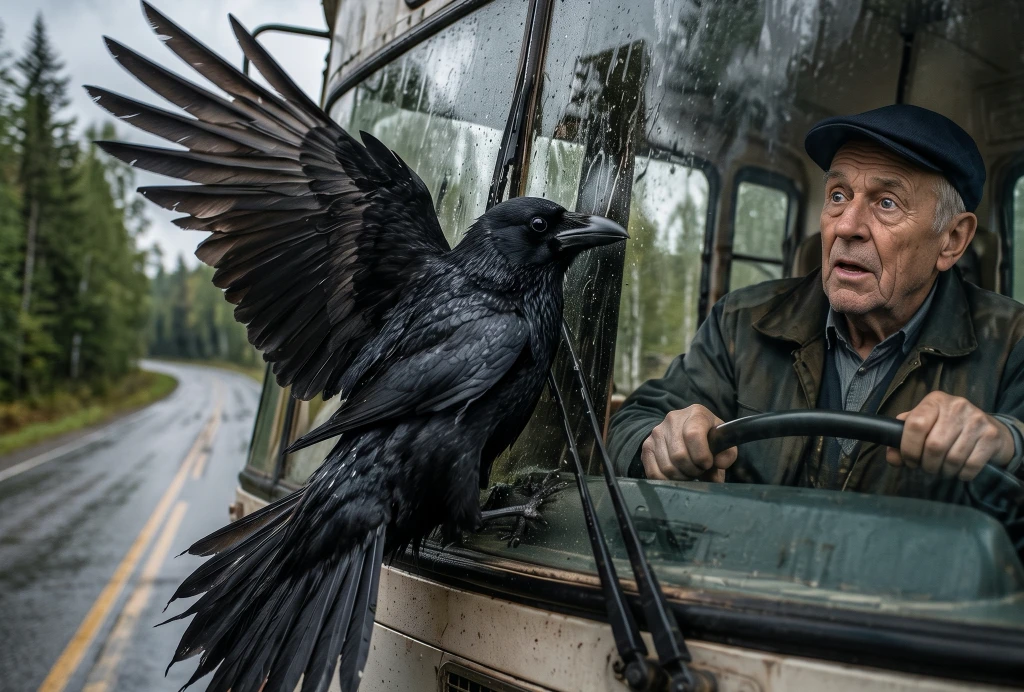
She was not stunned. That was what troubled him. She looked through the glass at Walter, struck it once with her beak, then flew ahead of the bus and veered toward the footpath buried in the mountain laurel.
“You owe her a fare now,” Tasha Greene called from the second row.
The morning riders laughed. Tasha laughed too, though she leaned toward the window to keep watching. Walter guided the bus through the bend and into the straightaway beyond it. In his right mirror, the crow had returned to a leaning utility pole above the path. She sat there with her feathers lifted by the damp wind, looking after the bus.
Laurel Cut was a bad place to stop. The county road bent around a sandstone bank, the shoulder narrowed on one side, and the laurel grew thick enough on the other to hide a person standing ten feet from traffic. The footpath cut from three houses on Ridge Lane to the shared roadside shelter. Since school had started that week, Ellie crossed it each morning with Mason and Callie, usually a few minutes after Route 4 passed.
Walter knew every rut and blind entrance on the route. He also knew there was a gravel pullout just beyond the bend, wide enough for his twenty-six-seat diesel if he ever truly needed it.
He had not needed it that morning. As far as any dispatcher would care, a bird had crossed his windshield, nothing more.
At the county-seat transfer stop, Nolan Price stood under the awning with a tablet tucked against his white shirt. Nolan had been operations manager for nine months and could tell Walter, without looking anything up, which riders needed the hospital shuttle and which connection waited no more than three minutes. During the spring bridge washout, he had slept two nights in the dispatch office and rebuilt every route by hand. Walter respected that more than he admitted, though he liked less the colored performance charts Nolan taped beside the time clock.
“Two minutes down at Laurel Cut,” Nolan said when Walter opened the door.
“Something hit the glass.”
Nolan glanced at the windshield. “Damage?”
“No.”
“Anybody hurt?”
“No.”
Nolan entered the delay and stepped aside. He was not rude. That almost made Walter more annoyed.
The crow stayed with him through the day. Not in fact—Walter made three more passes through Laurel Cut and saw no sign of her—but as a dark pressure at the edge of his attention. The tail had looked chewed off on one side. By supper he knew where he had seen it before.
The previous April, Walter and his eleven-year-old granddaughter, Ellie, had stopped behind Foster’s Feed for seed potatoes. A crow was hanging from the top strand of a wire fence, one leg and half its tail twisted in blue plastic baling twine. It had bloodied itself fighting to get loose, and the twine had pulled the outer toe on its left foot sideways. Even after Walter cut the last loop, the toe remained crooked. Ellie had held his jacket open like a curtain while he covered the bird, worked his side cutters under the twine, and freed it a strand at a time.
The crow had bitten his glove hard enough to bruise his thumb. Once free, it had flown only as far as the loading-dock roof. It watched while Walter wound the blue twine around his hand and put it in the trash.
“Ragtail,” Ellie had named it.
“It won’t keep that tail forever,” Walter had told her. “Feathers grow back.”
They had eaten their sandwiches in the truck. The crow remained on the roof until they left.
Walter mentioned none of that to June after the first morning. He had been married to her for thirty-eight years, which meant she could often hear what he had not said, but she let him eat his pork chop in peace.
The next morning, the crow was waiting. She came off the leaning pole before the bus entered the bend. This time she did not collide with the glass. She flew just above the hood, flared at the windshield, and struck it with both feet. For an instant, Walter saw one outer toe folded sideways against the glass. Then she dropped toward the laurel path, rose again, and crossed in front of him so closely that he saw the uneven gap in her tail.
He slowed. The bus hissed and settled behind him.
“There’s your girlfriend,” a man in the back called.
Several phones came up. Tasha filmed for a moment, then lowered hers. “Walter, that bird keeps going to the trail.”
“I see it.”
“Maybe there’s something in there.”
The schedule display on his dash showed he was already a minute behind. Mrs. Bell had to make the hospital shuttle at 7:05. Walter watched the crow dive into the laurel and reappear on the leaning pole.
He drove on.
By the time Route 4 reached the transfer stop, a passenger’s video had reached dispatch ahead of him. Nolan asked Walter into the narrow office beside the radio room. A printout lay on the desk: the route-condition report Walter had filed six weeks earlier about the same pole.
“I checked this after your first delay,” Nolan said. “The electric co-op inspected from the road in June. They marked the pole serviceable and the lean stable.”
“They didn’t walk down to the base.”
“Did you?”
Walter looked at the report. He had written POLE LEANING TOWARD FOOTPATH, BRUSH BLOCKS VIEW. He had not walked in either. The route had been full, and he had trusted the yellow card to move through the system.
Nolan turned the tablet so Walter could see the missed connections from the previous week. “If you see smoke, debris, a person in trouble—stop. Call it in. But you can’t slow a loaded bus on a blind curve because a crow acts strange. Mrs. Bell has dialysis. Tasha has a home-care client waiting for her. Those minutes aren’t just marks on my chart.”
“That bird is trying to pull me toward the path.”
Nolan’s expression changed, not to mockery but to concern. “Listen to what you’re asking me to authorize.”
“I didn’t ask you for anything.”
“That’s part of the problem. You haven’t called in a hazard. You’ve called in a bird.” Nolan rubbed both hands over his face, tired rather than triumphant. “One more unexplained stop and I have to pull you pending a safety review. I don’t want to do that. Don’t make me.”
At home, Ellie had already seen the video. She replayed it at the kitchen table, pinching the image larger when the crow turned above the hood.
“It’s Ragtail,” she said.
“Lots of crows lose tail feathers.”
“Not in the same crooked place.”
June set three bowls of beans on the table. “Did you look where it kept going?”
“I had people aboard.”
“After your shift?”
Walter tore cornbread over his bowl. He had driven through Laurel Cut twice that afternoon. The path had looked empty from the road, and each time he had told himself he would stop on the next pass if the crow returned.
She had not.
June sat across from him. “You can hear a loose belt before the rest of us know there’s an engine running. But the same bird does the same thing two mornings at the same bend, and now you don’t trust repetition?”
“A belt is a belt.”
“You don’t have to know what the crow means to notice that she keeps pointing at the same trail.”
That night another storm crossed the foothills. Rain struck the bedroom windows in hard handfuls, and somewhere toward Laurel Cut came a dry crack that Walter felt more than heard. He thought of the pole report, the co-op’s roadside inspection, and the laurel hiding the pole’s downhill base.
Before dawn, he called the co-op’s outage line. There was no reported outage in that section. The old inspection ticket was closed. The operator took his information and said a crew would check when storm calls allowed.
At 6:02, Nolan watched Walter sign out the keys to Bus 14. “Straight run this morning,” he said.
Walter put on his cap. “That’s the route.”
The rain had stopped, but every ditch ran full and brown. When the bus climbed toward Laurel Cut, Walter could smell wet wool, coffee, and the faint hot-dust odor from the heater Tasha had asked him to turn on. The schedule display showed him on time.
The crow sat in the middle of the road. Walter sounded the horn. She did not move until the bus was almost at the bend. Then she rose straight at him, struck the windshield, and slid across the glass in a burst of water. Her right wing dipped before she recovered. She flew to the mouth of the footpath and landed, hopping into the laurel, then back out again.
Walter passed the entrance.
For three seconds he kept his foot steady on the accelerator. Nolan’s warning sat beside him as plainly as another driver. So did Mrs. Bell’s transfer. Then the crow flew level with his side window, and Walter saw the strip of missing tail feathers, the crooked outer toe tucked against her body, and the round black eye that had watched him wind blue twine around his hand.
He checked his mirrors, signaled, and pulled fully into the gravel turnout beyond the curve. “Dispatch, Fourteen,” he said into the radio. “Stopping for a possible route hazard at Laurel Cut. Bus is clear of the travel lane. Passengers remain aboard.”
Nolan answered at once. “What hazard?”
Walter watched the crow disappear into the brush. “I don’t know yet.”
There was a beat of radio static. “Walter, stay with the vehicle.”
Walter set the brake, switched on the flashers, and opened the door. “Tasha, keep everybody on. If I’m not back in two minutes, tell dispatch.”
“He just told you to stay put.”
“I heard him.”
He took the reflective vest and side cutters from the emergency drawer. The crow waited at the footpath, then moved ahead of him through dripping laurel. Walter followed far enough to lose sight of the bus. The ground smelled of crushed fern and wet stone.
Twenty yards in, the reason for the crow’s panic appeared. A nearly grown fledgling hung from a bent maple sapling, one wing pinned by a loop of blue baling twine. It kicked and twisted whenever the adult crow came near. Walter felt the first clean relief he had known in three days.
“All right,” he whispered. “That’s what you wanted.”
He took one step toward the trapped bird and stopped. Between him and the sapling, a dark electrical conductor sagged across the path at shoulder height. A storm-broken limb held it above the ground. Wet leaves trembled against it, and from somewhere inside the laurel came a faint, steady buzz.
Walter backed away without turning, taking short steps and keeping his feet close. Beyond the line, from the house side of the trail, a stainless-steel water bottle struck a backpack buckle.
Then Ellie’s voice came through the leaves. “Grandpa? Is that your bus?”
To read the rest of the story – CLICK the NEXT button 👇👇👇