


Less than half an hour after I told an old woman that a lion would not remember her, Kito stepped out among the strollers on Merritt Park Zoo’s south promenade. Working around animals teaches you the different sounds a crowd can make. There is the bright shriek of a child who has dropped an ice cream, the collective gasp when a gorilla strikes the glass, and the nervous laughter of adults who have wandered too close to a peacock with its tail spread. The scream that morning belonged to none of those categories.
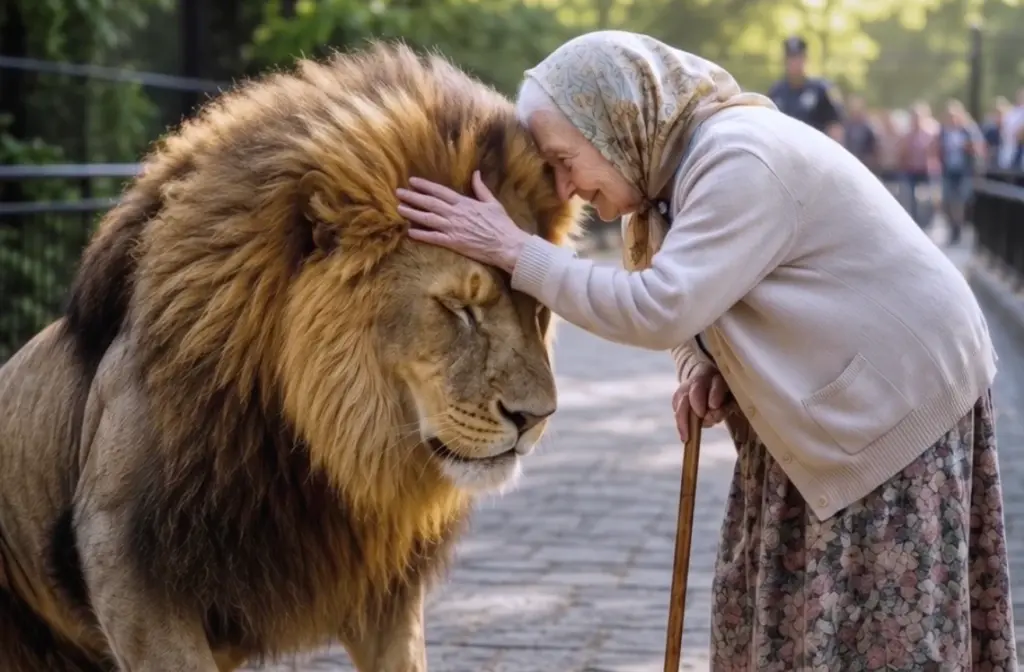
I rounded the corner by the primate house and found four hundred and thirty pounds of African lion walking toward me through spilled popcorn. A father was dragging two children into the gift shop. A woman had abandoned a stroller beside the drinking fountain and was running back for it while her husband shouted at her to leave it.
Kito did not look at any of them. His head was low, his black-tipped tail swinging behind him, the thick muscles of his shoulders moving beneath his coat. His right foreleg turned slightly outward with every step, the old injury giving him a rolling gait I could recognize from the far end of an exhibit.
I pulled the radio from my belt.
“Code Red, south promenade. Kito is outside containment. Lock every public building and clear the outdoor paths. Dr. Shah, bring the immobilization kit. Security, get police to the perimeter.”
My voice sounded controlled. My left hand was shaking hard enough to rattle the keys clipped to my belt.
Kito stopped near the carousel and lifted his nose. Children cried behind locked glass. Somewhere in the gift shop, a display rack fell over. He flicked one ear toward the crash but did not turn.
Instead, he angled toward the south service lane.
That was when I thought of the woman.
She had been standing at Kito’s viewing window shortly after opening, carrying a faded green canvas bag and leaning on the arm of a woman about my age. The older woman was thin beneath her denim jacket, with cropped gray hair and the weathered skin of someone who had spent more time outdoors than was good for her.
She had called to me after reading my name badge.
“Mr. Holloway, was this lion transferred from a rehabilitation station outside Otjiwarongo?”
I had already been late for a maintenance briefing. An alarm fault in the horticulture building had pulled two security officers away from the south end, and a contractor was waiting for authorization to enter the service yard.
“He came from Namibia,” I said. “But I can’t discuss nonpublic records with visitors.”
“His intake number began with N-four.” She placed two fingers against the acrylic. “He had a compound fracture in the right wrist. The joint healed outward.”
That made me stop.
The injury was visible if Kito stood, but he had been asleep behind a rock ledge when she arrived. The transfer number had not appeared on the public sign in years.
The woman beside her touched her elbow. “Mom, maybe we should ask at the office.”
“I don’t need to go behind the barrier,” the older woman said. “I only want to know if it’s him.”
Kito raised his head.
She made a soft, two-note whistle. It was not loud enough to draw the attention of the families around her, but Kito stood at once. He crossed the enclosure without looking at the meat left near his feeding platform and stopped on the other side of the acrylic.
His gaze fixed on her.
The woman’s mouth trembled. “Hello, Kee.”
Kito pressed the side of his face close to the ventilation gap beneath the window. Then he lifted his damaged paw and placed it against the glass.
I had seen him react to umbrellas, wheelchairs, squeaking shoes, and children wearing animal masks. A response was not recognition. That distinction had kept visitors—and more than one inexperienced keeper—from making dangerous assumptions.
“What did you say your name was?” I asked.
“Ruth Bell.”
The woman beside her answered before Ruth could say more. “I’m Laura. Her daughter. She worked in wildlife rehabilitation for almost thirty years.”
My radio crackled with another call from maintenance. Behind me, a school group was arriving early, thirty children in matching yellow shirts pouring onto the promenade.
“I’m sorry,” I said. “Kito is trained for protected contact only. Whatever happened when he was a cub, he won’t remember you the way you remember him. He is an adult male lion now.”
“I know what he is.”
Ruth said it without offense, which somehow made my impatience worse.
“Then you understand that a reaction at the glass isn’t proof.”
“Of course,” she said.
I told myself I would check the acquisition file after the maintenance briefing. I did not write her name in my field notebook. I did not log Kito’s unusual behavior, and I did not ask another keeper to watch him.
By the time I returned to the habitat, the fire alarm in the horticulture annex was sounding and Kito was gone.
Now he passed the service-lane entrance without breaking stride. I followed at a distance, telling visitors to get inside while security sealed the path behind us.
The steel transfer door at the rear of the cat house was standing several inches open. It should have been secured by two separate mechanisms. Beyond it, the outer service gate had been rolled aside for the fire department.
I could not stop to determine which safeguard had failed first. Kito crossed the service yard, paused at the open gate, and lowered his nose to the pavement.
Then he walked out of the zoo.
A city bus stopped sideways across the intersection when the driver saw him. Cars backed into driveways. A man came out of a coffee shop holding up his phone until I shouted at him to get inside.
Kito ignored every person. He moved along the sidewalk with the steady concentration he showed when following a scent trail inside his enclosure, pausing at corners before choosing a direction.
He turned where Ruth and Laura had turned after leaving the zoo.
The realization did not feel miraculous. It felt like an accusation.
I gave our location to the dispatcher and kept moving. Kito was trained to touch a blue target and shift between secured spaces on command, but I had no barrier, no transport crate, and no safe position from which to use either. Calling his name could turn his attention toward me. Running ahead could trigger pursuit.
All I could do was follow.
Three blocks from the zoo, he crossed Maple Avenue and entered Linden Square, a narrow neighborhood park with an old brick restroom building at one end. Police were closing the surrounding streets, their sirens cutting out as they approached.
Ruth Bell was sitting beneath an oak tree.
Her canvas bag rested beside her on the bench. Laura was nowhere in sight. Ruth had one hand pressed against her abdomen and the other wrapped around a paper cup.
Kito slowed.
I raised my radio. “Lion has located a civilian. Hold your distance. No sirens.”
Two police vehicles stopped along the far curb. Officers took positions behind them but did not advance. Dr. Priya Shah arrived in the zoo response truck and crouched behind its open door with a dart projector ready.
“Ruth,” I called.
She looked up.
For one terrible second, surprise emptied her face. Kito was less than twenty feet away, approaching in a low, fluid walk. His ears were forward. His mouth was closed.
“Don’t run,” I said. “Don’t reach for him.”
Ruth set the paper cup on the bench. Her hand found the strap of the canvas bag, but she did not pick it up.
“Kito,” she said.
The lion stopped.
She gave the same two-note whistle I had heard at the glass.
His head lifted. The tension in his shoulders changed—not gone, but redirected. He crossed the remaining grass and stood directly in front of her.
Ruth looked at the crooked joint above his paw. “You grew into those feet after all.”
Kito pushed his muzzle beneath her motionless hand.
A sound came from him, too low to be a roar. I had heard that rumbling vibration during social greetings between lions, but never directed toward a human. He rubbed the side of his face along Ruth’s knee, turned once, and lowered his front quarters beside the bench.
Then he rested his head across her lap.
Ruth’s fingers disappeared into his mane. Tears ran down her face, but her hand remained steady.
Behind the police vehicles, an officer whispered something I could not hear. Priya kept the dart projector raised.
I moved closer by inches, watching Kito’s ears, tail, and breathing.
“Ruth, I need you to listen to me. We have to contain him.”
“I know.”
“We may have to sedate him.”
Her hand stopped in his mane.
Kito opened one amber eye.
“Don’t dart him while he’s touching me,” Ruth said. “The drugs won’t take him down immediately. He’ll wake frightened in a transport crate.”
“We can keep you safe.”
“I’m not talking about me.”
Priya shifted behind the truck. Kito heard the movement and raised his head. Ruth laid her palm against his cheek. “He was asleep the first time I left him,” she said. “If you put him under now, let me be there when he wakes…”
To read the rest of the story – CLICK the NEXT button 👇👇👇