


By six in the morning, a pale ring from Dr. Mara Quinn’s coffee had dried across the blank signature line on Clover’s euthanasia form. Mara left the form in her office and followed Tessa Rowan, the senior keeper, to the hoofstock barn. Clover lay folded on a heated mat, her legs arranged at angles no young giraffe would have chosen while awake. At the stall, Tessa struck the rubber floor twice with the heel of her boot.
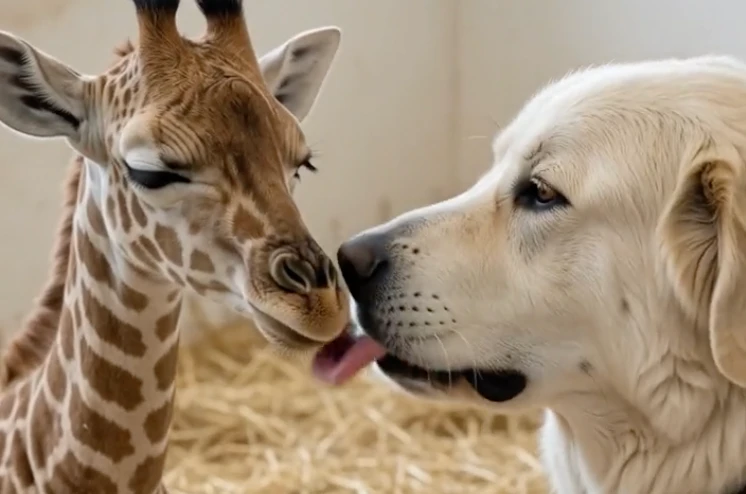
“Clover. Coming in.”
One small brown ear turned. The rest of the calf did not move.
Tessa entered sideways, keeping her steps slow and audible. Clover’s eyes were open, though scar tissue clouded both corneas and hid the pupils beneath a bluish-white haze. She had been blind since an untreated infection swept through a roadside menagerie in western Oklahoma. State officers had removed her at nine days old; her mother, already weakened by dehydration, had died in the transport barn before sunrise.
At sixteen days, Clover knew the Great Plains Wildlife Center as heat under her belly, cedar shavings, Tessa’s two knocks, and the rubber nipple of a bottle she had refused since the previous afternoon.
Mara waited until Tessa had cleared the calf’s feet, then entered with her stethoscope and crouched near Clover’s shoulder. The calf’s gums were tacky. Her temperature had slipped again, and the intravenous fluids running into a taped catheter could buy time but could not turn glucose and saline into the milk she needed.
“Any attempt to get up?” Mara asked.
“A little after one. She got her chest off the mat, then quit.”
“How much at the five o’clock feeding?”
“She closed her mouth around the nipple. Didn’t draw.”
Tessa never upgraded a bad fact to make a morning easier. Mara had hired her for that habit twelve years earlier and resented it only on days when she needed it most.
Gwen Park, the center’s operations director, waited beyond the hygiene barrier with a clipboard tucked under one arm. The isolation barn had not been designed for a giraffe; it had been built for elk calves and injured antelope, and Clover’s head already reached above the padded divider when she stood. Every extra day meant staff hours, infection-control problems, and a larger animal in a temporary room. None of those facts belonged on the line that decided whether she should live, but pretending they did not exist would have been its own kind of dishonesty.
“The welfare committee meets at noon,” Gwen said when Mara stepped into the wash area. “They need a recommendation, not another set of lab values.”
“Give me until tonight.”
“You said that last night.”
“Her kidneys are still responding. Her pain is controlled.”
“And she hasn’t taken a meal in nineteen hours.” Gwen lowered her voice, although Clover could not have understood the words through two doors. “What changes by tonight?”
Mara looked back at the stall. “I don’t know yet.”
“Then write down what makes you stop. If her temperature falls again, if she can’t hold her head up, if her blood work worsens—name it now, before hope starts moving the line.”
Mara felt the rebuke because it was accurate. She wrote the limits in Clover’s chart and signed beneath them. The authorization itself remained blank.
Shortly after eight, a county shelter van pulled into the clinic yard with an animal large enough to make its suspension dip.
Mara had agreed two days earlier to examine an aging livestock guardian named Otis. The shelter veterinarian had found no medical reason for his refusal to walk or eat, but the dog’s owner had died, and Otis had been declining since the body was carried away. In the pressure of Clover’s case, Mara had forgotten he was coming.
The rear doors opened. A cream-colored dog lay inside a transport crate with his head raised and his gaze fixed past the people waiting for him. An old tear divided the edge of his left ear. Dust had stained the feathering on his legs, and the fur across his shoulders was dense enough to hide the outline of his ribs.
A woman in a navy office skirt and scuffed ranch boots stood beside the ramp. She was holding a waxed-canvas coat despite the warm September morning.
“I’m June Avery,” she said. “Otis belonged to my father.”
The past tense made the dog look toward her. His tail moved once against the crate floor, then stopped.
June’s father, Eli, had raised sheep on a leased section near the Colorado line. Three weeks earlier, he had suffered a ruptured aneurysm while checking a ewe in the north pasture. The ranch hand found him the next morning with Otis pressed along his back, facing the open field.
“He stayed there almost eighteen hours,” June said while Mara reviewed the shelter notes. “After the funeral I took him home with me. I have a second-floor apartment in Wichita. He went through the screen door the first night and broke the patio glass trying to get outside.”
“Was he trying to escape?”
“He was trying to get a view of the parking lot. He stood there until daylight and wouldn’t come in.”
June had placed him with the county shelter under a short crisis-care hold because a hundred-and-thirty-pound guardian dog could not patrol a balcony. She remained his legal owner until Friday, when the hold would become a permanent surrender. The distinction showed in the way she kept one hand on the crate even when Otis did not return the touch.
Mara examined him in the domestic-animal recovery room on the outer side of the isolation corridor. His raw paw pads had healed. Mild arthritis explained the care with which he unfolded his hind legs, but not his refusal to use them. His heart and lungs sounded appropriate for a dog estimated to be ten. When Tessa offered warmed chicken, he smelled it and resumed watching the service door.
“He’ll eat if someone sits in the kennel after dark,” June said. “A few bites. Like he’s doing us a favor.”
Mara removed the stethoscope from her ears. “His body hasn’t given up. That doesn’t mean he’s well.”
“The shelter gave me until Friday. They can’t keep lifting him, and he’s too frightened for the adoption floor.” June glanced at Otis. “I don’t know what I’m asking you to do. I just need to know we didn’t miss something fixable.”
Before Mara could answer, a bottle cart squeaked in the adjoining corridor. A faint, hollow bump followed as Tessa set a pail on the floor outside Clover’s stall.
Otis stood.
His back legs shook until he shifted his weight forward, but he did not wait for help. He crossed the recovery room and put his nose to the seam beneath the steel service door.
On the other side of two hygiene barriers, Clover lifted her head.
Mara saw it through the observation window. Tessa saw Otis on the corridor camera and looked toward Mara through the glass.
The dog drew a long breath beneath the door. Clover’s nostrils opened. She angled her muzzle toward a scent she could not place and held it there.
“That’s the first thing he’s chosen all week,” June said.
Mara’s first impulse was to open the corridor and see what happened. Gwen’s voice arrived in her head before she touched the latch: name the line before hope starts moving it.
They stopped and built a plan instead. Otis would remain outside the inner hygiene zone. There would be no physical contact, no shared air handler, no shared equipment, and no return of anything that entered Clover’s space. June would stay with the dog. Tessa would stop the trial if Clover’s breathing or posture showed distress; Mara would stop it if Otis froze, strained toward the door, or could not be led away.
“Five minutes,” Gwen said. “Not five minutes that become twenty because something pretty happens.”
The steel door remained closed. Mara clipped Otis to a floor ring six feet back so he could choose whether to approach. Tessa entered Clover’s stall from the opposite side and tapped twice.
Otis went to the end of the loose lead and lowered his nose. His nails made one dry scrape on the concrete.
Clover’s ear turned.
He exhaled through his nose, not a whine or a growl but a low, contained rush of air. June’s face changed.
“He’s knocking,” she said.
Mara looked at her.
“Dad taught him at the lambing shed. Otis wasn’t allowed to charge in and scatter the ewes. He’d breathe against the bottom of the door, and Dad would knock back when it was all right to enter.”
Tessa set the warmed bottle within reach of Clover’s muzzle. She did not force the nipple between the calf’s lips. Otis breathed beneath the door again.
Clover searched the air, found the rubber nipple, and took it into her mouth. For a moment she only held it. Then her tongue curled, her throat moved, and milk began to disappear from the bottle.
Tessa’s eyes lifted to the camera, but her hands stayed quiet. “Easy, Clover.”
The calf drank less than a quarter of the feeding before releasing the nipple. She kept her head upright. Otis shifted his front paws, and the small oval tag on his shelter collar touched the buckle with a muted click.
Clover gathered one front leg beneath her. Tessa moved the support strap within reach but did not lift. The calf brought her other knee forward, rocked twice, and drove her chest away from the mat.
Her hindquarters rose in a separate, awkward surge. For several long seconds she stood without a sling or a hand against her body, blind eyes open, all four legs trembling beneath her.
When she folded again, Tessa guided her shoulder onto the padding. Clover landed safely and continued facing the steel door.
Five minutes had passed. Mara unclipped Otis and gave June room to lead him back to recovery.
“Come on, old man,” June said.
Otis did not turn. He lowered himself along the bottom of the door and pressed his ribs against the steel. June’s hand stopped above his collar. “That’s how they found him,” she said. “Lying against my father…”
To read the rest of the story – CLICK the NEXT button 👇👇👇