


By the time Mara Bell recognized Caleb Mercer beneath the bus-shelter light, Holly Baines had already turned her phone sideways.
“You have got to be kidding me,” Holly said, holding the screen at chest height. “Caleb Mercer. Our valedictorian.”
The first hard freeze of November had turned the rain to clear beads along the shelter roof. Caleb sat on the bench in a coat too thin for Lake Erie weather, his beard threaded with gray, an empty paper cup near one boot. A cardboard sign rested facedown beside him. Mara could still read the last two words where the marker had bled through: ANYTHING HELPS.
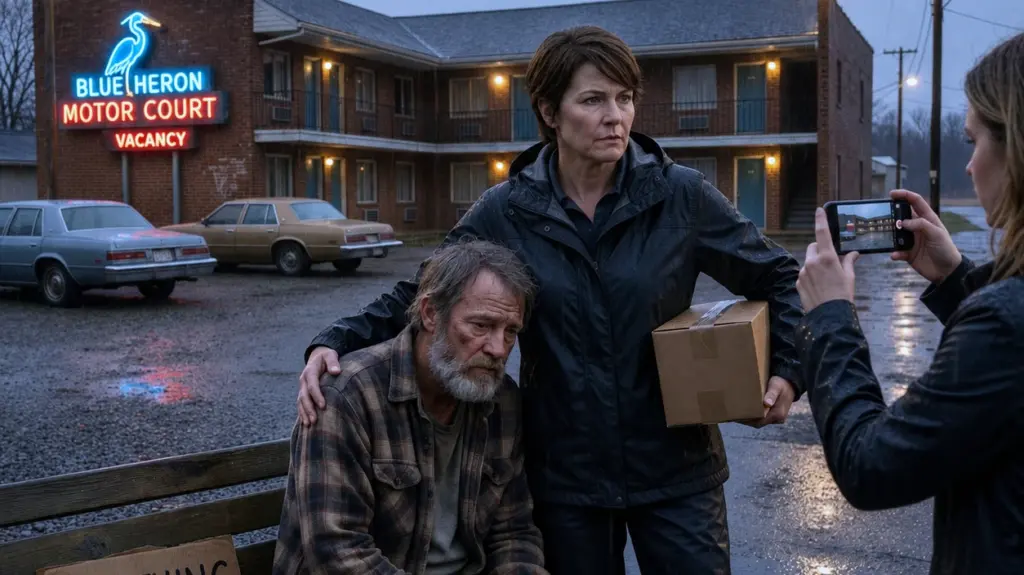
She stepped between him and Holly’s phone. The box under her arm—the replacement igniter for the Blue Heron’s boiler—dug into her ribs.
“Put that away.”
Holly gave her the bright, wounded look she used whenever someone denied her an audience. “I’m not doing anything. I was going to send it to the reunion group. People will want to know.”
“Then tell them you saw a man in the cold and kept walking.”
For a moment Mara thought Holly might aim the camera at her instead. Then a bus pulled in, spraying gray water along the curb, and Holly climbed aboard with her phone still in her hand.
Caleb had not moved. At seventeen, he used to bend over algebra books in the Blue Heron lobby, turning his pencil in long, careful fingers before writing anything down. The face above those hands had filled out and weathered, but the eyes were the same: dark, watchful, almost formal in their attention.
“Hi, Mara,” he said.
Hearing her name made the years between them feel badly locked rather than gone. “How long have you been sitting here?”
“Long enough to learn the eight-ten is running late.”
“That isn’t what I asked.”
His mouth shifted, not quite a smile. “A few hours.”
She set the igniter box on the bench and called the county warming line. The church shelter was full. The woman who answered suggested an intake center across town, then admitted its last van had already left. Mara asked Caleb whether he needed medical care, whether he had used anything that would make him sick overnight, and whether anyone was looking for him.
He answered no three times. He did not bristle at the questions, which worried her more than anger would have.
“I have an empty room,” she said. “One night. You show me what’s in your bag, you don’t bring anybody else onto the property, and you hand the key back at ten tomorrow morning.”
Caleb looked past her toward the lake road. Headlights moved in the wet dark, smearing white across the glass. “You still have the motel?”
“The motel still has me.”
“Room Eight?”
Mara stared at him. “How do you remember that?”
He picked up the cardboard and folded it once, hiding the words. “Your father put my mother and me there for six weeks. I remembered a lot of things about that room.”
She remembered too. His mother coming in after late shifts at the cannery, smelling of apples and machine oil. Caleb sitting in the lobby because the lamp in Room Eight flickered when the heater came on. Her father pretending not to notice when their weekly payment arrived three days late.
Mara took the folded sign from him and tucked it beneath the igniter box. “Then you remember Dad’s rules.”
“Pay when you can. Don’t lie about damage.”
“Those were the rules he said out loud.”
The two-story Blue Heron Motor Court sat half a mile away on the old lake road outside Ashtabula, Ohio, its twelve rooms arranged in a shallow U around a gravel lot. Mara’s manager apartment occupied the rear corner. Its neon bird had lost one blue wing, and the transformer buzzed even after she switched off the red VACANCY tubes. Twelve numbered hooks lined the walnut key rack behind the desk. Seven hooks were empty, their keys held by people who had stayed long enough to receive mail; three rooms were winterized; one had a tub that drained slowly. Room Eight was clean.
Caleb paused in the office doorway. He looked first at the key rack, then at the ledger, then at the dark coffee stain on the counter that no cleaner had ever lifted. He seemed less surprised by what had changed than by what had not.
“Bag,” Mara reminded him.
He unzipped a worn canvas duffel and placed its contents on the counter: two shirts, socks, a toothbrush still in its wrapper, a paperback with the cover torn off, a bottle of water, and a cheap flip phone with a dead screen. No medication. No wallet.
Mara gave him the brass key tagged 8 and a stack of white towels. “The hot water takes a minute. The radiator knocks before it warms up. It isn’t exploding.”
“You used to tell guests that when you were fourteen.”
“Guests used to wake me when I was fourteen.”
She found a flannel shirt and work pants in the donation cupboard, then brought him a pair of her father’s old boots from the storage closet. Caleb touched the worn leather at the ankle before taking them.
“I can’t wear these.”
“They’re boots, not a family title. Put them by the radiator.”
While he showered, Mara pulled the dead igniter and installed the replacement. She was still tightening the housing when the shower shut off. By the time he dressed and returned to the office, the boiler had caught on its second try. The sound loosened something between her shoulders. A frozen motel meant burst pipes, displaced residents, and another repair bill Nora would enter in the books with a red note beside it.
Caleb returned to the office with damp hair and his beard combed by water. The borrowed shirt fit across his shoulders but hung loose at the waist. Without the grime, he looked neither young nor ruined. He looked tired in a way money could not necessarily fix, which was how Mara let herself explain the details that did not fit.
She set two bowls of beef stew on the small table behind the desk. He remained standing.
“If you tell me you don’t want to dirty the chair, I’ll make you mop the whole office.”
He sat. “Your father said something similar.”
“My father gave you stew from a can.”
“It was warm.”
They ate while rain clicked against the office windows. He told her his first company had failed after a lender pulled out. That much she remembered from hometown talk years ago: Mercer Freight, a warehouse lease, debts, then nothing. He said he had spent a long time moving around after that. Whenever she asked what he had done for work, he answered with a category—transportation, property, consulting—instead of a job.
Mara laid her spoon down. “You still answer questions like you’re writing around something on an exam.”
“I learned that from having teachers who only read the first page.”
“I’m reading all the pages.”
He looked at her then. Back in high school, she had thought his silences meant confidence. Sitting across from him now, she recognized labor in them—the quick sorting of what could be given away and what had to be kept.
“I’m not asking for every bad thing that happened to you tonight,” she said. “But don’t make me help with the wrong problem.”
“What does that mean?”
“If you need a room, take the room. If you need a hospital, say so. If someone might come looking for you, I need to know before I put you beside seven occupied rooms.”
His hand closed around the water glass. “No one is looking for me.”
“The ice-machine flap needs a new hinge,” Mara said. “If you want work tomorrow, I pay cash by the hour. Coffee’s at seven.”
Caleb looked at her across the steam rising from his bowl. “I’d like that.”
Mara carried the bowls to the sink. On the office counter lay the original purchase packet Northline had sent both sisters two months earlier. NORTHLINE CIVIC ACQUISITIONS appeared in small gray type beneath a picture of the lakefront block. Mara turned it facedown, but Caleb had already seen it.
“They made an offer?” he asked.
“They made us an offer. Nora thinks it’s an exit. I think it’s a demolition schedule with nicer paper.”
“The plans include housing.”
Mara turned from the sink. “You’ve seen the plans?”
“I read about the project.”
“Nobody has read about the project. They haven’t announced it.”
The boiler stopped. In the sudden quiet, tires rolled slowly over the motel gravel.
A black SUV came to rest outside the office. A woman in a charcoal coat stepped out of the passenger side while a driver stayed behind the wheel. She did not look toward the vacancy sign or the numbered doors. She came straight to the office.
Caleb stood. For the first time that night, he looked caught. The woman opened the door without knocking. Her gaze took in the borrowed shirt, Mara, and the purchase packet turned facedown on the counter. “The board moved the vote to nine tomorrow,” she said. “They won’t approve the Bell parcel until they know what you found, Caleb.” Mara looked at the brass key in his hand. “Are you the man trying to buy my motel…”
To read the rest of the story – CLICK the NEXT button 👇👇👇