


The first thing I noticed was a red balloon moving against the wind. Its ribbon dragged through a scatter of french fries, snagged under the wheel of an abandoned stroller, and pulled tight toward a little girl whose father was carrying her into the gift shop. Beyond the balloon, in the middle of Alder Creek Zoo’s main plaza, a male lion walked with his head low and his mane lifting in the May air.
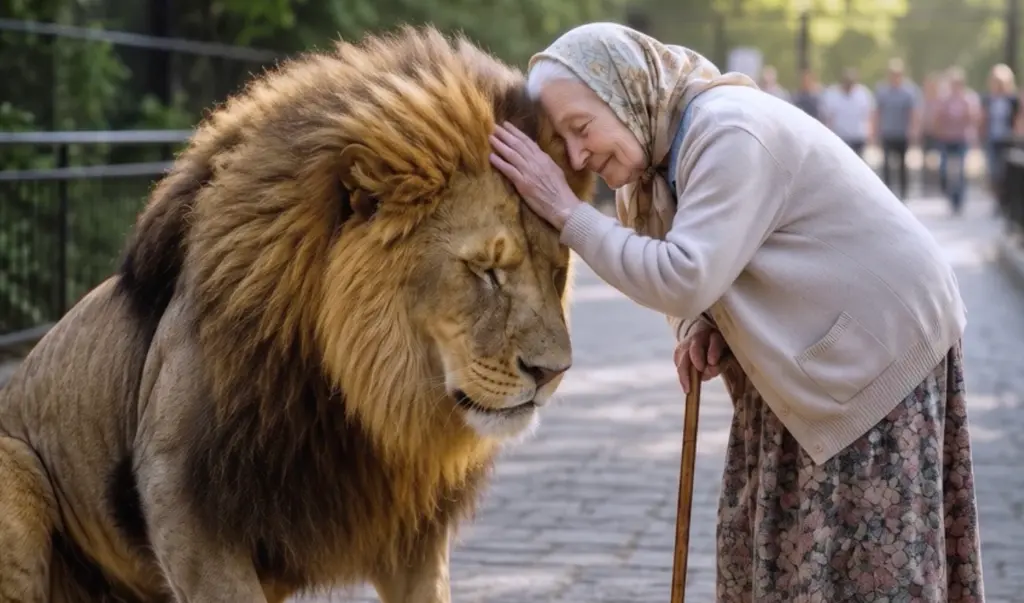
For half a second, no one seemed to understand what they were seeing. Then a woman swept two children behind the lemonade cart. A rack of postcards went down. The gift-shop doors shut on a crush of people with pale faces and open mouths.
Ranger did not look at any of them. He was thirteen years old, four hundred and forty pounds, and strong enough to make every distinction I had learned in eighteen years of carnivore work feel like a thin shelter. His ears were forward. His tail hung low instead of cutting the air. He was not stalking, and he had not threatened anyone. None of that made him safe. It only meant the screaming had not yet given him a reason to change his mind.
He was following something across the pavement. I raised my radio. “Lion in Main Plaza. Full guest shelter. Lock the pedestrian perimeter. Stop traffic at North Service and keep the fire response outside the inner road. Dr. Nair, bring the immobilization kit.”
The channel filled at once—door locations, missing-child reports, a keeper calling numbers from the reptile house. Under the voices, the evacuation alarm kept making its broken three-note cry from the renovation corridor behind the lion building.
Ranger passed the carousel without glancing at the painted horses. His nose stayed a few inches above the concrete. When he put weight on his right foreleg, the old thickening above the wrist showed beneath his tawny coat.
That leg was the reason he had come to us as a yearling and the reason no serious release program had taken him. In cold weather he favored it. On warm mornings he moved as if it belonged to some other lion’s history.
An hour earlier, Tess Wynn had stood at the rear shift gate with one hand on the frame.
“Cycle it again,” she had said.
Tess was twenty-nine, five years into the job, and better at hearing machinery than anyone on my crew. She could identify a failing exhaust fan from the change in its hum and tell when the old hydraulic door at hoofstock needed fluid before it began to shudder. I had hired her after she corrected me during her working interview and then waited, expressionless, to see whether that would cost her the job.
That morning she drew the gate open six inches and closed it. The latch struck once—a flat, shallow clack.
“There,” she said. “It missed the second seat.”
The position sensor had been placed in maintenance mode while electricians replaced fire-alarm conduit. A red tag on the control box warned us that the panel could no longer confirm the gate. Until the work was done, our written procedure called for two people to inspect the pin after every cycle.
I shone my flashlight into the housing. The pin looked down. I pulled the handle twice, hard enough to rock the mesh. The gate held.
“The produce truck is waiting, and Priya needs the medication cooler,” I said. “Log a maintenance request. We’ll take it apart after unload.”
“I’m asking to hold Ranger in the secure den until we check it.”
Tess did not raise her voice. That made it easier for me to treat her concern as negotiable.
I pulled once more. “It’s seated.”
She looked at the latch, then at me. For years I had trusted that look. Tess used it when a calculation was unfinished, when an animal’s behavior did not match the chart, when I was moving too quickly for the people behind me. Most days I stopped.
That morning, I recorded the gate as secure and authorized Ranger’s release from his den into the habitat and rear transfer run. The gate Tess had questioned was the final animal barrier between that run and the keeper corridor. Then I sent her to answer the call from North Delivery while I crossed the public side to find the electrical contractor.
After enough years in charge, I had learned how to make a temporary judgment sound like a fact.
On my way through the public side, an older woman in a moss-green cardigan had stopped me at Ranger’s overlook. She held a weathered field book against her ribs. The corners had gone soft, and a strip of blue tape repaired the spine.
Ranger was asleep on the shaded ledge below us. The woman did not lift a phone or call his name. She made two low notes in her throat, the second slightly lower than the first. One of Ranger’s ears turned toward the rail.
“Excuse me,” she said. “Did he come through a wildlife clinic outside Otjiwarongo? Twelve years ago, perhaps?”
Visitors recognized animals all the time. They had seen a documentary, visited a sanctuary, or owned a calendar with a lion that carried a similar scar. Usually the resemblance mattered more to them than the answer.
“Guest services can submit a records request,” I said. “They’ll need your contact information.”
“His name was Ranger.”
The name appeared on the exhibit sign, so by itself it proved nothing. What stopped me was the past tense and the way her gaze had not left his right leg.
She opened the field book. Inside the cover was a photograph of a lion cub in a plastic laundry basket. One foreleg was wrapped in white gauze. An oversized felt hat covered most of his body, leaving only two ears and the bandaged paw visible.
Before I could take the book, Tess’s voice came over the radio from the service corridor. “Mara, the latch still sounds wrong.”
The older woman watched me listen. “I’m sorry,” I said. “I have an animal-care issue.”
“So do I, I think.”
It was not a joke. I heard that much and still left.
A younger woman waiting near the ramp touched her elbow. As they walked toward the north exit, I heard her say she would bring the car around if her grandmother would wait in Maple Square Park. The older woman tucked the book into a canvas bag and went on alone. Now Ranger crossed the plaza along the route she had taken.
I moved sideways into his sight line without walking directly at him. “Easy, Ranger.”
His amber eyes found me. I was part of his routine—the woman who checked the pads of his feet through mesh, hid beef shank inside cardboard drums, and knew which scrape of a shift door would bring him out of summer rain. Recognition was not affection, and routine was not obedience. Still, his ears turned toward my voice. Then he looked beyond me toward the north passage.
The renovation alarm had emptied the keeper corridor. Beyond it, the produce truck was halfway across the delivery yard’s outer gate. Ranger had entered the rear transfer run, pressed his shoulder against the shift gate, and lifted the shallow-set pin. From there he crossed the unmanned corridor and fenced yard, then slipped behind the truck before the final perimeter could close.
At North Service, Tess was waving the driver forward. Ranger brushed his mane against a stack of melon crates and walked through the narrowing gap as if the truck and gate had opened for him.
The service lane ran between the zoo fence and a row of maples for less than a quarter mile before reaching Maple Square Park. Houses lined the other side. A daycare stood beyond the next intersection.
I called county dispatch on my phone because the zoo channel had become useless. I gave the route, the animal’s weight, and the fact I needed every officer to understand.
“He has not charged or displayed. Block traffic quietly. Keep sirens and engines back, and don’t crowd him toward the houses.”
“Can you tranquilize him?” the dispatcher asked.
“Our veterinarian is coming. The drug takes time. If he runs after the dart, he can cover a lot of ground before it works.”
Two boys abandoned their bicycles and climbed onto the hood of a sedan. A delivery driver froze with one boot on his running board. Ranger passed within thirty feet of both and never turned his head.
At the park, pigeons rose from beneath an old sycamore. Their wings struck the air before I saw what had disturbed them. The woman in the green cardigan sat on a bench under the tree.
Her canvas bag rested beside her sensible brown shoes. A paper sack of birdseed lay open in her lap. When she saw Ranger at the edge of the grass, she became so still that only the loose silver hair at her temple moved.
I wanted to call to her. A frightened person running from a lion can change the meaning of a scene in one step, so I slowed instead and held up one hand.
Ranger left the pavement. His paws made no sound on the short grass. He raised his head, drew in the air, and walked toward the bench with the uneven rolling stride the old injury gave him.
The woman’s fingers closed around the paper bag. Seed spilled across her skirt.
She made the two low notes. Ranger stopped six feet away. His ears moved forward. A sound passed through him, too soft to be a roar and too pulsed to be a growl.
“Ranger?” she said.
He took the last steps slowly. Then he lowered his great head until the scarred side of his face rested across the green wool on her knees.
She closed her eyes. One hand disappeared into the heavy fur behind his ear, moving slowly enough to let him refuse her.
Behind me, a rifle bolt slid into place. “Keeper,” a police sergeant said, “if he rises toward her, we fire.”
I stepped sideways until my body blocked his cleanest angle. The sergeant’s face hardened. “Move.”
“Kill the engines first. Nobody shouts, and nobody runs.”
The woman opened her eyes. “He used to startle when the clinic generator coughed before it caught.” The detail was too small and strange to have come from an exhibit sign.
Dr. Priya Nair reached us with the dart rifle held low. She watched Ranger’s breathing, the line of his back, the woman’s hand in his mane. “I can take the shot,” she murmured, “but if he reacts on impact, she takes his full weight. If he runs before the drug works, we have a loose lion in a neighborhood.”
The sergeant kept the rifle at his shoulder. “Can you separate them?” I looked at the woman, at Ranger, and at the strip of open grass between the bench and the road.
“Not out here,” I said. “Bring me the flood trailer, and tell Tess to bring the red target…”
To read the rest of the story – CLICK the NEXT button 👇👇👇