


The left wheel of the game cart dropped between two roots, pitching Owen Hale against the aluminum rail. Pain tore through his right shoulder. He tried to tell Ruth to stop, but his tongue could not find the word quickly enough. What came out was a strained, shapeless sound. Ruth kept pulling.
Owen knew that cart better than he knew most furniture in their house. He had bought it for hauling elk, reinforced the axle in his workshop, and wrapped the handles in russet saddle leather so they would not freeze against his gloves. He knew what every weld could carry.
He had never calculated for himself.
Ten months after the stroke, the right side of his body still behaved like lumber someone else had stacked against him. His right arm rested in a sling. His braced foot dragged at the edge of the cart, catching wet fern as Ruth hauled him along the abandoned timber road.
She was sixty-seven and breathing hard, but her steps never wandered. She wore the brown canvas jacket from their years at Hale Custom Millwork, when Owen built cabinets and Ruth matched stains, kept the books, and told customers exactly what their last-minute changes would cost.
Above them, ponderosa branches crossed an October sky gone dull with rain. Sparrow Creek moved somewhere below the ridge.
Owen struck the rail twice with his left hand.
No. Stop.
Ruth’s shoulders drew tight. She did not turn.
They had left the pickup almost half a mile behind them where spring runoff had eaten through the road. The old cabin stood beyond the next granite rise. That morning, Ruth had typed a message into his speech tablet.
ONE LAST VISIT BEFORE SNOW?
He had pressed YES.
The cabin had belonged to them before the house, the business, or Claire. Owen had built it at twenty-eight from storm-felled larch and windows salvaged from a condemned school. Ruth had carried roofing felt up the washed-out road, two rolls at a time, because he had insisted they could finish before the first hard frost.
Their first night beneath the completed roof, they had eaten canned peaches with Owen’s pocketknife and slept under a quilt on bare floorboards. A mouse had run across his boot after midnight. Ruth laughed so hard she had to bury her face in the quilt.
He could still remember the pressure of her forehead against his chest.
He could not remember the last time he had heard that laugh.
The cart rounded the granite shoulder. The cabin appeared between the trees, gray and tilted toward the creek. Moss covered half the porch roof. The red door Ruth had painted was faded to the color of dried blood.
She stopped beneath the porch eave and lowered the handles.
“You wanted to see it,” she said.
A strand of damp hair had escaped her braid and stuck to her cheek. Her face looked smaller than it had before the stroke, as though exhaustion had been carving inward where no one could see.
Owen reached for the speech tablet strapped across his chest. The screen remained black.
He pressed the power button again.
Nothing.
Ruth watched his thumb move over the dead glass. “I didn’t charge it.”
He stared at her.
“Maybe I forgot.”
She unfastened the waist strap. Owen gripped the cart, but one hand could not control his descent when she tipped the frame. He slid onto a folded moving pad. His hip hit first, followed by the damaged shoulder, and the pain left him gasping beneath the porch.
Ruth dropped beside him immediately.
For one bewildering second, her body remembered before the rest of her did. She checked the back of his head, straightened the leg brace, and tucked the moving pad beneath his neck exactly as the occupational therapist had shown her. Her hands were practiced and gentle.
Then she removed the speech tablet and placed it inside her daypack.
Owen caught her sleeve.
“Let go.”
He tightened his grip.
“Owen.” Her voice broke around his name. “Please.”
He pulled her close with the only arm that obeyed him. “Hh—home.”
The word was damaged, but Ruth understood.
“Home?” She sat back on her heels. “You mean the house where I sleep until you hit the bed rail? The house where I change the sheets at two in the morning because you won’t let an aide stay overnight?”
Owen shook his head and raised his open palm.
Wait. Give me time.
Ruth stood before he could finish.
“You refused the hospital bed for three months. You wouldn’t let Rosa help you shower. You made Claire cancel the respite stay because you said people were trying to get rid of you.”
He pointed toward her, then toward the trail.
You go. I accept now.
His meaning felt precise inside him. His body reduced it to two blunt motions.
Ruth looked at them and heard something else.
“Don’t tell me to go home.”
She took a fleece blanket, a squeeze bottle of water, and two vanilla nutrition shakes from the cart. She arranged them near his left hand and loosened the bottle cap.
Owen watched her line up the bottles beneath the porch. She had decided where his hand could reach, how much he could drink, and how long the blanket might keep him warm.
He struck the porch board twice.
No.
“You said you would rather die at Sparrow Creek than be put in a facility.”
He remembered saying it six years earlier, after they visited Ruth’s mother in memory care. Her mother had called Ruth by a dead sister’s name. The hallway smelled of disinfectant and boiled vegetables, and Owen had driven home furious at the indignity of it all.
A healthy man had made the declaration. A man who could climb a ladder with a cabinet door under one arm and believed dying would wait for his instructions.
Owen shook his head.
“You did say it.” Ruth pressed both hands against her face. “I remember every word you say because everyone expects me to remember everything. Which pills can be crushed. Which side to place the spoon. How long to wait while you point at letters. How to lift you without tearing my back again.”
He held his palm toward her.
She looked at it. Her own hand rose an inch, almost answering the gesture that had once meant pass me the chisel, come look at this grain, dance with me while the baby sleeps.
Then her hand fell.
“Claire scheduled another aide for Monday,” she said. “Four hours. Do you know what I was going to do with those four hours? Sit in the grocery-store parking lot where no one would ask me for anything.”
Owen pointed toward the road again. He nodded urgently.
Yes. Go. Rest.
Ruth’s mouth hardened. “You still think you get to decide.”
She folded the cart handles against the frame. Metal struck stone.
Owen lunged and caught the hem of her jacket. Ruth stumbled, and for a moment they were both on the ground, breathing into each other’s faces. He saw the broken vessels around her eyes and the yellow bruise above her wrist.
He had made that bruise three nights earlier when his knee collapsed during a transfer. He had been falling and had grabbed whatever he could reach. Ruth had said it was fine while pulling down her sleeve.
It had not been fine.
She freed herself and stood.
“I was good at this,” she said. “For a long time, I was good.”
Owen nodded. Tears ran cold into his hair.
Ruth’s mouth trembled. She turned away.
Her boots scraped up the trail. Owen listened until a pickup door slammed above the ridge. The engine started and idled long enough for him to imagine her behind the wheel with both hands locked around it.
Then the sound descended toward the highway.
The cabin door stood six feet away.
Owen had crossed open framing three stories above the ground. He had carried full sheets of plywood because asking another man to take one end seemed slower. Now six feet of porch boards lay between him and shelter, and he did not know whether he could cross them before dark.
He hooked his left heel into the dirt and pulled.
Pain flashed through the injured shoulder. His right side dragged behind him. When he stopped, his fingers had advanced no more than an inch.
He rested, then pulled again.
By the time he reached the first porch board, sweat had soaked his collar. Clouds pressed down over the ridge, and the smell of rain entered the clearing. If the blanket got wet before he reached the cabin, Ruth’s last kindness would become another source of cold.
Owen reached for a porch post and missed.
Brush moved beyond the cabin.
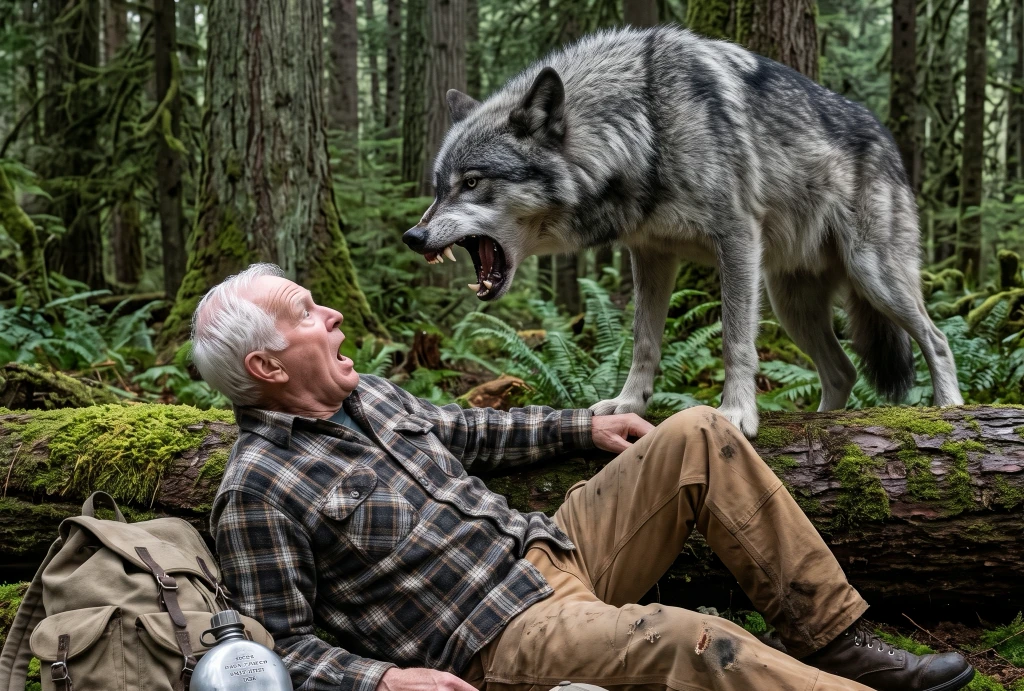
A deer would have stepped lightly and stopped between sounds. This animal moved low and without hurry. A gray muzzle appeared beneath the trees, followed by pale amber eyes.
The wolf stood at the edge of the clearing, long-legged and narrow through the hips. Its coat had begun to thicken for winter. It was too large for a coyote and too still to mistake for someone’s dog.
Owen closed his hand around the water bottle. It was not a weapon, but it was the only object he could lift.
The wolf tested the air and took three steps toward him.
“Easy,” Owen tried to say.
Only the first breath of the word emerged.
The wolf turned slightly. Above its left hind paw, a pale band circled the leg where gray fur should have lain smooth. Owen forgot the bottle. He had seen that scar before…
To read the rest of the story – CLICK the NEXT button 👇👇👇