


The sound came from beneath the guardrail, too thin to be a bark and too stubborn to be the wind. I was ten minutes from home, driving north out of Bozeman with the heater on high and my work gloves drying on the dashboard. The thermometer in my truck showed eight below. I had spent the afternoon repairing kennel doors at the county shelter, and until that sound reached me, the only problem in my head was a warped latch I meant to finish on Saturday.
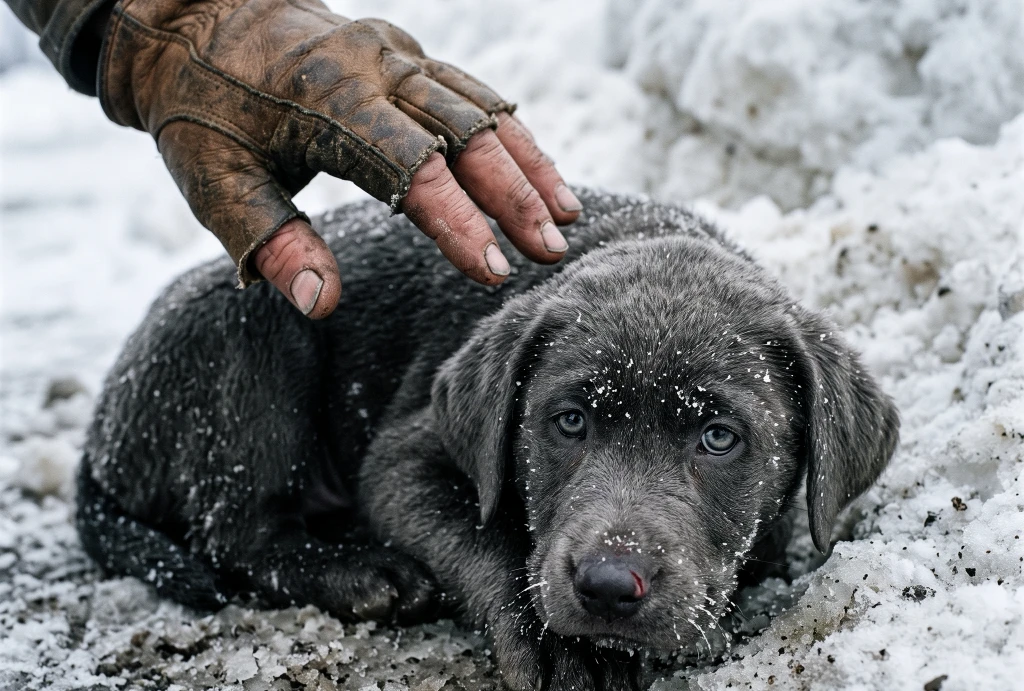
I backed onto the shoulder and aimed the headlights into the ditch. At first I saw wind-packed snow, gray with road grit. Then something moved where the drift had folded over itself: one dark ear, no bigger than a fallen leaf.
The animal beneath it was almost entirely buried. He looked like a German Shepherd puppy at first glance, perhaps eight or nine weeks old, but his legs were too long for the small, starved body attached to them. Ice had sealed the fur along his belly into a hard shell. When I put two fingers against the inside of his thigh, I could not feel a pulse through my numb hand.
I called the emergency veterinary clinic on speaker and did what the technician told me. I did not rub him or pour anything hot over him. I lifted him with the towel I kept behind the seat, held his rigid body against my chest beneath my coat, and turned the truck around.
Halfway back to town, he drew one ragged breath. The sound that followed was not quite a whine. It rose against my ribs in a narrow, wavering note, then broke off as if he had forgotten how to finish it.
“I hear him,” the technician said through the truck speakers. “Keep coming. Don’t try to feed him.”
Dr. Lena Moreno met me at the side entrance. She had treated enough of my shelter fosters to know I did not arrive pale and speechless over a scraped paw. She took the bundle from my coat, laid him on warmed blankets, and began issuing quiet instructions to the two technicians waiting beside her.
The treatment room filled with ordinary objects doing urgent work: towels from the dryer, fluid lines, a heating unit blowing beneath a blanket, a monitor blinking green. Moreno cut away the worst mats and checked the pale, waxy edges of his ears and the cracks in his pads. His temperature was dangerously low. His blood sugar was low too, and his heartbeat kept losing its rhythm.
“You found him when?” she asked.
“Maybe twenty minutes ago.”
“Then twenty minutes matters.” She looked at the monitor rather than at me. “That’s all I’m promising tonight.”
I sat on an overturned feed bucket outside the treatment area because every chair in the lobby felt too far away. I knew the shelter cases that arrived too late. Sometimes warming, oxygen, and careful hands bought only enough time to keep an animal’s last minutes quiet. I had stayed for those minutes before.
Just after midnight, Moreno pushed through the door and handed me a paper cup of coffee.
“He’s holding his temperature,” she said. “He’s not safe yet.”
Through the glass, I could see his narrow chest moving beneath the blankets. One forepaw had slipped free. It was enormous compared with the rest of him, dark nails curved against the white towel.
“No chip,” she added. “No collar mark. We’ll report him as found in the morning.”
The county required a stray hold, which meant he belonged to no one and everyone for the next several days. Because I was already an approved foster, the shelter director arranged for him to recover at my house once Moreno cleared him. By then, photographs had gone to the local lost-animal pages and the sheriff’s dispatch had my number. No one called.
I named him Quartz on the second morning. Under the clinic lights, his eyes had cleared to the smoky gray-brown of the stone my father used to keep on his workbench. Moreno raised an eyebrow at the name but wrote it on the chart.
“Temporary name,” I told her.
“Of course,” she said. She had written the names of eleven of my temporary dogs over the years.
He came home with medication, bandaged feet, and instructions long enough to cover my refrigerator door. For the first week, his life fit inside a faded patchwork quilt on my kitchen floor. I slept in a dining chair beside him, waking whenever the old furnace clicked off. He accepted water from a shallow bowl and food from a spoon, but he would not take either if I held him facing the room. He twisted until he could see the kitchen window and the white fields beyond it.
That was the first thing about him I could not explain.
The second was the silence. Shelter puppies complained about confinement, dropped pans, empty bowls, closed bathroom doors, and the criminal unfairness of bedtime. Quartz made small sounds deep in his chest, but he almost never barked. When the plow scraped past the house, he did not startle toward the noise. He lowered his body and located every exit.
By the end of the stray hold, no owner had appeared. I signed the adoption papers before I could pretend I was still considering it.
Moreno watched me initial the final box. “You know surviving something doesn’t tell us what he’ll be like when he’s healthy.”
“That’s true of every animal you send home with me.”
“This one worries me.”
I took the papers and let the remark pass. I had made a living as a finish carpenter by believing most damaged things would tell you how to repair them if you paid attention. A swollen door left a rub mark. A loose stair announced itself under a heel. With dogs, patience had usually worked the same way.
Quartz healed, and then he grew.
At twelve weeks, his front paws already reached above the cabinet handles when he stood. At four months, his back reached the seat of my dining chairs, though he was all rib, leg, and narrow chest. He moved through the house without the loose-jointed clatter of a young Shepherd. I would look up from a book and find him standing beside me, silent as a shadow cast by something outside.
At night he sat on the broad sill in the living room. He did not watch the driveway or the neighbor’s porch light. He watched the black line of the Bridger foothills. I could shake his food container, call his name, even open the refrigerator, and sometimes he would not turn.
One February night, a howl carried down from the ridges. Quartz rose before I heard it. His ears pointed forward, and his weight shifted onto his toes. When the second call came, he lifted his muzzle and answered.
The sound started low enough to vibrate the window glass. It lengthened into something clean and lonely, nothing like the uncertain note I had heard inside my coat. I stood in the doorway with a dish towel in my hand while the animal I had carried out of a ditch called into country I could not see.
Afterward he came to me and pressed one shoulder against my leg. That small contact was enough to let me postpone the question.
I postponed it again when he began checking the backyard fence from end to end. I told myself he liked the smells caught in the cedar. When he stopped at the soft boards near the irrigation ditch, I replaced them. When he ignored tennis balls but spent twenty minutes following the flight of a raven, I called him observant.
The question finally stopped waiting on a Sunday afternoon. The frost damage had left one front nail split, and Moreno had told me to keep it short so it would not catch. I sat on the kitchen floor with clippers, treats, and the confidence of a man who had trimmed a hundred frightened dogs.
Quartz let me touch his shoulder. He let me slide my hand down his leg. The instant I closed my fingers around his paw, his body changed.
He did not snarl or bare his teeth. He became rigid, every muscle engaged at once, and the sound in his chest dropped below a growl. He tore his leg free. One claw opened three red tracks along my forearm as he crossed the room and wedged himself between the table and the wall, staring at my hands.
The cuts were shallow. What shook me was how little he had meant to do.
I put the clippers away and called Moreno. She had me bring him through the clinic’s side entrance the next morning, before the waiting room filled. Quartz paced the exam room once, chose the corner with a view of both doors, and settled there without taking his eyes off the handles.
Moreno watched him longer than she examined him. She measured his legs, looked at his teeth, and ran her hands over the narrow plane of his skull. Then she stepped into the hall and made a call I could not hear.
“Who are you calling?” I asked when she came back. She kept her eyes on Quartz. “Someone who works with wolves…”
To read the rest of the story – CLICK the NEXT button 👇👇👇