


At first Noah Keene thought the dog had frozen standing up. She was braced beneath the broken porch of the Rourke place, her back bowed against the wind. Snow had gathered along her spine and filled the hollows behind her ribs. Only when Noah slowed his truck did he see the four small bodies tucked beneath her belly. He stopped so hard that a box of carburetor parts slid off the passenger seat.
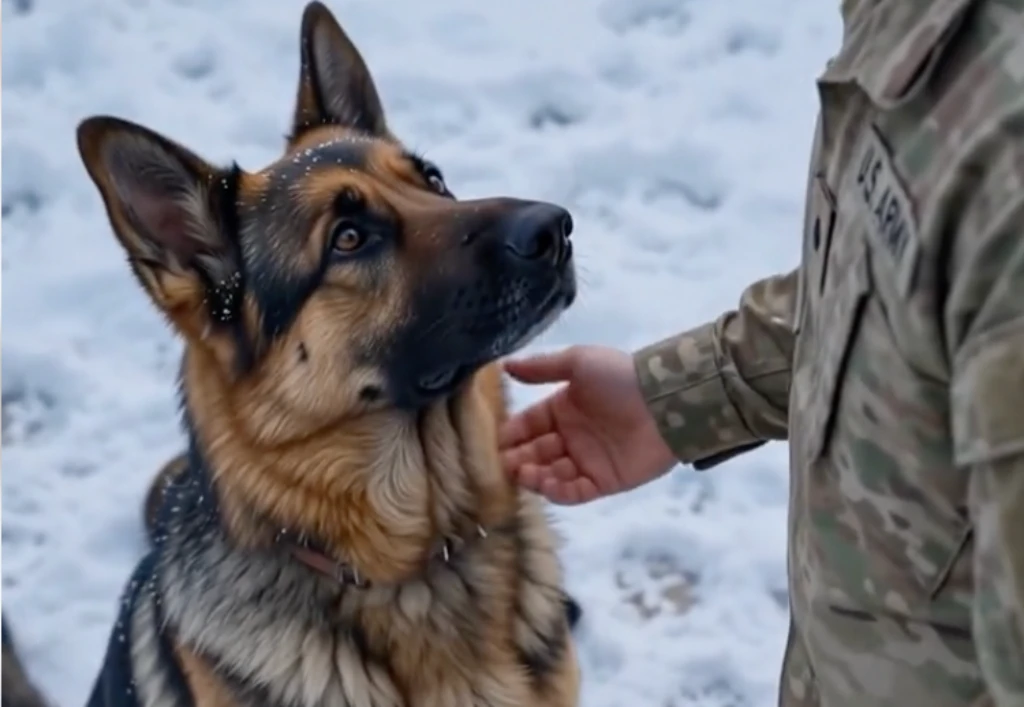
The temperature had fallen below zero before noon. By dusk, the county expected wind chills cold enough to close the schools and freeze exposed skin within minutes. Noah had spent sixteen years pulling people out of Lake Superior. He knew what cold did once the body stopped fighting it.
The dog was no longer shivering.
He set the parking brake and called county dispatch before stepping outside. The wind took his breath the moment he opened the door.
“I’ve got a mother dog and four newborn pups outdoors at the old Rourke house on County Six,” he told the dispatcher. “The mother’s tethered. At least one pup isn’t moving.”
The woman transferred him to Lena Ortiz, the county’s animal-control officer. Noah put the phone on speaker and slipped it into his coat pocket while Lena asked him what he could see.
“Chain around the porch post. No food bowl. No open water. The pups are directly on the ground.”
“Can you transport them without putting yourself at risk?”
“Yes.”
“Then get them out of the wind. Don’t feed the puppies until a veterinarian says they’re warm enough to swallow. I’m documenting the call now.”
Noah took a bolt cutter and two wool blankets from behind the truck seat. He approached sideways, keeping his eyes below the dog’s face.
Up close, he could see where the chain had worn a raw groove through the fur around her neck. She lowered her head but did not growl. Her weight shifted over the puppies, legs trembling under the effort.
“I need what’s under you,” Noah said.
His voice sounded different outdoors—smaller, stripped of the authority it had once carried over radios and helicopter noise.
He knelt beyond the reach of the chain and spread one blanket over the snow. When he reached toward the nearest puppy, the dog’s lips lifted just enough to show the edges of her teeth.
Noah stopped.
The cold worked through the knees of his jeans. He left his hand where she could inspect it, palm down, fingers loose.
Years earlier, during a night search on the lake, a flight mechanic had asked Noah whether he needed relief. Noah had said no. He had already been in the water too long, his hands going wooden inside his gloves, but admitting that had felt worse than another lowering through the dark.
The lie had cost another man the full use of his left shoulder.
Noah had spent three years arranging his life so no one would ever again have to depend on his judgment.
The dog looked at his hand. Then she looked at his face.
She moved one front paw half an inch.
It was not trust. It was the last decision available to an animal who had run out of strength.
Noah slid the first puppy free. Its body felt like a bundle of cold cloth. He tucked it beneath his sweater against his skin, then took the second and third. The fourth lay farther back, half buried where the porch roof had shed snow into the nest.
When Noah touched it, one tiny paw opened.
“Four,” he told Lena. “I have all four.”
He wrapped the puppies together and placed them in an insulated tool bag lined with the second blanket. The mother tried to follow, reached the end of her chain, and fell against the porch post.
The bolt cutter snapped through a link.
She took two steps before her hindquarters folded. Noah slid one arm under her chest and another beneath her hips. She weighed less than a dog her size should have, but carrying her across the yard still brought back the old, unwelcome awareness of how easily a living body could become cargo.
She did not struggle. Her nose remained pointed toward the bag holding her puppies.
Noah settled her on the passenger floor, secured the bag on the seat, and turned the heater high without aiming the vents directly at them. Lena told him that Dr. Tessa Moreno was leaving the veterinary clinic and would meet him at his house.
“You understand this is emergency protective care,” Lena said. “Not ownership.”
“I understand.”
“Don’t disappear with them, Mr. Keene.”
Noah almost told her he was good at disappearing. Instead, he gave her his address.
His cabin stood six miles north of Ash Harbor, close enough to the lake that winter wind found every seam in the walls. The attached workshop smelled of machine oil and old gasoline; the living room smelled of cedar and the woodstove he kept burning from November through April.
He carried the puppies inside first. The mother dragged herself after them before he could return for her.
Noah built a nest on the floor several feet from the stove, using folded towels, a foam camping pad, and bottles of warm water wrapped in cloth. He set a room thermometer beside them. The dog lay down around the bundle, but she had no strength left to clean or nurse them.
The smallest puppy remained limp.
Noah was rubbing it with a dry towel when headlights crossed the front window. Dr. Tessa Moreno entered carrying two canvas cases and wearing snowmobile bibs beneath her coat.
She was short, broad-shouldered, and quick without seeming hurried. She had treated Noah once after he drove a fishhook through his thumb. He remembered that she had asked before cutting his glove and had not laughed when he refused anesthetic.
Tonight she barely greeted him.
“How long were they exposed?”
“I don’t know.”
“How long since you found them?”
“Twenty-eight minutes.”
“That, you know exactly.”
“Yes.”
Tessa examined the mother first, then each puppy. She worked on the floor, keeping them together whenever she could. The smallest male went into a padded carrier supplied with controlled warmth while she treated dehydration and low blood sugar.
“No formula yet,” she said. “A cold puppy can’t digest properly, and he’s too weak to protect his airway.”
Noah nodded.
“I’m not testing you,” she said. “I need you to tell me if anything changes, even if it seems small.”
“I’m listening.”
“Good. Keep listening after I leave.”
She went back to work.
The mother’s gums were pale, and her milk supply was poor but not gone. Beneath the dirt, Tessa found old pressure sores, overgrown nails, and the ring around her neck. None of it had begun during a single afternoon in the snow.
The smallest puppy gave one thin cry from the carrier.
The mother lifted her head.
Noah felt the sound beneath his breastbone. It was not loud enough to fill the room, but the cabin seemed to rearrange itself around it.
Tessa allowed the mother a little warmed water. When she finished drinking, she touched each puppy with her nose, one after another. Only after reaching the fourth did she lower her head to the blankets.
“She’s been counting them,” Tessa said.
Noah opened his mouth, then closed it.
Tessa passed a microchip scanner over the dog’s shoulders. It beeped.
“Good,” she said. “Let’s see who she is.”
The registration named the dog Birdie. Her listed owner, Mae Rourke, had lived at the house where Noah found her.
Mae had been dead for eleven months.
Tessa called Lena while Noah added wood to the stove. The puppies were warm enough now to begin careful feeding, though the smallest still could not nurse on his own.
The clinic’s overnight ward had no technician until six, and the road through town was already glazing over. Because all four puppies were responding and another trip would separate them from Birdie’s warmth, Tessa chose monitored home care for the next few hours. It was a temporary medical arrangement, not an ordinary foster placement, and she wrote clear conditions for ending it.
By seven, all four puppies were breathing steadily. Birdie had stopped panting. Snow tapped softly against the windows, and for the first time since Noah had seen her beneath the porch, she let her eyes close.
A vehicle came up the drive.
Birdie’s eyes opened before Noah heard the engine. She rose too quickly, stumbled, and placed herself between the puppies and the front door.
The knock shook snow from the porch roof.
Noah crossed the room but left the dead bolt set. Through the glass, he saw a man in a canvas work coat, bareheaded despite the cold. Melted snow ran down his face.
“I got back and found the chain cut,” the man said. “Yours were the only fresh truck tracks leaving my drive. I followed them to the turnoff and saw your repair sign on the mailbox.”
He looked past Noah toward the blankets by the stove.
“Her name is Birdie,” the man said. “And she belongs to me…”
To read the rest of the story – CLICK the NEXT button 👇👇👇