


The first sandwich I gave George Fletcher was supposed to be my lunch. It was late March, cold enough that the metal bench at the bus stop shone with frost. George sat on flattened cardboard beside it, wrapped in an olive Army blanket with one boot showing at the bottom. I had passed him every weekday for two weeks without learning anything except that he slept lightly and folded his blanket into a precise square each morning.
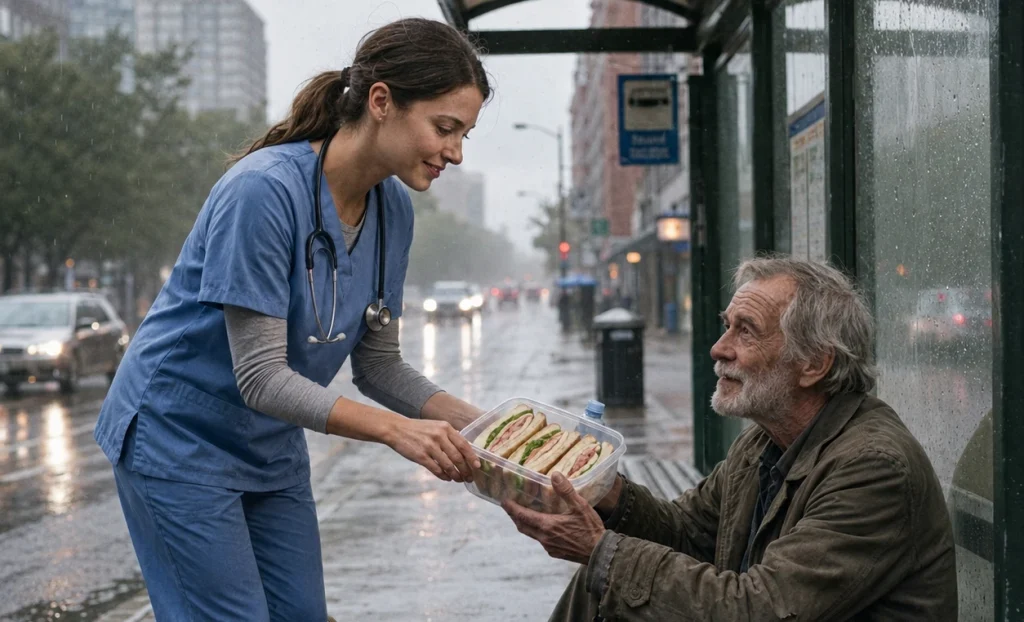
That day, I had a peanut butter sandwich in my tote and no time to eat it. My cafeteria shift at St. Catherine’s ended at two-thirty. At three, I had a nursing-assistant class across town, followed by five hours stocking shelves at Bell’s Market. By midnight, the sandwich would be warm paste in plastic wrap.
I stopped in front of George.
“I made an extra,” I lied.
He looked at the sandwich, then at my hospital badge. His eyes were gray and irritatingly alert.
“You don’t look like a woman who makes extra food.”
“I’m offering it, not defending it.”
That brought the smallest movement to his mouth. He accepted the sandwich with both hands.
“Thank you, Aaliyah.”
I touched my badge. “You cheat.”
“Reading isn’t cheating.”
The eastbound bus appeared at the light. I climbed aboard before he could ask why I had given away my lunch.
The next morning, I brought two sandwiches and black coffee in my dented thermos. George accepted the food but refused the paper cup until I poured one for myself.
“Bad manners to make somebody drink alone,” he said.
“My bus comes in nine minutes.”
“Plenty of time for bad coffee.”
It was terrible coffee. We drank it anyway.
After that, six-fifteen belonged to us.
Some mornings George spoke only enough to say thank you. On others, he watched the low clouds over the rowhouses and told me what kind of wind was moving above them. He claimed he had flown helicopters in the Persian Gulf and the Balkans. He described instruments icing over, dust swallowing a landing zone, and the peculiar quiet inside a cockpit when everyone had run out of useful words.
I assumed the stories were pieces of truth rearranged by illness. The city was full of men who had once been mechanics, fathers, union workers, soldiers. It was also full of men who had been presidents, spies, and professional quarterbacks after midnight.
George never asked me to believe him.
He did ask about the index cards sticking out of my tote. I was studying basic patient care and anatomy at Baltimore City Community College, one course at a time because one course was what I could afford.
He picked up a card.
“Signs of a stroke,” he read.
“Face drooping, arm weakness, speech difficulty. Note the time and call 911.”
“Good. Don’t give them food or water.”
“I know.”
“Then why’d you leave that off?”
“Because the card is small.”
“A patient’s airway doesn’t care about your stationery.”
I snatched it back. “Were you always this annoying?”
“Only with people worth annoying.”
At the hospital, Mrs. Chen supervised the cafeteria with a thermometer in one pocket and reading glasses balanced on her head. She noticed everything: missing hairnets, undercooked chicken, workers who had cried in the supply room and believed cold water had hidden it.
In May, she watched me push my employee meal toward the trash after wrapping half of it in foil.
“That for the man at your bus stop?”
“His name is George.”
“That wasn’t my question.”
“I can eat at the store.”
Mrs. Chen glanced at the clock. “Bell’s gives you a fifteen-minute break at eight, and you spend it studying.”
“I’m not hungry.”
She took the foil package out of my hand, added another scoop of baked pasta, and wrapped it again.
“One for him,” she said. Then she filled a second container and pressed it against my ribs. “One for the liar.”
I resented her for nearly ten minutes.
George was no easier. One morning he studied my face, unwrapped the sandwich, and divided it with the edge of his thumbnail.
“Fair is fair.”
“That’s yours.”
“So’s this half.”
“I ate at home.”
He held the sandwich out without blinking.
I took it because the bus was coming and because arguing required energy I no longer had. Peanut butter stuck to the roof of my mouth while George drank his coffee. He pretended not to notice my eyes watering.
By June, the morning heat had begun to hold the smell of the closed laundromat against its bricks—old soap, damp plaster, and something sour from the alley. George still kept his cardboard square and his black trash bag in the same narrow space between the boarded door and the bus shelter.
A man in a charcoal suit came through one rainy morning, talking into a headset. George’s blanket had slipped six inches into the walkway. The man caught it with his shoe and kicked it toward the gutter without breaking his conversation.
The blanket landed in oily water.
“Pick that up,” I said.
The man turned, surprised that the obstruction had spoken. “He can’t block the sidewalk.”
“He wasn’t.”
George put a hand on my wrist before I could follow.
“Let him go.”
“He did that on purpose.”
“Maybe.” George reached for the wet wool. “He still has somewhere he thinks he needs to be.”
I crouched and helped wring out the blanket. Cold brown water ran over my fingers and into the cuffs of my scrubs.
“You should’ve let me handle him,” I said.
“I did handle him.”
“You sat there.”
“Sometimes that’s how.”
I disagreed, but I carried the blanket to the hospital laundry in a trash bag. Mrs. Chen washed and dried it between loads of kitchen towels, then warned me that if anyone asked, the blanket had been a tablecloth.
For the rest of the summer, George slept under wool that smelled faintly of industrial lemon detergent.
He disappeared near the end of August.
On the first morning, I assumed the police had moved him. On the second, I checked two shelters and the emergency department at St. Catherine’s, where nobody could tell me whether a George Fletcher had been admitted. On the third, I missed my bus walking the blocks around the abandoned rail yard.
He returned on the fifth morning.
His face was thinner, and a white hospital bracelet circled his wrist. Purple bruises marked the places where tape had held an IV.
“Where were you?”
“Good morning to you, too.”
“You were in a hospital.”
“For part of it.”
“What happened?”
“Got dry.”
“You were dehydrated for five days?”
He reached for the coffee, but his hand shook badly enough that I kept hold of the cup.
“George.”
“Don’t start taking attendance, Miss Cooper.”
“I already do.”
The sharpness left his face. He looked toward the intersection, where buses and delivery trucks moved through the wet morning light.
Then he reached inside his coat and brought out a thick envelope. My name was written in one corner. The front was addressed to Victoria Ashford at a legal-services office in Alexandria, Virginia.
“If I disappear and you find out I can’t come back on my own,” he said, “mail this.”
“What does that mean?”
“It means you don’t mail it just because I’m late.”
“Then why give it to me?”
“Because next time I might not be able to change my mind.”
I turned the envelope over. It was sealed with two strips of clear tape.
“Why don’t you mail it yourself?”
“Because I might change my mind.”
“That isn’t an answer.”
“It’s the one I’ve got.”
I slipped the envelope into my tote. Beneath the address, in smaller letters, George had written COL. V. ASHFORD, RET.
“Who is Victoria Ashford?” I asked…
To read the rest of the story – CLICK the NEXT button 👇👇👇