


The cable rang against the river ice before Mae Donnelly saw the wolf. She had come down to the Alder to check the flood marker, a striped post bolted into the limestone below her pasture. It was the last week of April, and three days of warm rain had eaten the snowpack off the Cabinet Mountains. The river had risen overnight until brown water ran beneath shelves of old gray ice. Mae was leaning over the gauge when metal scraped twice somewhere upstream—thin, sharp notes under the heavier sound of water.
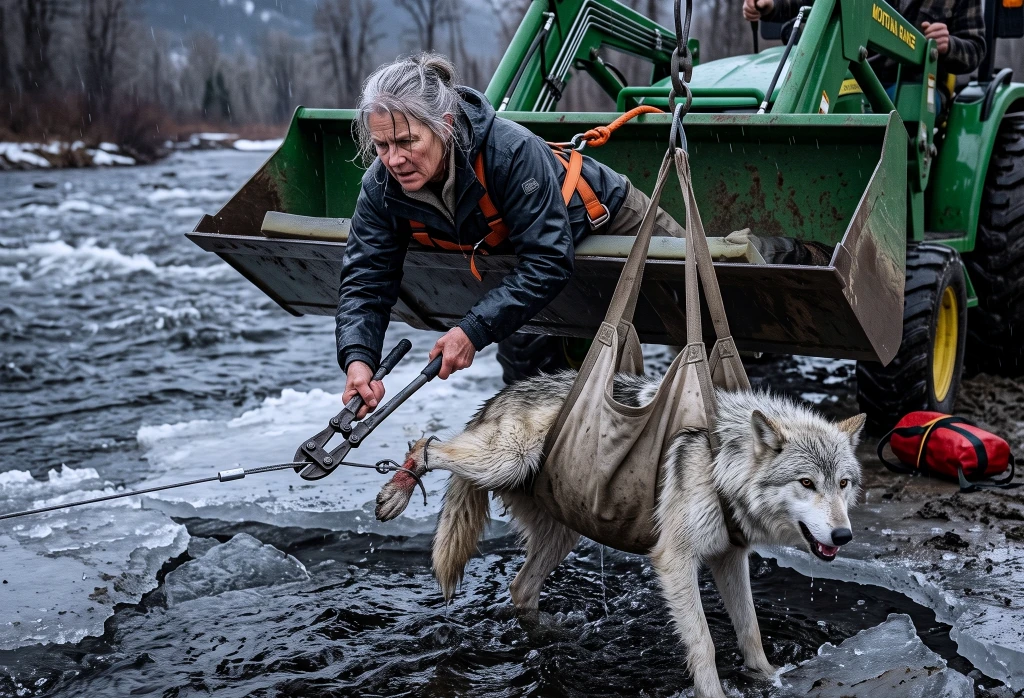
Then a pale head lifted beside a fallen cottonwood.
The wolf was half in the river, half on a slab of ice that flexed each time the current struck it. Wet fur narrowed her body, but her belly was unmistakable: low, round, close to term. A cable loop had closed above one hind paw. Its other end disappeared beneath the cottonwood roots, holding her in the worst possible place as the ice broke around her.
Mae’s hand went to the red throw bag clipped to her belt. She carried it whenever she came within sight of the Alder, though no county rule required it. Cal had stopped teasing her about the habit years ago. Thirty-eight springs earlier, an ice shelf had broken at this same bend under her eight-year-old son. Searchers found one red wool mitten caught in the willows. They never found Danny.
Her daughter Erin had sent the county flood notice before dawn with Be careful beneath it. Mae had replied, Will do. They had not spoken since Christmas.
The wolf tried to climb. Her front claws scored the wet ice; her trapped leg jerked her backward. When the slab dipped, water washed over her chest and she snapped at it as if the river had a throat.
Mae pulled out her phone and called the state wildlife line. She gave the dispatcher the river mile, the access road, the washed-out culvert above the lower bridge, and the fact that the animal wore no visible collar. Then she called Cal Mercer.
“I need your tractor at the bend,” she said.
“For what?”
The ice cracked. The wolf’s head vanished, then came up again with water streaming from her muzzle.
“An animal in the river. Bring the loader and the calf sling.”
Cal was silent just long enough to tell her he had heard what she had not said. “Mae. What kind of animal?”
“One that’s drowning. Move.”
She ended the call before he could refuse. The dispatcher called back with a wildlife veterinarian on speaker. Dr. Saira Patel sounded younger than Mae expected and tired enough to skip introductions.
“Do not go onto that shelf,” she said. “Our truck is north of the bridge. Best estimate is forty-five minutes if the logging road holds. Can you keep eyes on the animal from the bank?”
“I can. Forty-five minutes is too long.”
“I know. It is still the instruction.”
Mae had spent thirty-two years as a veterinary technician in a mixed-animal practice. She knew the difference between a hard instruction and an instruction given because the person issuing it could not see the water. She also knew what cold did to muscle, how little reserve a pregnant animal had, and how fast a quiet patient could become a dead one.
The wolf stopped clawing. Only her nose and eyes remained above the edge.
Mae took the throw bag from her belt. The rope inside was meant for a person who could catch it. She anchored one end around an alder trunk anyway, tied a second line to the folded aluminum stock panel lying beside the fence, and waited for the growl of Cal’s diesel engine.
He came down the pasture in an old green tractor, the loader bouncing over gopher mounds. At sixty-six, Cal had a bad left knee and the broad, stooped shoulders of a man who had lifted feed sacks since childhood. He stopped twenty yards from Mae, saw the wolf, and closed his eyes once.
“You could’ve said wolf.”
“Would you have come as fast?”
“I would have brought the rifle.”
“The sling, Cal.”
He climbed down without answering. His family had lost a yearling steer the previous fall, one of two livestock deaths Wildlife Services had confirmed as wolf kills in the valley. Mae had sat at his kitchen table while he worked the numbers on the back of a feed invoice and decided which repair could wait. He had not asked her to admire wolves then. He had asked her to understand what six hundred pounds of missing beef meant.
Now he opened the loader’s toolbox, took out the calf sling, two tow straps, and a long sorting pole. “If that shelf goes under while the panel’s on it, the panel goes too. You don’t follow it.”
“I know how water works.”
His eyes flicked toward the bend. Cal had been twenty-eight when he spent four days in a search boat looking for Danny. He was the one who brought the red mitten to Mae’s door in a paper evidence sack.
“That’s not what I said.”
They worked without arguing after that. Cal chained the tractor to a pine above the slope and lowered the bucket near the bank. Together they fed the stock panel over the rotten ice. One strap kept it from drifting; another ran from the loader through the calf sling, making a cradle they could slide beneath the wolf and lift without stepping onto the river.
The wolf saw the moving panel and found enough strength to snarl. Her lips drew back from dark gums. Mae felt relief at the sound. Anger used oxygen, but it also meant the animal had some left.
“Good girl,” she said before she could stop herself. “Keep that.”
Dr. Patel heard through the phone. “Mae, stay behind the bucket. Use the panel as a barrier. Do not reach for her head or leg.”
Mae slid the sling forward with the sorting pole. The current shoved it sideways. Cal corrected with the loader, inch by inch, until the canvas opened beneath the wolf’s chest.
“Now?” he asked.
“Not yet.”
The wolf’s hindquarters slipped. The cable snapped tight, spinning her onto her side. Water covered her head.
Mae drove the pole under the sling and lifted with both hands. “Now!”
The tractor engine climbed. Canvas tightened under the wolf, the stock panel bowed, and one of its welds popped like a shot. The ice shelf split from the cottonwood to the bank. For an instant the wolf hung between black water and the loader, still tethered by the cable around her leg.
Cal stopped the lift before it tore the paw off. “She’s hung up.”
Mae could see the cable now, running from the leg to a loop cinched around a root. Not a fence wire. A snare. There was no visible identification tag.
She worked the free end of the alder line around her chest and shoulders, tied a rescue loop, and stepped onto the tractor bucket. Cal reached down from the operator’s seat and caught her sleeve.
“No.”
“The root is four feet away. Keep the bucket low.”
“Patel told you—”
“If you pull, you take her foot. If you let her down, she goes under. Pick one.”
His grip stayed on her sleeve for another second. Then he swore softly, lowered the bucket, set the brake, and returned both hands to the controls. Mae lay flat behind the steel lip and reached with Cal’s bolt cutters while the wolf thrashed in the sling close enough that spray hit her face.
The first bite of the cutters glanced off. The second dented the cable. On the third, the jaws met.
The severed end whipped past Mae’s wrist. As Cal raised the bucket, Mae pulled herself behind the steel lip on the safety line. Beneath them the entire shelf folded, tipped, and disappeared into the Alder.
The wolf came onto land in the sling, coughing river water and striking weakly at the canvas. Mae stayed behind the steel while Cal dragged the cradle beyond the flood line. They lowered a rigid plywood panel over her head, left the severed loop around her paw for the veterinarian to remove under restraint, and moved the sling onto a calving sled.
Only when the tractor started uphill did Mae notice blood running from a split in her own glove. The cable had caught the heel of her hand. Cal saw it too.
“You don’t get to die for every living thing that hits that bend,” he said.
“Drive.”
Her old treatment room occupied the north end of the barn. It had not held a patient since Mae retired, but the floor drain worked, the stall gates were solid, and a propane heater kept the space above freezing. Under Dr. Patel’s direction, they spread a horse blanket on the stall floor, slid the sling onto it, secured the wolf’s front half behind the solid partition used for difficult mares, set radiant heat at a distance, and backed away.
Mae watched from behind the gate. The wolf’s breaths came too quickly and too shallowly. Her abdomen tightened under the wet fur, held, then released.
“She’s in labor,” Mae said.
Dr. Patel’s voice sharpened through the phone. “How close are the contractions?”
Before Mae could answer, fluid darkened the blanket beneath the wolf. The animal pushed once, feebly, and one small rear foot appeared with no second paw behind it.
Cal took off his cap. “Tell me that isn’t what I think.”
Headlights swept across the barn wall. Dr. Patel and two wildlife technicians came through the door with a capture panel and medical cases. Working through the gate, they secured the wolf’s head behind the panel and gave enough medication to remove the cable loop, examine the leg, and manage the obstructed delivery. Dr. Patel treated the injured paw and bagged the loop.
The pup was lodged backward. Under Dr. Patel’s direction, Mae worked from the hind end while a technician watched the mother’s breathing. One contraction, a careful correction, and the pup slid into Mae’s towel already drawing a thin, uneven breath.
Mae cleared the membrane from his face and rubbed him until the breath steadied. He gave a dry complaint and worked his mouth against the towel. When she placed him within reach of the mother’s muzzle, the wolf licked him twice, slowly. Her tongue stopped against his back.
Mae saw the change before Cal did: the slackening jaw, the fixed space between breaths, the way the body no longer gathered itself against pain. Dr. Patel checked for a pulse, started the measures that still made medical sense, and stopped when they no longer did. A portable ultrasound found no additional fetuses; the pup had been a rare, large singleton, which partly explained the obstruction. The river, the cold, and internal bleeding had left the female with nothing in reserve.
The team warmed the pup, treated his cord, weighed him, collected routine neonatal samples, including a genetic swab, and placed him in an incubator supplied with supplemental oxygen. They examined the female without unnecessary movement. Mae stood at the sink with blood and river grit drying in the creases of her hands while Cal held gauze against her cut.
It was full dark when one of the technicians went outside and came back too quickly.
“There’s another wolf by the west fence.” Mae stepped to the barn door. Fifty yards beyond the pool of work lights, a black wolf stood between two larches. He was leaner than the animal stories made wolves, long-legged and winter-rough, with a torn notch in his right ear. He did not look at the people. He looked at the barn. Inside the treatment room, the pup gave one thin, searching cry. The black wolf lifted his head—and answered…
To read the rest of the story – CLICK the NEXT button 👇👇👇