


The Oakhaven County Livestock Auction always smelled the same—a heavy, sun-baked blend of diesel exhaust, sweet alfalfa, and the sharp ammonia of nervous animals. It was a place of loud, transactional energy. Over the tinny loudspeakers, the auctioneer’s rhythmic, breathless chant rolled across the gravel lots, punctuated by the slam of metal gates and the shouting of men moving herds through the chutes.
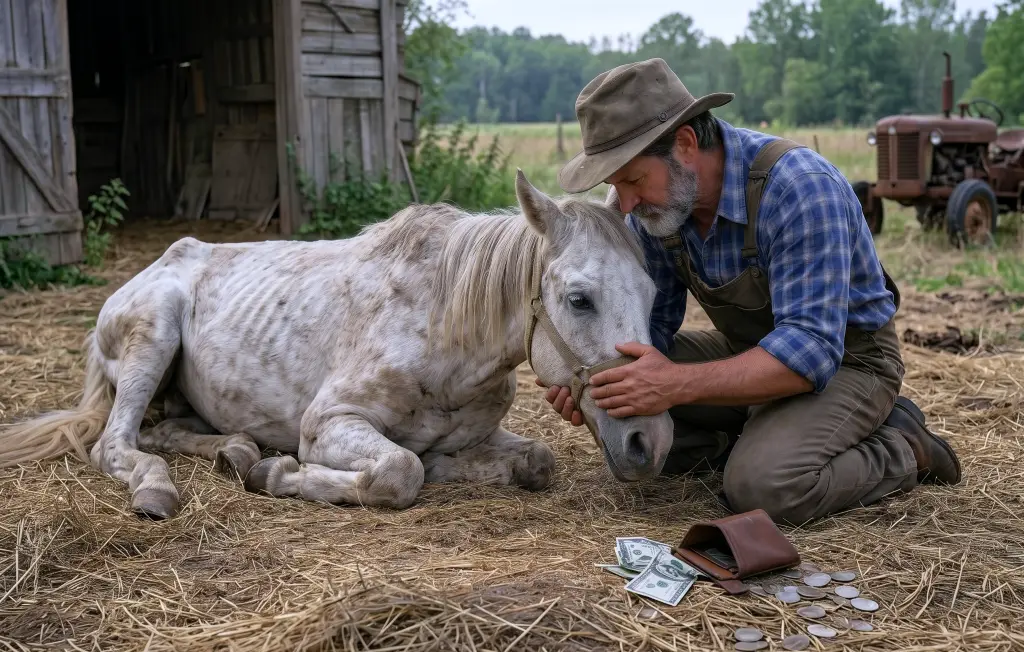
Elias Thorne stood near the back of the yard, his hands deep in the pockets of his faded canvas jacket. At sixty-eight, he looked like a man who had been left out in the weather too long. The lines around his eyes were set deep into weathered skin, and his shoulders carried a permanent, subtle stoop.
He hadn’t come to the auction for livestock. He had come for the equipment swap in the north lot, looking for a rebuilt alternator for a tractor that had died in the middle of his lower pasture three days ago. His leather wallet, worn smooth at the corners, held exactly two hundred and forty dollars. It was the last of the cash he could safely pull from the farm’s operating account before the county property taxes came due.
Elias walked past the holding pens of healthy yearling steers, past the cages of nervous chickens and the trailers full of bleating Boer goats. He kept his head down, avoiding the eyes of the other farmers. Since his wife, Sarah, had passed away fourteen months ago, Elias had mastered the art of being invisible. He didn’t want their sympathy, and he didn’t want to answer questions about the farm he was slowly, quietly losing.
He found himself drifting away from the noise, toward the far edge of the property where the gravel gave way to sparse, dust-choked weeds. This was the cull lot. It was where the auction house put the animals that weren’t going to fetch a breeding price—the old, the injured, the ones waiting for the meat buyers to load them onto double-decker trailers bound for the processing plants.
The air was quieter here. The silence felt heavy, marked only by the occasional shuffle of a hoof or the flick of a tail against flies.
Elias stopped at the rusted pipe-rail fence of the last pen.
She was a white mare, though it was hard to tell at first glance. Her coat was severely matted, stained with dark, greasy patches of mud and dried sweat. She stood perfectly still in the center of the pen, her head lowered so far her nose nearly brushed the dirt. Her hip bones jutted out beneath her hide with sharp, architectural cruelty, and her ribcage rose and fell in shallow, uneven intervals.
But it was her front left leg that caught Elias’s attention. The knee was horribly deformed, swollen to the size of a cantaloupe, pulling the limb at an unnatural angle. She kept it hovering just above the ground, trembling with the effort of bearing all her weight on three exhausted legs.
“Don’t bother looking, old man.”
Elias turned his head slightly. A gaunt man in a soiled baseball cap was leaning against a nearby truck, smoking a cigarette down to the filter. He was a broker, one of the middlemen who bought cheap and sold by the pound.
“She ain’t gonna make it through the weekend,” the broker said, exhaling a thin stream of gray smoke. He didn’t bother looking at Elias, his eyes scanning the crowd closer to the main barn. “Look at that leg. Bones are probably grinding like gravel in there. I’m just waiting on the transport truck to take her off my hands. Honestly, I don’t even know if she’ll survive the ride up the ramp. Dog food plant might not even take her with that much infection.”
He spat into the dirt and finally turned toward Elias. “So unless you’re looking to buy yourself a massive hole in your pasture to dig, keep walking.”
Elias didn’t walk. He turned his attention back to the mare.
His rational mind ran the inventory of his life. He was broke. The farm was a month away from foreclosure. He didn’t have extra hay, he didn’t have grain, and he certainly didn’t have the money for a vet bill. Buying a dying horse was an act of financial suicide.
But the mare slowly lifted her head, and Elias saw her eyes.
There was no panic in them. There was no wild, thrashing fear of a prey animal trying to survive. There was only a quiet, bottomless emptiness. It was the look of a creature that had fought until there was nothing left, a creature that had finally, silently accepted that the end was coming.
Elias felt a cold, heavy tightness seize his chest. He knew that look. He had seen that exact same quiet resignation in Sarah’s eyes during her final week in the hospice bed, when the pain medication had stopped working and the fight had simply drained out of the room. He hadn’t been able to stop death then. He had just sat in a plastic chair, holding her hand, entirely powerless as she slipped away.
Elias stepped closer to the fence. He reached his hand through the rusted steel bars, his knuckles scarred and calloused from decades of labor.
He didn’t make a sound, but the mare saw the movement. She flinched, a weak shudder rippling across her shoulders. She expected to be struck. She expected to be forced to move.
Elias kept his hand perfectly still.
For a long moment, neither of them breathed. Then, with agonizing slowness, the mare took a small, shuffling hop forward on her three good legs. She lowered her heavy head and let her velvet muzzle rest inches from Elias’s palm. She exhaled, a warm puff of air against his skin.
Something in Elias’s chest cracked open. The logic of the tractor, the taxes, and the failing farm vanished.
He pulled his hand back, reached into his jacket pocket, and pulled out his worn leather wallet. He didn’t count the bills. He just took all of them—every crumpled twenty and ten he had—and held them out over the fence rail.
“I’ll take her,” Elias said. His voice was rough, unaccustomed to use, but entirely steady.
The broker pushed himself off the truck, staring at the money, then at Elias, as if trying to figure out the punchline to a joke. He let out a short, harsh laugh.
“Suit yourself, buddy,” the broker said, stepping forward and snatching the cash before Elias could come to his senses. “No refunds when she drops dead in your trailer.”
Elias didn’t answer. He just looked through the bars at the mare. He had two hundred dollars less to his name, a broken tractor, and a dying horse. And for the first time in fourteen months, he felt like he had a reason to go home…
To read the rest of the story – CLICK the NEXT button 👇👇👇