


Caleb Doran knew the line was wrong before it pulled tight. Crab pots dragged with a steady, stupid weight. This line kicked against the gunwale of the Cora May as if something below the surface were still trying to live. He cut the engine and hauled hand over hand. Dawn had not yet cleared the fog from the Merritt River, and the incoming tide pressed cold water through the reeds below Sutter Marine Works. Caleb expected a fouled branch or an abandoned length of cable.
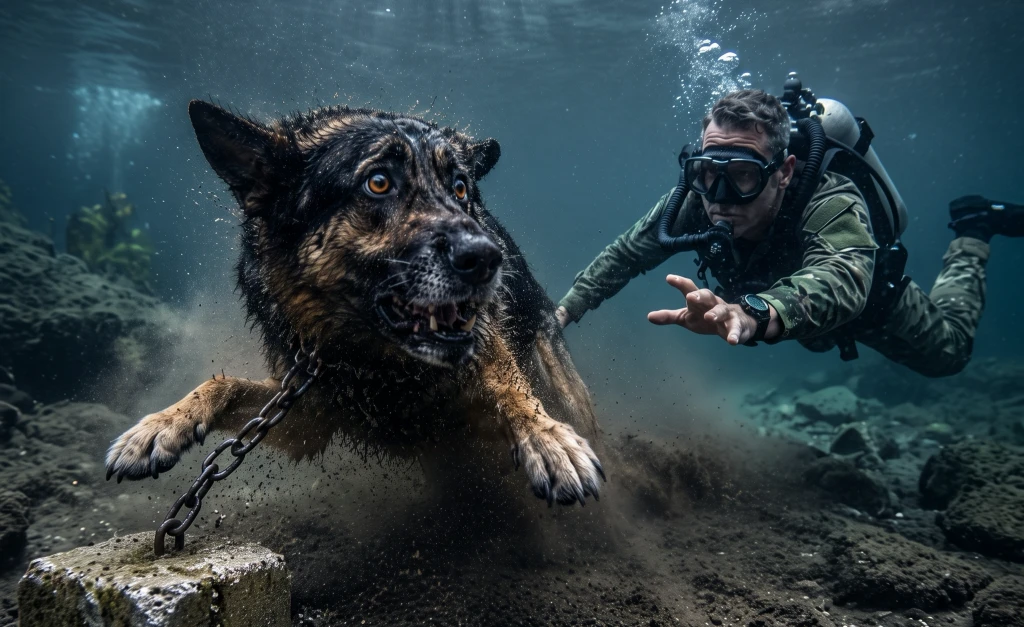
A black muzzle broke the surface beside the boat.
The dog managed one breath before the chain pulled him under again.
Caleb dropped the line, grabbed the bolt cutters from beneath the aft bench, and went over the stern ladder in his float coat and rubber bibs. The river reached his waist, then his chest when the mud gave beneath one boot.
The German shepherd was wedged against the edge of the tidal shelf. A chain ran from his collar to a concrete core sunk in the mud. Only the animal’s ears and nose cleared the water when the tide lifted him.
“Easy,” Caleb said. “Don’t fight me.”
The dog fought anyway. Not to bite or escape, but to keep his head above water.
Caleb caught the collar in one gloved hand and forced the cutters over a link with the other. His left ear filled with the thin electrical whine that came whenever cold or strain disturbed the old injury. The fog, the boat, and the dog slipped in and out of focus.
For half a second he saw another stretch of water, another man trapped beyond collapsed steel, and an officer’s hand closing around Caleb’s shoulder.
Fall back, Chief. There’s nothing you can do.
The shepherd’s paws struck his ribs.
Caleb braced the cutters against his thigh and squeezed until the link snapped. The dog sagged against him. Caleb dragged him to the ladder, pushed from below, then hauled himself aboard after him.
The shepherd lay motionless on the wet deck. His black-and-tan coat had been rubbed bare around the neck and hips, and his ribs rose like narrow slats beneath his skin.
Caleb cleared mud from his mouth and extended the dog’s neck. A weak pulse moved under his fingers. He covered the shepherd’s muzzle and gave two careful breaths.
The dog convulsed.
River water spilled onto the deck. He coughed again, drew a ragged breath, and opened amber eyes clouded by exhaustion.
“That’s enough,” Caleb murmured. “You don’t owe me anything else.”
He wrapped the dog in an old wool blanket and carried him into the cabin. When Caleb turned to retrieve the cutters, the shepherd tried to rise.
His front legs folded immediately, but he kept staring through the open door toward the southern end of the shipyard. Beyond the reeds stood a decommissioned discharge gantry, its lower braces disappearing beneath the tide.
The dog scraped one paw across the floor.
Caleb followed his gaze. “Something back there?”
A metal tag struck the deck when Caleb lifted the broken chain. It was a small brass disk wired near the severed link, green at the edges and stamped with two characters:
B-12.
He put it in his pocket.
Movement showed through the fog onshore. A young man stood beside the maintenance road wearing a gray work jacket with the Sutter Marine patch over his chest.
Caleb recognized Noah Price, a yard mechanic who lived with his mother in a duplex near the high school. Noah was twenty-eight or twenty-nine, narrow through the shoulders, with oil-dark hands and a face that always seemed to be waiting for bad news.
He stared at the dog.
“You found him,” Noah said.
“That surprise you?”
Noah looked toward the shipyard fence. “I thought you’d already run your pots.”
Caleb stepped onto the stern deck. Water ran from his bibs. “How did you know where I’d be?”
“I didn’t.”
The shepherd lifted his head at Noah’s voice. He made no sound, but his body tightened under the blanket.
Noah backed away.
“Who chained him?” Caleb asked.
“I don’t know.”
“You came down here before daylight to look at the river.”
“I said I don’t know.”
Noah turned toward the road.
Caleb’s voice stopped him. “He had minutes left.”
Noah stood with his back to the boat. His shoulders rose once beneath the work jacket.
“You weren’t supposed to see him that way,” he said.
Then he disappeared into the fog.
Caleb called Dr. June Hallowell from the cabin radio because his phone had gone into the river. June had treated every dog Caleb had owned as a boy and most of the injuries he refused to take to a physician as an adult. She told him to bring the shepherd immediately and not to offer food.
The Cora May’s berth belonged to Sutter Marine, though Caleb owned the boat. Wesley Sutter had given him the slip at half price nine years earlier, after Caleb came home from the Navy with a damaged ear and nowhere he could sleep through a full night.
Wes had not asked about the explosion. He had replaced a corroded starter cable, left two bags of groceries in the cabin, and sat on the stern while Caleb checked the mooring lines until dawn.
Caleb had never forgotten that.
He had also never asked why Wes’s yard horn sometimes sounded outside its posted operating hours, or why pale residue appeared along the southern mudflat after heavy rain.
The veterinary clinic stood four blocks from the waterfront. June met him at the side entrance in blue scrubs beneath an old canvas coat. At sixty-eight, she had silver hair cropped close to her head and the compact strength of someone who had lifted frightened animals for forty years without expecting them to cooperate.
She took one look at the shepherd and stopped asking questions.
They placed him on warmed blankets and started oxygen. June listened to his lungs, checked his gums, inserted an IV catheter, and examined the injuries beneath his coat.
“He’s hypothermic and badly dehydrated,” she said. “I’m worried he inhaled river water. These marks aren’t from one night.”
“How long?”
“Long enough for some wounds to close and others to open over them.”
The leather collar was cracked but expensive, made for working dogs. Someone had cut at the buckle without getting through it. A narrow section of the inner lining had also been resewn by hand.
The dog’s eyes opened when June touched that seam.
“All right,” she said, withdrawing her fingers. “That can wait.”
Caleb stood at the table with wet clothes clinging to him. His left ear still rang, and his hands had begun to shake now that there was nothing left to cut or carry.
“Will he make it?”
“I don’t know.”
June’s bluntness steadied him more than reassurance would have.
She passed a microchip scanner over the dog’s shoulders. The first sweep produced nothing. On the second, the device beeped.
June wrote down the number and entered it into the registration database. The screen took long enough to load that Caleb counted four complete breaths from the oxygen mask.
A record appeared.
The shepherd’s name was Rook. He was six years old and belonged to a nonprofit that trained dogs to detect vapor associated with industrial contaminants. His assigned handler was Maya Serrano, a contract field investigator who had disappeared from Darrow Point seven months earlier.
June read the next line twice.
“What?”
She angled the screen toward him.
Rook had been reported euthanized for aggression six days after Maya vanished. The microchip record had been closed, and an animal-control transfer form was attached as verification.
Caleb looked at the dog breathing beneath the warming blanket.
“Who filed it?”
June scrolled to the bottom of the form.
The death report had been submitted by Sutter Marine Works…
To read the rest of the story – CLICK the NEXT button 👇👇👇