


The first warning came through the speaker mounted beneath Ethan Caldwell’s right hand. It interrupted the private ritual of watching lunch go untouched while rain stippled the pool.
“Mr. Caldwell, we have a child on the west lawn.” Marcus Lee, the head of security, sounded offended by the laws of physics. “She came over the wall.”
Ethan turned his chair toward the lawn. A Black girl in a yellow coat was crossing the clipped grass with a blue plastic bucket knocking against her knee. Two tight braids, each finished with a clear bead, swung against her hood. She was small enough that the six-foot wall should have stopped her and muddy enough to prove that it had not.
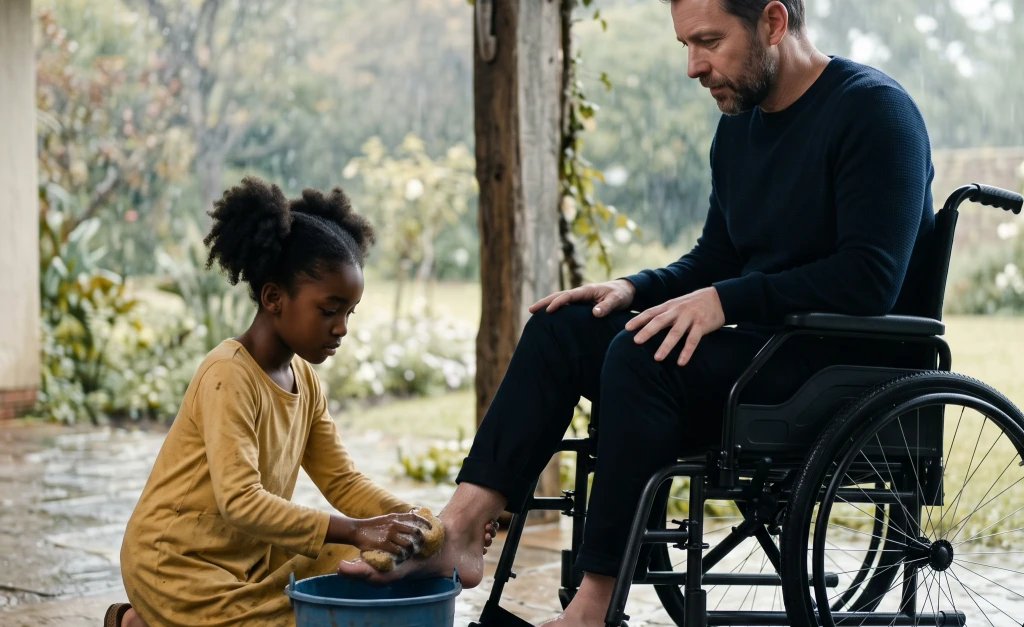
Marcus appeared twenty yards behind her, moving quickly without running. Ethan touched the speaker.
“Don’t grab her.”
“I wasn’t planning to.”
“You were planning something.”
“That’s my job.”
The girl reached the covered terrace and set the bucket beside Ethan’s wheelchair. A dented thermos knocked against one side. A folded white towel and the corner of a black notebook showed through a clear grocery bag tucked above it.
She looked at Ethan, then at Marcus. “Am I arrested?”
“Trespassing isn’t usually how guests arrive,” Marcus said. He was a broad-shouldered Black man with an old Marine Corps habit of checking hands before faces, but his voice softened when he spoke to her. “What’s your name?”
“Maya Brooks.”
“How old are you, Maya Brooks?”
“Eleven.”
“Who knows you’re here?”
That took half a second too long. “I know I’m here.”
Marcus glanced at Ethan. The girl’s answer had established two things: she was quick, and some adult was already going to be furious.
Ethan should have let Marcus take her to the gate and call the police or a guardian. In the nearly three years since a chartered helicopter had dropped into a stand of mesquite outside Waco, strangers had mailed him prayer cloths, magnets, powdered roots, electrical devices, and one vial supposedly containing water from the Jordan River. His family office maintained a file called Medical Solicitations because Fraud had sounded too accusatory to the lawyers.
Then Maya reached into the bucket and removed a photograph. It showed a much younger Ethan on his knees beneath a folding table, a screwdriver between his teeth and a nest of gray computer cables around his shoulders. Behind him stood a woman in blue scrubs, laughing with one hand over her mouth. The room had cinder-block walls painted the color of butter and a hand-lettered sign that read CEDAR STREET COMPUTER ROOM.
Ethan knew the photograph before he remembered the day. He had been twenty-eight, still installing his own servers because he could not afford employees. A storm had flooded the basement of a South Dallas church, ruining the computers used for evening classes. He had gone there to donate three replacements and stayed until two in the morning rewiring the room.
“Where did you get this?”
“My grandma kept it.” Maya held the picture by its dry edges. “That’s her behind you. I found it in her notebook last week.”
The woman’s name returned slowly. Ruth. She had brought him bad coffee in a foam cup and refused to let him leave until every machine could print.
“Ruth Brooks?”
Maya’s chin lifted. “You do remember.”
“I remember that room.”
“Not the same thing.”
Marcus covered a cough with his fist. Ethan gave him a look, but the girl was right. He remembered wires, water damage, and a deadline he had set himself. Ruth had survived in the margins of the memory until now.
“Your grandmother sent you?” Ethan asked.
Maya rubbed her thumb along the photograph’s white border. “She died in April.”
The rain struck the copper gutter above them with sudden force. Ethan knew the proper response—he was sorry—but the words had been said to him so often after the crash that they felt manufactured. Maya saved him from choosing among them.
“She told me if I ever saw you sitting down for good, I had to bring you the picture.”
His hand tightened on the wheel rim. “I use a wheelchair. I’m not ‘sitting down for good.’”
“That’s not how she meant it.”
“You don’t know how she meant it.”
“I was there when she said it.” Maya’s voice stayed level, but one clear bead clicked against the other beneath her hood. “She saw you on TV after the crash. You looked mad at everybody for still being alive.”
Marcus looked toward the lawn. Ethan felt the familiar heat climb from his collar. Board members had feared him before the accident; afterward, they spoke gently and watched for signs that pain had made him unstable. His son measured every silence. His staff had learned to leave a room without appearing to flee.
This child had crossed a wall to insult him under his own roof.
“Call whoever is responsible for her,” Ethan told Marcus.
Maya caught the photograph against her coat before the wind could bend it. “I came to wash your feet.”
Ethan stared at her.
She pointed to the bucket. “Then you’ll walk.”
The laugh escaped him before he could prevent it. It was not kind. Maya’s face did not crumple, which somehow made the sound worse.
“Water,” Ethan said. “That’s what all the specialists missed?”
“I didn’t say the water would do it.”
“You just said—”
“Grandma said you’d argue about the wrong part.”
Marcus turned away completely now, one hand at his mouth.
Ethan’s chair hummed as he moved closer. “Your grandmother knew about my injury?”
Maya looked down at the bucket. “She knew your left foot was a liar.”
That ended Marcus’s amusement. Ethan heard the fountain beyond the rain and, beneath it, the faint machinery of the pool pump. His left foot lay inside a custom black shoe on the chair’s footplate, as still as the right. He had not moved either one deliberately since the crash.
“Explain that.”
“I can show you.”
Every sensible instinct told him to stop. Instead, he asked Marcus to have Margaret bring a bath thermometer and to call the girl’s guardian before doing anything else. Marcus’s eyebrows rose, but he obeyed.
The guardian turned out to be a great-aunt named Evelyn Brooks, whose number Maya recited from memory. Marcus spoke to her beyond the terrace doors. Even through the glass, Ethan could hear the woman’s alarm sharpen into anger. Maya studied her wet sneakers.
“You lied to her,” Ethan said.
“I said I was going to the library. I went there first.”
“To find my address?”
“I used the county property records,” Maya said. “The librarian thought it was civics homework.”
“That distinction won’t help you.”
Maya looked past him at the house. “It usually helps you.”
He almost asked what that meant. Margaret Dawson arrived with the thermometer, two clean towels, and the expression she reserved for events that had not been included in the household schedule. At sixty-eight, she ran Caldwell House with quiet authority and had long ago stopped pretending Ethan’s money made all his decisions intelligent.
“Lukewarm,” she told Maya after testing the water. “And five minutes. Reduced sensation makes burns easy.”
Maya nodded. “Grandma checked with the inside of her wrist.”
“Your wrist is not a thermometer.” Margaret placed the instrument on the flagstone. “Today, use both.”
Ethan expected Maya to object. She simply removed the thermos and added a little warm water to the bucket until Margaret approved. Then she rolled up the cuffs of her coat and knelt.
Her hands were narrow, the nails cut short. She unlaced his left shoe without the brisk efficiency of a therapist or the elaborate care of someone afraid to hurt him. She treated the task as ordinary. That was the first thing about it that unsettled him.
The second was the smell. A sprig of rosemary floated against the blue plastic, releasing a scent he associated with Ruth’s terrible coffee and the church basement after the flood. Maya lowered his foot into the water with both hands.
He felt pressure at his ankle. He always felt some pressure, a remote knowledge that something had touched him. The water itself seemed absent.
“Anything?” Maya asked.
“No.”
She did not promise, pray, or perform. She worked a washcloth between his toes, frowning at the task. Rain blew beneath the terrace roof and freckled the dry flagstones around them.
“Grandma did this at the hospital,” Maya said.
“She was a nurse?”
“Patient-care tech. Nights. She said rich people get the same paper socks as everybody else.”
Ethan looked down at her. “Which hospital?”
Before Maya could answer, a cold drop fell from the end of her wet braid and struck the inside of his left heel.
“Cold,” he snapped.
Maya stopped moving.
Ethan held his breath. The sensation was gone, if it had been sensation at all. He could see the drop making a clean track through the water on his skin. Perhaps he had seen it first. Perhaps his body had supplied what his eyes expected.
Maya lifted the foot just above the water, supporting his heel. “Close your eyes.”
“You’re not conducting an examination.”
“Then don’t call it one.”
Margaret opened her mouth, but Ethan shut his eyes.
Maya touched the warm cloth to his ankle. Nothing. She waited, then pressed something cooler against the outer edge of his heel.
“Cold,” he said.
When he opened his eyes, Maya was holding the metal probe of the thermometer against his skin. His toes had curled slightly—not a purposeful movement, perhaps only a reflex, but they were no longer arranged exactly as they had been.
The terrace had become very quiet. Maya dried his foot and reached for the black notebook. Its cover was soft with use, the elastic band replaced by a loop of red thread. She found a page marked with the old photograph and placed it on Ethan’s lap.
Most of Ruth’s handwriting was too small to read without his glasses. One line had been printed twice, firmly enough to score the paper beneath it; beside the note was a date from the second week after his crash.
LEFT HEEL—IDENTIFIED COOL CLOTH WITH EYES CLOSED. REPEAT WHEN FULLY AWAKE. Ethan looked at Maya. “How was Ruth Brooks in my hospital room?”
To read the rest of the story – CLICK the NEXT button 👇👇👇