


The first thing Mara Bennett heard through the door of Room 1214 was her sister laughing. Detective Elena Brooks stood beside her in the Buckhead hotel corridor, one hand resting near the badge clipped to her belt. Mara still held her bouquet. A strip of red-and-gold cloth from her grandmother’s sewing box was wound around the stems, and one loose thread kept catching against the beadwork of her wedding dress.
“You don’t have to open it,” Brooks said.
Three months earlier, $94,000 from Mara’s composition fellowship had vanished into an account belonging to Bennett Fleet Services. Her fiancé, Travis Cole, had blamed a bank error. Her father had called it a temporary transfer. Celeste had told her that artists should be grateful when practical people handled their money.
Then Brooks had shown Mara the forged authorization bearing her electronic signature.
That morning, a charge from the wedding account had placed Travis in the hotel suite booked under Celeste’s name. The financial-crimes unit already had warrants for their devices. Mara had asked to come because some stubborn part of her still wanted an explanation that did not require her to destroy the day.
She slid the key card into the lock.
Travis was pulling on his shirt when the door opened. Celeste stood near the bed in a hotel robe, holding a champagne glass with Mara’s lipstick shade on the rim.
“Mara.” Travis’s hands stopped at the third button. “This isn’t what you think.”
Celeste set down the glass. Her face changed more slowly, the way it always had when she needed time to choose between tears and contempt.
Detective Brooks entered behind Mara with two other officers.
“Travis Cole,” she said, “step away from the nightstand.”
“You brought police to your own wedding?” Celeste asked.
“They aren’t here because you slept with him.”
Mara was surprised by how steady her voice sounded. She looked at Travis, but he was watching the officer lift his phone into an evidence bag.
“They’re here because both of you used my fellowship account to cover Dad’s loan, then moved the rest through your consulting company.”
“It was going back,” Travis said. “Warren needed thirty days. That’s all.”
“Eleven months isn’t thirty days.”
Celeste’s mouth tightened. “Do you have any idea how many people depend on Dad’s company?”
“I know exactly how many people you used as an excuse.”
The ballroom was already filling when Mara came downstairs. Her mother saw the officers first. Denise Bennett crossed the marble foyer so quickly that the pearls at her throat struck one another.
“What have you done?”
“Ask Celeste.”
Warren Bennett emerged from the ballroom with two clients behind him. He had built his company from three delivery vans and still carried himself as if every room contained someone deciding whether to extend his credit.
Brooks intercepted him before he reached Mara. “Mr. Bennett, we need to speak privately.”
“There is nothing private left.” His gaze moved from the officers to the guests raising their phones. “My daughter made sure of that.”
Travis was escorted through the lobby. Celeste followed with her coat closed over the hotel robe, weeping now that there was an audience.
“Mara,” her mother whispered, “you could have waited until Monday.”
“Today I was supposed to marry the man who stole from me.”
“And Monday seventy-three employees were supposed to be paid.”
Warren’s voice carried beyond them. The lobby quieted in spreading circles.
“You think composing music makes you exempt from ordinary responsibility,” he said. “That company fed you.”
“Grandma fed me. You left me with her for eleven years.”
“We brought you back.”
“When my fellowship check came.”
Denise flinched, but Warren did not. He looked toward the ballroom, where the florist had built an arch around the name BENNETT as if there were still something to celebrate beneath it.
“If you walk out now, don’t come back asking this family to repair what you broke.”
Mara pulled Travis’s ring from her finger. “I’m not the one who broke it.”
“You called the police on your father’s business.”
“I reported money stolen in my name.”
“Then keep your name,” Warren said. “It is all you leave here with.”
Her mother reached for her, stopped, and lowered her hand. Celeste watched from beside the elevators, her face wet and vindicated.
“Who’s going to want you now?” she asked. “Everybody in Atlanta just watched you arrest your own wedding.”
Mara walked past her before anger could turn into something Celeste could use.
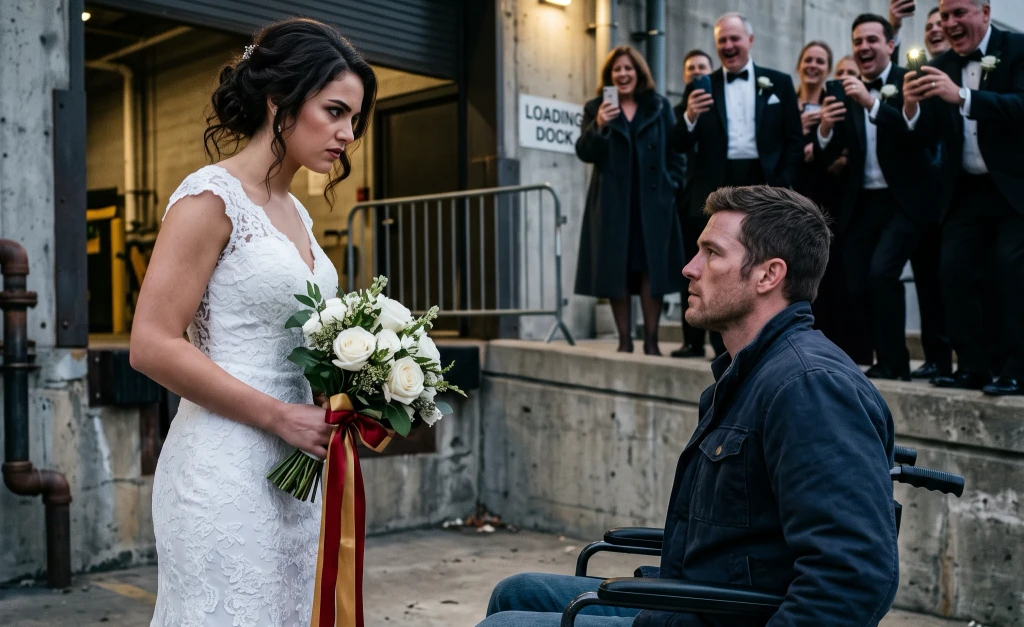
The hotel’s front drive was clogged with arriving guests and camera phones. Mara escaped through the side doors beside the accessible entrance, where delivery vans idled under a concrete awning.
A man in a wheelchair waited near the curb.
She had seen him three days earlier when a florist blocked the ramp with boxes. Mara had made the crew move every arrangement before continuing her rehearsal. He had thanked her in a low, dry voice and returned to the book in his lap.
Now the book was closed. His chair was matte black, built close to his body, and a pale scar crossed the back of his right hand. He had watched her leave the hotel without looking away.
Behind her, several guests spilled through the doors. Someone was still recording. Celeste came out last, wrapped in a bridesmaid’s coat.
“There,” she called. “Maybe the man by the loading dock will take you.”
A few people laughed.
The man’s expression did not change. “Your ride is waiting, Celeste.”
The authority in his voice made her glance toward the black sedan at the curb as if he might somehow own it. Then she laughed again, less certainly, and let Travis’s cousin lead her away.
Mara looked down at the stranger.
“You remember my name.”
“I heard it often enough upstairs.”
“You watched all of that?”
“I watched you walk in wearing one future and come out carrying what was left of it.”
She should have resented the observation. Instead, she noticed that he had not called her brave, ruined, or foolish. He had simply seen what happened.
“What’s your name?”
“Jonah.”
“Jonah what?”
“Mercer.”
The name belonged to one of the oldest fortunes in Georgia. Mercer Meridian controlled freight terminals, warehouses, construction companies, and half the contracts her father boasted about at dinner. But this Jonah Mercer sat alone beside a service entrance in a plain jacket with rain stippling the shoulders.
“How closely are you related to those Mercers?”
“Close enough to disappoint them.”
Mara heard the laughter behind her again. Something reckless rose inside her—not courage exactly, but the need to make one decision no Bennett could revise.
“Would you marry me?”
The phones lifted higher.
Jonah looked at her for a long moment. “Not for their cameras.”
“I’m not asking the cameras.”
“You’re wearing a wedding dress meant for another man.”
“I know what I’m wearing.”
“And you don’t know me.”
“No. But you looked at me today the way nobody in that ballroom did.”
“That is not enough for a marriage.”
“It’s more than I had an hour ago.”
He glanced at the red-and-gold ribbon around her bouquet. His scarred hand tightened on the push rim.
“If you still want to ask me tomorrow,” he said, “come to the Fulton County courthouse at nine. No dress. No audience. No one to punish.”
“And if I come?”
“I’ll answer you.”
Reverend Tasha Hill, who had been waiting to perform Mara’s wedding, drove her home that night. Mara slept badly on the minister’s sofa, woke before dawn, and borrowed her laptop.
A search for Jonah Mercer produced a six-year-old report about the crash of “Jonah E. Mercer, a member of the company’s founding family.” Older business articles called him J. Ellis Mercer and showed a clean-shaven man standing beside Grant Mercer at warehouse openings. The photographs were grainy, and the younger man’s unscarred face bore little resemblance to Jonah’s now.
The current company website listed no individual executive chairman, only an office represented by legal counsel and senior management. Recent articles described Mercer Meridian’s chairman as reclusive and did not name him.
At the courthouse, Mara showed Jonah one of the old photographs.
“That was you.”
“Yes.”
“You worked for Mercer Meridian.”
“Before the crash.”
“And now?”
“I vote a family trust and receive its distributions. My public role ended six years ago.”
The answer was precise enough to sound complete.
They spent the rest of the morning answering questions neither had asked the people they had intended to marry. Jonah was thirty-seven. He had no children or spouse. The crash had damaged his spinal cord, and he expected no one to become his nurse.
Mara was twenty-nine. She had twelve hundred dollars in an account her family could not reach, a pending fraud case, and no certainty that the music carrying her name would remain hers. She admitted that part of her proposal had been meant to wound the people who laughed.
“Anger wears off,” Jonah said.
“I hope so.”
“What happens to us when it does?”
“Then I learn who I married.”
He studied her face as carefully as he had the day before. “Ask me again.”
“Will you marry me, Jonah Mercer?”
“Yes.”
Reverend Hill met them that afternoon in the hotel’s small garden, far from the ballroom being dismantled upstairs. Detective Brooks came as Mara’s witness. A bellman and two banquet servers stood under the bare wedding arch because they had seen enough cruelty the day before and wanted to see what followed it.
Jonah’s voice caught once during the vows. Mara’s did not.
Reverend Hill had just pronounced them married when a woman in a cream suit entered the garden. She was in her sixties, silver-haired and straight-backed, and the hotel manager followed her with the frightened expression of a man escorting weather.
She stopped in front of Jonah. “Tell me,” she said, “that you did not just marry a Bennett…”
To read the rest of the story – CLICK the NEXT button 👇👇👇