


The bull stood alone behind the sale barn’s quarantine panels, his red-brown hide disappearing beneath clusters of gray ticks. They crowded the folds behind his ears, clung to his dewlap, and packed the tender skin beneath his tail until he looked as if someone had buttoned a second, diseased hide over the first. Emilio Garza had seen thin cattle, injured cattle, and cattle mean enough to attack a steel gate. He had never seen an animal endure so much without making a sound.
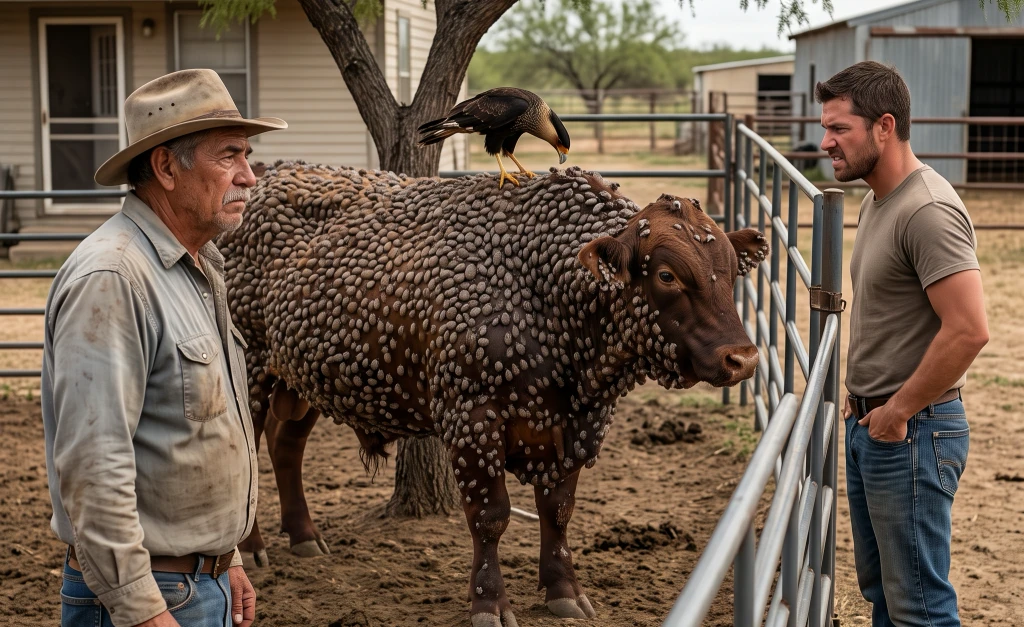
“Lot Twenty-Three has been withdrawn from the regular ring,” the auctioneer announced. “Four-year-old Beefmaster bull. Selling privately, subject to veterinary movement instructions. Buyer assumes all treatment costs.”
Most of the men along the rail stepped back.
Blake Hadley, a breeder from the next county, studied the bull and shook his head. “That isn’t livestock. That’s a veterinary bill with horns.”
A few men laughed. Emilio’s son did not.
David stood beside him with both hands hooked into the back pockets of his jeans. At thirty-four, he had his mother’s patient eyes and Emilio’s habit of tightening his jaw before saying something unwelcome.
“Don’t,” he said.
Emilio kept watching the bull. Beneath the parasites and the dull coat, the animal had a wide chest, sound legs, and the heavy bone Emilio’s herd needed. When a fly touched the corner of his eye, he flicked it away. There was still some fight in him.
“We said no unplanned purchases,” David reminded him.
“We said no foolish ones.”
“This one manages to be both.”
The seller wanted twelve hundred dollars. Emilio offered one thousand and signed before David could walk away.
The market veterinarian had examined the bull and taken tick samples. She authorized direct transport to Emilio’s isolation pen outside Pettus, with no contact with the herd and a follow-up examination as soon as their own veterinarian could get there.
Emilio called Dr. Rosa Castillo from the sale barn. She was handling a calving emergency north of Beeville, but she gave him monitoring instructions and promised to come when she was clear.
David watched him load the bull into the trailer.
“That thousand was for the south-well pump.”
“I know where our money goes.”
“That’s the problem. You still call it our money right before you spend it by yourself.”
Emilio secured the gate and pulled twice on the chain. “The pump can wait another month.”
David looked through the slats at the bull. “Maybe he can’t.”
Blake crossed the gravel lot carrying a paper cup of coffee. “Garza, you put that animal anywhere near your cows, you’ll be treating the whole ranch.”
“He’s going into quarantine.”
“And then what?”
Emilio remembered another fence, another morning, and his grandfather’s brown hand pointing toward three dark birds walking along a cow’s spine.
“I’ll give the land a little time,” he said.
Blake laughed again, but David had already turned away.
The trip home took twenty-five minutes. Emilio drove slowly, avoiding the broken shoulder along FM 623. Every few miles he checked the trailer in his mirror and saw one red ear above the steel panel.
Linda was at the kitchen table when they arrived, entering feed receipts into a ledger. After thirty-eight years of marriage, she could measure trouble by the sound of Emilio’s truck. She came outside before he reached the porch.
The bull stepped unsteadily down the trailer ramp and entered the holding pen beneath a mesquite tree. Linda stopped at the fence.
“How much?”
“Linda—”
“How much did you pay for the animal wearing all the ticks in Bee County?”
“One thousand.”
She pressed her lips together and glanced toward David. He lifted both hands, refusing responsibility.
“The pump money,” she said.
“We’ll manage.”
“We always manage. That’s what you say when you’ve decided the rest of us will absorb whatever you chose.”
Emilio carried a water tub into the pen. The bull drank for nearly a minute without lifting his head. Emilio could see the pale skin around his eyes and the dry foam at the corners of his mouth.
Linda lowered her voice. “What did Rosa say?”
“She’ll come when she finishes. First light at the latest.”
“And until then?”
Emilio looked beyond the holding pen toward the south pasture. Two crested caracaras sat on separate utility poles, black caps bright against the afternoon sky. They had visited the ranch on and off for years, walking the pastures for insects and scraps after the cattle moved through.
“My grandfather used to watch those birds clean his cows,” he said.
Linda followed his gaze. “Your grandfather also knew when to call for help.”
“I called Rosa.”
The screen door shut behind her with enough force to rattle its spring.
David stayed by the fence while Emilio spread hay beneath the mesquite. The bull sniffed it but did not eat.
“You told me Granddad Agustín never used chemicals,” David said.
“He didn’t need to pour something over every animal every month.”
“That isn’t what I asked.”
Emilio straightened. “You think the only thing worth knowing comes with a label and a dosage chart.”
“No. I think you remember the part that lets you do what you already wanted.”
David walked toward the equipment shed, leaving Emilio alone with the bull.
As a boy, Emilio had spent summer mornings on the tailgate of his grandfather’s truck. Agustín Garza would pour coffee from a dented thermos and wait without speaking until the pasture woke.
One morning, three caracaras had descended among the cattle. One landed on a cow’s back and bent its pale hooked beak toward the hide. The cow stood quietly while the bird worked.
“Look before you interfere,” Agustín had told twelve-year-old Emilio. “The land sends help if you leave room for it.”
Through the years, Emilio had held on to those words and let the rest of that morning fade.
The bull finally took a mouthful of hay. Emilio rested his arms on the top rail.
A shadow crossed the pen.
One of the caracaras from the utility poles landed on the mesquite, dropped to a low branch, and watched the bull with its head tilted. The bird descended to the ground, walking with the deliberate stride that made caracaras look less like hawks than stern men inspecting a fence line.
It hopped onto the water tub, then onto the bull’s back.
The bull’s skin trembled, but he did not move away. The bird leaned toward his shoulder, tugged once, and lifted its head with an engorged tick in its beak.
“David,” Emilio called.
His son came out of the shed. Linda appeared behind the screen door.
The caracara pulled another tick from the bull’s hide. Emilio felt twelve years old again, sitting beside Agustín while morning light spread over the grass.
“You see?” he said.
Then the bull’s front knees folded.
The caracara lifted away as the animal struck the dirt. David ran to the gate but stopped outside the panels, watching the bull’s horns and the shallow movement of his ribs.
“Call Rosa now, Dad,” he shouted, “or get out of my way…”
To read the rest of the story – CLICK the NEXT button 👇👇👇