


By the time Nell Mercer raised bidder card 19, the men in the Caldwell Transfer Yard had already decided that her mistake belonged to them. She had driven five hours through cold rain to buy two wagon horses before the bank took her father’s farm. Instead, she stood beneath the leaking roof of the sale barn bidding eighty-four dollars on twenty-seven mine mules that no dealer wanted to touch.
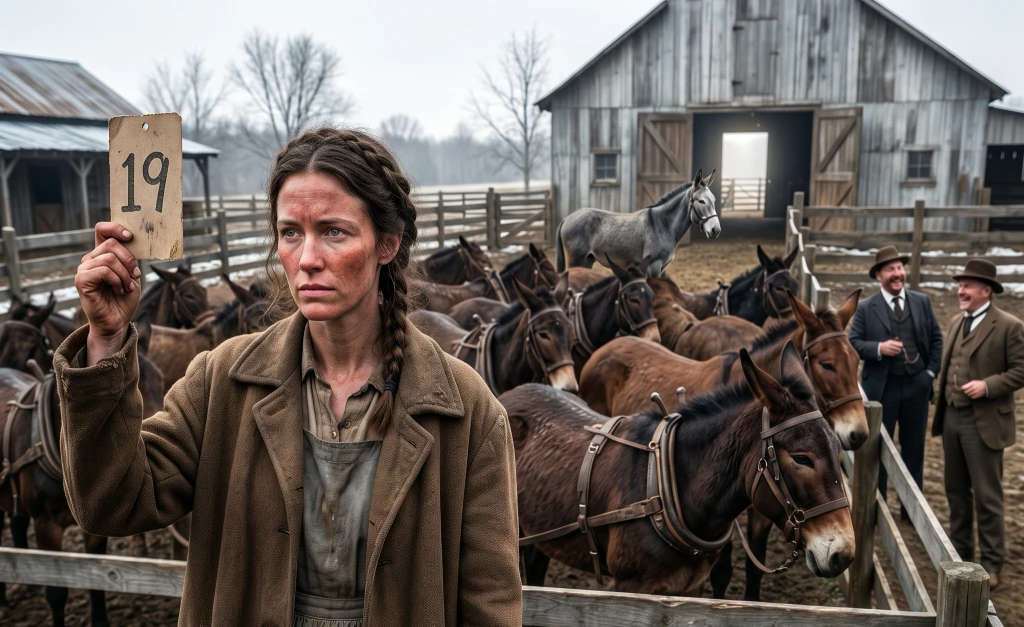
“The entire lot, Miss Mercer,” the auctioneer said. He held the gavel still, giving her one last chance to recover her senses. “No guarantee. Buyer removes them today.”
Nell kept the card up. From the third row, Ezra Rusk turned his hat in his hands. He owned the largest sawmill in the county and had bought hauling teams in this barn for twenty years. His laugh was not loud, but it gave everyone else permission.
“You came for horses,” he said.
“They sold higher than my money.”
“So you mean to feed twenty-seven animals with what it wouldn’t buy you two?”
That quieted some of the laughter. Ezra had known her father, and he understood the numbers well enough to make the question hurt.
Nell looked through the railings into the holding pen. The mules had belonged to Black Ridge Iron Company, whose lower shaft had closed after a roof fall in March. Lawyers had spent the summer arguing over pumps, track, timber, and unpaid wages while the animals stood in a field behind the mine. By September they were thin, scarred at the shoulder, and cheap enough to be purchased for hides.
Most of them crowded beneath a shallow shed. A small black molly stood alone in the rain, as if a roof had become more frightening than weather. At the back of the pen, a tall gray mule watched the open loading doors. He did not look at the whip on the rail or the men leaning over it. He looked past them, toward the strip of wet daylight outside.
Near the gate stood a narrow boy in an oversized canvas coat. He had been watching the gray too. When a yard hand lifted a length of chain, the boy’s shoulders rose before the metal even struck the post.
The gray mule flung up his head. Six animals crushed themselves into the far corner.
“Put that down,” the boy said.
The yard hand stared at him. “You giving orders now, Ward?”
“Not to you.” The boy’s voice nearly disappeared after the first three words. “To anybody who wants them through a gate.”
Nell knew his name then. Jesse Ward, sixteen, one of the boys who had opened ventilation doors and led teams underground at Black Ridge. His older brother, Cal, had died in the roof fall. Since the funeral, people said Jesse spoke only when silence would do more damage.
The auctioneer asked for eighty-six dollars. No one answered.
Ezra met Nell’s eyes. “They’ll hear that mine every time a chain drops behind them. You ready for that?”
It was the kindest thing he had said, and also his final warning. Nell’s father had used different words.
Samuel Mercer had never called an animal stubborn until he had checked its mouth, feet, harness, and the road behind it. When Nell was ten, she had watched him sit for an hour beside a mare that refused a bridge. The mare was not afraid of the creek. Two miles earlier, a rotten plank had broken beneath her.
Ask what she thinks comes next, Samuel had told Nell. Then prove her wrong without hurting her.
The bank note in Nell’s coat pocket was for three hundred forty dollars. It came due January 31. Without a team, she could not take the winter hauling work that had kept the Mercer place alive through lean years. Without hauling money, thirty-one acres of steep pasture, tired corn ground, and bare orchard would be advertised on the courthouse steps by spring.
Two sound horses would have solved one problem. The mules might become twenty-seven more.
Nell raised the card another inch. The gavel fell.
For several seconds no one moved. Then talk returned to the barn in small bursts, as if the room had been waiting to breathe until her future was properly ruined.
At the clerk’s window, Nell counted out eighty-four dollars from the money sewn into Samuel’s coat lining. She had seventy-six dollars left, no transport, and less than six hours of daylight.
Jesse waited outside the office.
“How many of them did you handle?” Nell asked.
“All, some days. Mostly the gray and the sorrel with the torn ear.”
“Will they follow you?”
He looked toward the pen. “That isn’t the same as trusting me.”
“I didn’t ask if they trusted you.”
His face closed. Nell heard herself too late. She had used the same hard tone men used when they wanted a boy’s labor without his judgment. “I’m sorry,” she said. “I need to get them home. I also need to know what I’m asking.”
Jesse studied her for a moment. “No narrow chutes. No chain behind them. Don’t let anybody hit the black one.”
“Did somebody?”
He pulled one sleeve down over his wrist. “That’s why I said it.”
By dusk, Nell had borrowed three freight wagons from a produce dealer who remembered Samuel repairing his barn roof after a storm. She hired Eli Boone and his grown son to drive two of them, bought oats and rope, and paid Jesse a dollar to come as far as the Mercer farm. The arrangement consumed nearly half her remaining cash.
Loading consumed everything else they possessed: patience, warmth, pride, and the good opinion of men with supper waiting at home.
The first ramp rattled under an empty bucket. The gray mule backed into the herd so violently that another animal went down. Yard hands crowded forward. Jesse stepped between them and the gate.
“Clear the lane,” Nell said.
“You’ll be here till Christmas,” one man told her.
“Then you should go home before it finds you here.”
She removed the loose bucket, wrapped the side chains in burlap, and laid Samuel’s coat over the lower boards of the ramp. Without it, the rain-polished planks looked like the timbered incline into a shaft. With it, they looked only unfamiliar.
Nell stood inside the wagon, well back from the opening. Jesse waited beside the rail, turned slightly away. No one pulled the gray’s halter because he wore none. No one drove him from behind.
For twenty minutes, the mule watched the coat darken in the rain. He stretched his neck once, drew back, and looked at the daylight visible through the wagon’s forward slats.
“He used to stop at the shaft mouth,” Jesse said quietly. “Every morning.”
“What made him go in?”
Jesse’s jaw worked. “Cal walked beside him.”
The gray placed one hoof on Samuel’s coat. The board creaked. Every muscle along his back locked, but nothing struck him and no chain closed behind him. Nell kept her hands at her sides.
After a long moment, he placed the second hoof down. Then he climbed into the wagon and turned toward the slatted daylight at the front.
The sorrel followed him. Four more came badly, stopping and scrambling, but they came. The black molly would not enter until every man had moved beyond the pen and Nell opened the little door at the front of the wagon so she could see a way out. She climbed in shaking, not from cold but from the effort of moving toward what she feared.
Jesse climbed up after her and fastened the gate without letting it slam.
“What did you call the gray in the mine?” Nell asked as they waited for the next wagon.
“Number Six on the company book. Cal called him Lantern when the bosses weren’t near.”
“Why?”
Jesse looked through the slats at the gray mule’s pale face. “He was always looking for one.”
The final wagon left the yard after two in the morning. Rain had thickened to sleet along the ridge. Nell drove the lead team; Eli Boone drove the second wagon, and his son took the third. Jesse rode beside Nell with his wet coat buttoned to the throat.
For the first mile, the lanterns showed only mud and the silver edges of mule ears above the sideboards. For the second, Nell could feel every dollar she had spent shifting behind her. At the third mile, the road narrowed above Laurel Fork and the second wagon’s left wheels slid into a rut.
Eli shouted. His horses lunged, the wagon slewed sideways, and a trace chain cracked against wood.
The mules inside began to hammer the boards.
Nell dropped the reins to Jesse and ran back. Eli was already at the wheel, pulling uselessly at the rim. The uphill wheels had sunk to their hubs. On the other side, the road fell steeply through laurel toward the unseen creek.
“Keep them in,” Eli said. “We’ll hitch both teams and drag her forward.”
Another chain struck the tailgate. The black molly reared. A sideboard bowed outward with a sound like a branch beginning to split.
Nell climbed into the wagon.
“Get out of there,” Eli shouted.
She crouched below the level of the animals’ shoulders. The gray’s eye showed white in the lantern glow. The black molly had wedged herself against the failing board, and every shove from the herd bent it farther over the drop.
Jesse appeared at the tailgate. He looked once at the mules, then down at the road.
“Nell,” he said. It was the first time he had used her name. “The bank under the rear wheel is washing away.” The wagon settled with a wet, wooden groan. Then the rear wheel slid six inches toward the dark and found nothing beneath it…
To read the rest of the story – CLICK the NEXT button 👇👇👇