


“Keep both hands on your side of the transfer gate, and don’t cross the yellow drain channel.”
Master-at-Arms First Class Dale Krieger spoke without looking at Nora Callahan. His attention stayed on the Doberman folded into the far corner of the run, all sharp hips and sleepless eyes. On the whiteboard beside the gate, FEED REFUSED had been written twice, the second time hard enough to dent the marker tip.
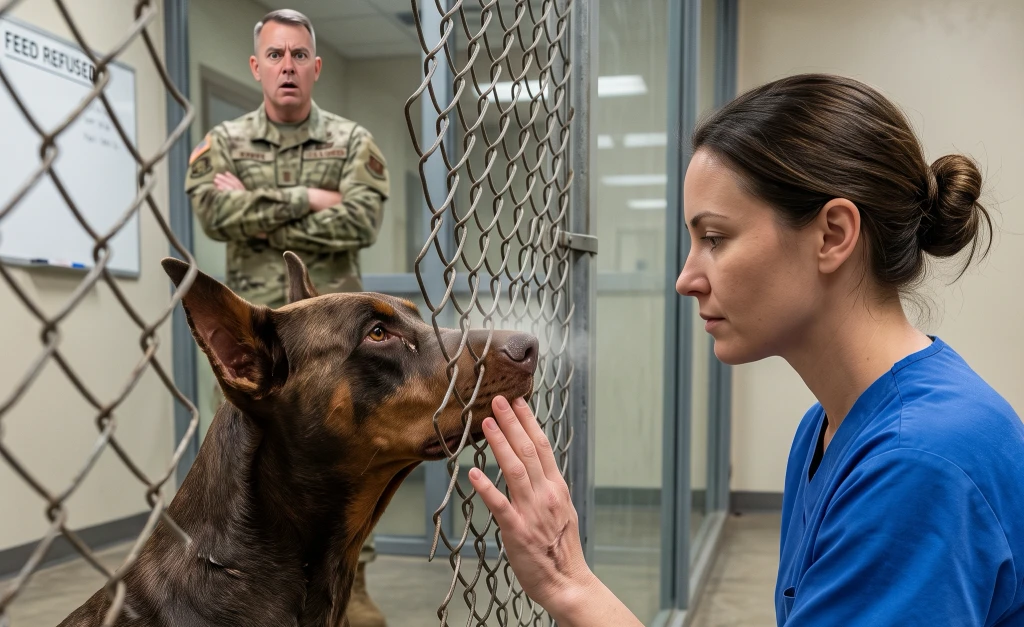
Nora stood inside the empty acclimation bay, an eight-foot concrete space secured between two chain-link gates. The Doberman remained behind the inner transfer panel; Krieger and Navy veterinarian Leila Shah watched from the corridor beyond the outer gate.
Nora’s cobalt scrubs were damp between the shoulder blades after twelve hours in surgical recovery. The hospital badge clipped to her pocket still carried a smear of adhesive from a patient’s dressing.
“I was told you wanted someone to sit with him.”
“Dr. Shah wanted it.” Krieger folded his arms. “I agreed to someone inside the empty bay, with a locked gate between her and the dog. I didn’t agree to touching, training, whispering, or whatever people think they can do after watching three videos online.”
Dr. Shah gave Nora an apologetic lift of one shoulder. She had seen Nora volunteer at the county shelter twice, both times with dogs the staff could not safely move between rooms. That was the experience she had mentioned when asking Nora to stop by.
The Doberman’s intake sheet identified him only as K417. Dr. Shah had removed his call name from the whiteboard after he began throwing himself against doors whenever anyone used it, apparently searching for the handler who was no longer there.
He had arrived eleven days earlier after an incident at a port facility farther up the Chesapeake. His handler was still in rehabilitation. Since the transfer, the dog had bitten through one catch pole, struck the kennel wall until his shoulder swelled, and stopped eating unless everyone left the building.
Now he watched Nora without lifting his head.
She noticed the notch in his left ear first.
Then the pale seam beneath his chin and the way he protected his right shoulder while keeping most of his weight over the back left leg. Three years earlier, in a training yard outside Front Royal, Virginia, a young Doberman with oversized feet had made the same shift whenever he wanted to approach but did not yet believe the space between him and a human was safe.
Nora’s fingers curled against her palms.
Krieger glanced at her. “Something wrong?”
“No.”
It was a practiced answer, smooth from fourteen months of use. Nothing was wrong when a tray clattered behind her and she had to unclench her jaw. Nothing was wrong when diesel fumes entered the hospital’s ambulance bay. Nothing was wrong when she walked the longer route to the employee lot because the shorter one passed this kennel block.
She lowered herself beside the yellow channel marking the closest point she was allowed to approach. Her knees objected after a full shift, but she settled with her forearms resting loosely across them and turned her face a few degrees away from the dog.
Krieger checked his watch. “Five minutes.”
Nora did not answer. She let her breathing lengthen, not theatrically and not for the dog at first. The fluorescent fixtures buzzed above the runs. Water clicked through an old pipe in the wall, and somewhere beyond the building a forklift gave two warning beeps.
The Doberman’s eyes moved toward the sound, then returned to her.
His panting remained quick and shallow. Nora breathed in through her nose and let the exhale take longer, the way she had once taught new handlers who believed steadiness began in the leash hand. The dog’s nostrils worked. His ears lifted by a fraction.
“He’s not going to come over,” Krieger said.
“He doesn’t have to.”
“That’s not why Dr. Shah called you.”
Nora looked at the concrete between her shoes. “Then she called the wrong person.”
Krieger shifted behind the outer gate, impatient enough that she could hear the fabric of his uniform move. Dr. Shah stopped him with a quiet, “Give her the five minutes.”
The dog raised his head.
Nora saw what the others had mistaken for indecision. He was mapping the run: inner panel, drain, human, exit. His left hind leg tightened beneath him. He released it, then tightened it again.
She remembered him at nine months old, refusing a patch of blue flooring because someone had dragged him across a similar surface before he came into the program. She had spent four afternoons sitting on that floor with a paperback she never managed to read. On the fifth, he had placed one paw over the threshold and looked offended by the lack of celebration.
The memory brought his name so close to her mouth that holding it back hurt.
She kept still.
The Doberman unfolded one joint at a time. He crossed half the run, stopped, and lowered his head until his nose almost touched the concrete. Krieger’s hand moved toward the panel control.
Nora lifted one finger without turning around.
To her surprise, he stopped.
The dog took another step. His breathing caught, and Nora’s body supplied an old sound before she could decide whether to make it—a low hum on the exhale, barely more than vibration. His eyes changed. Not softened, exactly. Focused.
“There you are,” she whispered.
He reached the transfer panel and stood with his narrow chest trembling. Nora kept her palms turned down on her knees.
For several seconds, neither of them moved. Then the Doberman placed his nose against the chain link and drew in the scent of her.
His breathing changed.
Dr. Shah stepped closer to Krieger. “Open the transfer panel.”
Krieger stared at her. “He hasn’t crossed it for anyone.”
“We aren’t entering his run. We’re giving him the choice to enter the bay.”
“He could redirect.”
“He could. Keep the outer gate locked.”
Krieger placed his hand on the control but looked at Nora before pressing it. “If I tell you to stand, you stand.”
Nora nodded.
The inner panel slid aside with a low mechanical scrape.
The Doberman flinched but did not retreat. He looked into the empty bay, tested the air, and stepped across the threshold.
Nora stayed behind the yellow channel.
He approached until his nose almost touched the center of her wrist. Heat traveled up Nora’s arm with the clean force of pain. She did not grab him or stroke his face. She let him smell the hospital soap, the powder inside her gloves, and whatever remained beneath those things after three years.
His nose moved to the faint rope scars across her palms.
The dog made a sound deep in his throat.
Nora closed her eyes once. “Easy, Ranger.”
His head snapped up.
Krieger’s boots scraped behind the gate, but the dog had already crossed the yellow channel. He pressed the top of his skull beneath Nora’s open hand and leaned until she had to brace herself. The body everyone had treated as dangerous shook against her knee.
Nora rested her palm between his ears. She could feel every ridge of his skull.
“Hey, old man,” she murmured. “You got too thin.”
Ranger pushed closer. His ribs moved rapidly at first, then slowed beneath her other hand. When Nora lengthened her next breath, he followed. The two of them stayed on the floor while the building settled around them.
Dr. Shah covered her mouth, then lowered her hand and quietly turned away.
Krieger did not. He watched Nora’s thumb find the small bare patch behind Ranger’s left ear without searching. He watched the dog allow her hand near the swollen shoulder he had protected from everyone else. Most of all, he watched Ranger close his eyes.
“He hasn’t slept in front of a person since he arrived,” Dr. Shah said.
Nora looked down before anyone could read her face. Ranger’s weight against her leg had become complete, the surrender of an exhausted animal who had finally stopped measuring the distance to the gate.
Krieger crouched outside the bay. His earlier irritation had narrowed into something more careful.
“You can’t stay there all night.”
“I know.”
“You work tomorrow?”
“At seven.”
“You should go home.”
Nora nodded, but her hand remained where it was.
When she finally moved, Ranger’s eyes opened. His muscles tightened before she had risen more than an inch, so she settled again and waited until his breathing steadied. Only then did she stand, slowly enough that he could follow every part of the motion.
He came with her to the outer gate.
Krieger opened it only far enough for Nora to step into the corridor, then secured it behind her. Ranger placed his nose against the chain link and held it there. She touched two fingers to the same spot from the other side.
“I’ll come back tomorrow,” she said.
The promise escaped before she could decide whether she was entitled to make it.
Ranger’s ears tilted forward. Behind Nora, the printer in Krieger’s office began feeding out a temporary access badge Dr. Shah had apparently authorized while they were sitting on the floor.
Krieger did not reach for it.
He was staring at Nora with the expression of a man who had discovered an unmarked door in a building he believed he knew.
“Dr. Shah removed his call name from the board and from the intake sheet you saw. None of us has used it since you arrived.”
Nora’s fingers remained against Ranger’s nose.
Krieger stepped between her and the corridor. “So tell me, Nurse Callahan. How did you know to call him Ranger…”
To read the rest of the story – CLICK the NEXT button 👇👇👇