


The largest of the three German shepherds did not bark when Caleb Mercer stopped in front of the transport crates. He sat behind the wire door and watched Caleb with one amber eye, the tip of his left ear folded slightly inward. The other two were less composed. A honey-colored female kept retreating to the back of her crate, while the smaller male paced from side to side and shoved his nose through every opening he could find.
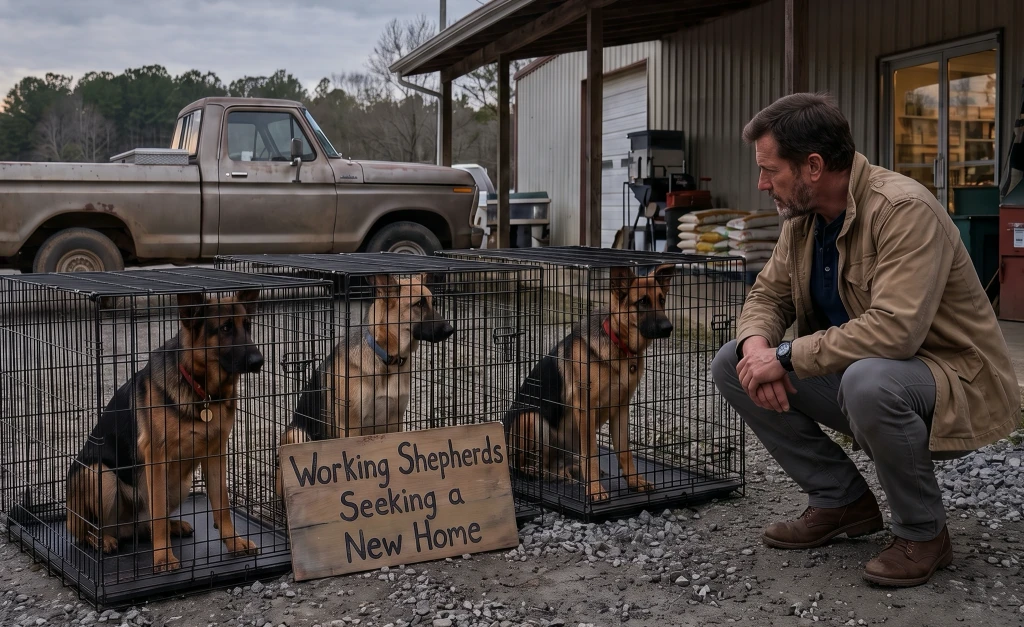
A hand-painted sign leaned against the wall of the feed store.
WORKING SHEPHERDS NEED HOMES
Caleb had stopped for coffee, not a dog. His pickup was already carrying everything he intended to take to Mercer Hill: tools, bedding, water, one duffel bag, and a wooden records box the probate attorney had handed him that morning.
The cabin he had inherited had stood empty for nearly eight years. Its roof leaked, the well had not been tested, and the nearest neighbor lived somewhere below the southern slope. A sensible man would have inspected the house before deciding he needed an animal.
Caleb had rarely been accused of arranging his life in the sensible order.
“You looking or buying?” a man asked.
He stood beneath the store awning with a hickory cane planted beside his right boot. White hair had been combed back by hand, and a heavy mustache concealed most of his mouth.
“Possibly one,” Caleb said.
The man looked at Caleb’s worn Navy jacket, then at the truck. “One what?”
“Dog.”
“Good. I was afraid you meant crate.”
His name was Walter Hayes. He was sixty-eight, scheduled for hip surgery in three weeks, and selling the farm where the dogs had been born. His sheep already had a buyer. The dogs did not.
“They’re fourteen months old,” Walter said. “Same litter. Basic commands, comfortable around equipment and livestock. They haven’t had enough structured herding work for me to call them trained.”
He opened a folder containing veterinary records, vaccination certificates, and notes written in square blue handwriting. Caleb read every page.
“You always study a dog like a used truck?” Walter asked.
“A truck can’t decide it hates me.”
“A German shepherd can. Usually with better reasons.”
Caleb crouched in front of the largest dog’s crate. Up close, he saw a broken black saddle across a copper-colored back and a pale ring around the dog’s right eye.
“Flint,” Walter said. “Thinks before he moves.”
Caleb rested his hands loosely on his knees. Flint leaned forward, drew in Caleb’s scent, then sat back without either cowering or challenging him.
Caleb had spent twenty-two years in the Navy, most of them in SEAL teams, and another decade trying to become the kind of man who could sleep through an upstairs neighbor crossing a floor. He understood restraint. He also understood the difference between stillness and ease.
Flint was not relaxed. He was managing himself.
“What do you need him for?” Walter asked.
“An isolated property. I may keep sheep eventually.”
“Eventually is the safest kind of sheep farming.”
Caleb glanced up.
“That was humor,” Walter explained. “It doesn’t always travel.”
The smaller male struck his crate door with one paw.
“Scout,” Walter said. “Speed first, judgment later.”
Scout had a bright amber coat, an uneven black mask, and a right ear whose tip folded forward. He stared at Caleb as though the two of them had been interrupted in the middle of an important conversation.
The female was Maple. She stayed several feet back, but her gaze followed Walter whenever he moved. A charcoal-colored saddle divided across her shoulders like a torn leaf.
Caleb approached her last. Maple lowered her head, not submissively but to make herself smaller. When he shifted his weight, she shifted hers.
“She been mistreated?” he asked.
“Never.”
“Something frightened her.”
“Plenty of things frighten a careful dog. Doesn’t mean a person put the fear there.”
Walter’s answer was protective rather than defensive. Caleb respected that.
He returned to Flint. One dog would be enough. One dog meant one food bill, one set of veterinary expenses, one animal to train while he repaired a house that might not survive the winter.
Numbers had always been easier than attachment. Numbers did not change because something looked at you.
“I’ll take Flint,” he said.
Walter nodded but did not appear relieved. He clipped a lead to Flint’s collar before opening the crate.
The shepherd stepped onto the wet concrete and stood beside Walter. Caleb let him smell the back of his hand. Flint’s nose touched his knuckles once.
“That’s all you get today,” Walter said. “Don’t take it personally.”
“I don’t.”
“You look like a man who takes everything personally and calls it caution.”
Caleb straightened. Walter turned toward the pickup.
Behind them came a metallic scrape.
Scout had forced one front paw beneath his crate door. His claws dragged across concrete as he reached toward Flint. Maple pressed her muzzle between the bars and made a low sound that barely qualified as a whine.
Flint stopped.
Walter gave the lead a gentle pull. The dog did not follow. His attention remained on the other two crates.
“They’ve been separated before?” Caleb asked.
“Only for examinations. Never longer than an hour.”
“You could have said that.”
“I could have told you they were inseparable and hoped the word cost you another two dogs. I wanted you to see what it meant.”
Scout stretched until his shoulder pressed against the bottom of the door. Maple did not make the sound again. She simply watched Flint with her face between the bars.
Caleb knew better than to turn their behavior into a human story. They were young dogs reacting to a disrupted routine, unfamiliar handling, and the removal of a littermate.
He also knew what it sounded like when fear became quiet because noise had failed.
A dry road rose in his memory, blurred by rotor wash. Men had been counted. An order had been given. Caleb had climbed aboard because that was what the living were required to do.
For years, he had told himself that survival depended on clean decisions: take what could be carried, leave what could not, and do not look back long enough to become useless.
Flint looked back.
The dog planted his feet and leaned toward the crates. His tail remained low. Beneath the thick fur along his shoulders, a tremor passed through him.
Caleb had chosen Flint because he seemed least likely to be afraid. The dog was shaking…
To read the rest of the story – CLICK the NEXT button 👇👇👇