


Ruby read the eviction notice before Lena could fold it small enough to hide in her pocket.
“Does seventy-two hours mean three sleeps?”
Lena looked down at her six-year-old daughter, who stood barefoot in the apartment doorway with an orange crayon in one hand. Behind her, half their belongings were already packed in black trash bags because they had run out of boxes.
“It means Mr. Haskins wants to talk to me again.”
“It says we have to leave.”
Ruby had learned to read early and literally. Both qualities made lying to her difficult, but Lena had been doing it in small installments for months.
“We’re not sleeping outside,” she said. “That part is true.”
On the kitchen table lay eleven dollars and thirty-six cents, a shutoff warning, and a drawing of a white house with flowers crowding both sides of the walk. Ruby had colored every window orange. She said yellow disappeared against the paper.
Lena’s phone rang while she was counting the quarters for the third time.
The woman from Meridian Home Staffing spoke quickly, as if she feared Lena might interrupt before hearing the important part. An overnight personal-care placement had opened in Sandy Springs. Private residence. Room and board included. The client was eighty-two, mentally sharp, physically frail, and recovering from another hospitalization for advanced heart failure.
“He’s dismissed nine aides since January,” the recruiter said. “Two walked out before their first shift ended.”
“What does he do?”
“He insults them. Refuses care. Complains about noise, food, light, breathing—whatever comes to mind. His daughter manages the contract, and she insists on strict documentation.”
Lena looked at the notice in her hand.
“When do they need someone?”
“Tonight.”
Ruby was sitting at the table again, drawing a second person in the doorway of the orange-windowed house.
“Is there a staff apartment?” Lena asked.
“A room and private bath.”
“Could a child stay there?”
There was a silence long enough to tell Lena what the contract said before the recruiter answered.
“No children on the property. Not even visitors without family approval.”
Lena closed her eyes. She had no relative nearby who could take Ruby overnight and no friend able to help for more than a day or two. The subsidized after-school program had a waiting list. Every job she found required child care, and every child-care option required a job.
“I have overnight care arranged,” she said.
Ruby glanced up from the table.
The lie left Lena’s mouth quietly. That did not make it smaller.
They arrived at Vale House shortly before four with two duffel bags, Ruby’s backpack, and the flowered dress she had insisted on wearing over purple leggings. The dress had fit at the beginning of kindergarten. Now the waist sat high against her ribs.
Beyond the iron gate, the driveway curved through neglected boxwoods toward a limestone house with more windows than Lena could count. Nearly every curtain was closed. A dry fountain stood in the circular drive, its basin stained green, and the rose canes along the terrace had been left to knot around themselves.
Ruby pressed her face to the car window.
“It’s bigger than my drawing.”
“Remember what we discussed. You stay with me until the person picking you up comes.”
“What person?”
“Ruby.”
“I know. The pretend person.”
Joan Mercer, the household manager, met them beneath the portico. She was a spare woman in her early sixties, dressed in black slacks and a cardigan with two keys clipped inside one pocket. She looked first at Lena, then at the duffel bags, and finally at Ruby.
“The agency said one person.”
“My child-care arrangement fell through for a few hours. Someone will collect her before dinner.”
Joan’s gaze rested on Lena’s face. She had likely heard better lies in this house.
“She may wait in the downstairs staff room until six. At six, I call Ms. Vale.”
“Thank you.”
“Don’t thank me yet. Mr. Vale notices weakness the way some men notice perfume.”
Joan led them through a foyer paneled in dark wood. Pale rectangles marked the walls where pictures had once hung. Even the long console table was bare except for a silver bowl containing three unopened envelopes.
“Where are all the people?” Ruby whispered.
“Working,” Joan said.
“I mean the people in the pictures.”
Joan did not answer.
Everett Vale’s bedroom was at the far end of the second floor. Before opening the door, Joan lowered her voice.
“He can transfer with assistance, but he uses the wheelchair most of the day. Record every medication reminder, every refusal, his morning weight, fluid intake, breathing complaints, and swelling. You do not change a dose. You call the nurse.”
“I know the protocol.”
“He’ll tell you his daughter is trying to imprison him. She isn’t. He’ll tell you his doctors are idiots. They aren’t. He’ll tell you he owns you because he pays the agency. He doesn’t.”
Joan studied her for another moment.
“And if you’re planning to keep that little girl hidden here, abandon the plan now.”
Lena felt heat climb her neck.
“I said someone was coming.”
“Yes. You did.”
The room beyond the door smelled faintly of cedar, coffee, and the medicinal sweetness of oxygen tubing. Everett Vale sat beside the bed in a high-backed wheelchair, wearing a white shirt buttoned to the throat. His body had narrowed inside it, but his face remained imposing: deep-set gray eyes, a straight nose, and silver hair combed carefully back.
Financial magazines still printed that face when they wrote about the hotels and office towers he had sold. Some estimated his fortune above a billion dollars. At that moment, he was rubbing his thumb over a thin gold ring that looked cheaper than Lena’s watch.
“You’re late,” he said.
“My shift begins at four.”
“It’s four-oh-two.”
“The clock in the hall says four.”
“The clock in the hall is slow.”
Joan left without defending either of them.
Lena set her bag beside the dresser. On the nightstand stood a small photograph in a tarnished silver frame, turned facedown.
“I’m Lena Carter. I’ll be your overnight aide.”
“I know what you are.”
He examined the hem of her navy scrubs, then her shoes.
“The agency sent someone who came directly from an eviction.”
Lena’s hand tightened around the strap of her bag.
Everett pointed toward her left shoe. A strip of orange paper protruded beneath the sole where Ruby had tried to cover a hole in the lining with tape from her craft box.
“You’re less mysterious than you think,” he said.
“I’m not here to be mysterious.”
“Good. I dislike mysteries almost as much as I dislike cheerful people. Leave the curtains alone. Don’t move the photograph. Don’t call me Mr. Everett, Grandpa, sweetheart, or any other name intended to make infirmity adorable.”
“Mr. Vale will work.”
“It has for eighty-two years.”
Lena checked the care binder, compared the medication list with the labeled packets, and measured the swelling around his ankles as the instructions required. He objected to each task but allowed it.
When she reminded him about his five o’clock pills, he swallowed them with water and opened his mouth afterward in exaggerated obedience.
“Do I receive a sticker?”
“Only if you go a full hour without firing me.”
“That seems manipulative.”
“It’s a difficult sticker to earn.”
One corner of his mouth moved before he stopped it.
Downstairs, Lena found Ruby at a small desk in the staff room, surrounded by crayons. Joan stood in the doorway.
“It’s five-twenty,” Joan said.
“I’m working on it.”
“There is nothing to work on. Either someone collects her, or you both leave.”
Joan was called away by a grocery delivery. Lena crouched in front of Ruby and took both her hands.
“I need fifteen minutes. Stay in this room. Do not explore. Do not go upstairs.”
“Are we leaving?”
“Not yet.”
“That means maybe.”
“It means stay here.”
Lena went to the laundry room and called every person she could think of. Her former coworker was on a double shift. A neighbor agreed to take Ruby for one night, then called back to say her landlord prohibited guests. The family shelter had no beds available until Monday.
When Lena returned to the staff room, the orange crayon lay on the desk.
Ruby was gone.
Lena checked the kitchen, the breakfast room, and the half bath beneath the stairs. Then she heard a voice drifting from the second floor.
“Are you hiding from the daytime?”
Everett answered, “I’m trying to.”
Lena stopped outside his partly open door.
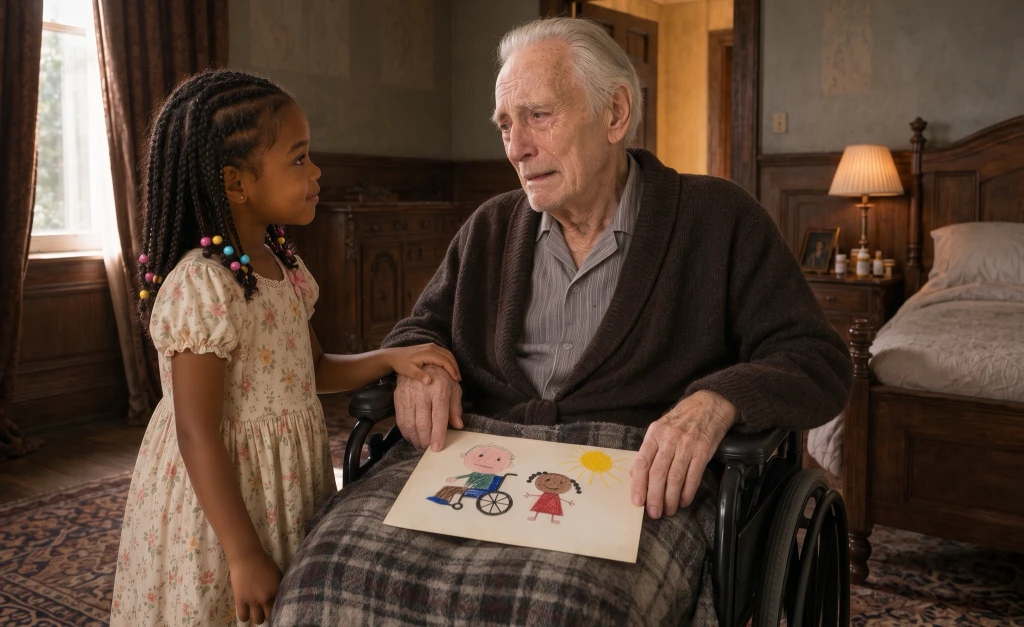
Ruby sat cross-legged on the rug with her paper balanced on a hardcover book. Everett watched from his wheelchair, an expression of irritated fascination on his face.
“You shouldn’t be here,” he said.
“I know.”
“Then why are you still here?”
“I got lost on purpose.”
“That isn’t how getting lost works.”
“It worked for me.”
She returned to her drawing. Everett looked toward the door but did not yet see Lena.
“What are those?” he asked.
“Windows.”
“They’re floating.”
“They’re upstairs windows.”
“Upstairs windows still require a building around them.”
“I haven’t done that part.”
Ruby selected a brown crayon, rejected it, and reached for the orange one that was not there.
“Can I use your pen?”
“No.”
“Do you have crayons?”
“Why would I have crayons?”
“You have everything else.”
Everett looked around the dark room as though evaluating the truth of that statement. Ruby noticed the facedown frame.
“Who’s in the picture?”
“No one you know.”
“Do you know them?”
“Yes.”
“Then it’s somebody.”
Everett’s fingers closed over the ring.
“You ask too many questions.”
“My teacher says questions make your brain bigger.”
“Your teacher has never met a six-year-old determined to test the theory.”
Ruby held up the picture. It showed the room, Everett’s chair, and a large orange rectangle where the closed window should have been.
“That is not what this room looks like,” he said.
“It could.”
She placed the paper on his lap. Then she found her orange crayon in the pocket of her dress and offered it to him.
“You forgot the line at the bottom,” Everett said.
“What line?”
“Otherwise your window falls into the garden.”
His hand trembled when he took the crayon. He steadied his wrist against the book and drew one careful line beneath the window.
Ruby leaned closer.
“You know how to draw.”
“I know how buildings stay up.”
Lena stepped into the room.
Ruby’s shoulders rose toward her ears.
“I told you to stay downstairs.”
“I know.”
“You deliberately disobeyed me.”
“I got lost on purpose.”
“That isn’t better.”
Everett still held the orange crayon. Lena reached for Ruby’s hand, but he spoke before they could leave.
“How long has she been living in my house?”
“She hasn’t.”
“Your luggage says otherwise. Joan’s expression says otherwise. And you looked for that child like a woman who had no second place to look.”
Lena could not make another lie arrive.
“Since this afternoon.”
“Does the agency know?”
“No.”
“Does my daughter?”
“No.”
He turned the crayon between his fingers, leaving a small orange mark on his thumb.
“You entered my home under a false statement and brought in the one thing the contract expressly forbids.” He looked at Ruby’s drawing on his lap, then back at Lena. “Give me one reason I shouldn’t call the agency now…”
To read the rest of the story – CLICK the NEXT button 👇👇👇