


The cry reached Nora Bennett between two gusts, so thin she first mistook it for a branch rubbing against another branch. Then it came again from the timber below Willow Draw—one high, raw note that stopped before the wind could carry it away.
Her phone buzzed inside her coat. RACHEL, the screen said, for the third time in twenty minutes. Nora pressed the side button without answering and pushed the phone back into her pocket.
“I heard the forecast,” she said to nobody. “I can see the sky.”
The sky had dropped low enough to snag on the firs. Snow was already needling across the upper meadow, though the weather service had said the hard part of the storm would not reach this corner of western Montana until evening. Nora had come up to drain the spring box before the temperature plunged. It was a chore Cal had done every September until the stroke took him eighteen months ago, and one she had promised Rachel she would leave alone today.
At seventy, Nora could drain a spring box, split kindling, and drive the tractor if she climbed up from the right side. She also knew what wet snow could do to a replaced knee on a steep trail. What irritated her was that Rachel knew it too. That morning her daughter had asked her to turn on the satellite locator Cal had bought and Nora had never learned to like. When Nora refused, Rachel had said, “Then stay close to the house for once.”
For once had done it, and Nora had gone uphill with the old spring-box wrench before either of them could call back and apologize.
The spring box was shut now, its pipe emptied and capped. Nora could have followed her own boot prints down to the house in twenty minutes. Instead she stood with wet snow collecting on the shoulders of her canvas coat and listened toward the draw.
The cry came a third time, and she left the path.
Dead grass hid slick stones beneath the new snow. Nora planted the hickory walking stick Cal had shaped for her after her knee replacement and descended sideways, favoring the leg that still announced every change in weather. The sound led her past a windthrown spruce. On the far side, where the roots had lifted a wall of black soil and stone, something gray moved once and went still.
Nora stopped six feet away. It was a young wolf, not the soft round pup the word called to mind but not grown either. Its legs were too long for its narrow body, its paws still out of proportion, its autumn coat silver along the shoulders and dark down the spine. One front foot was clamped in a steel foothold trap chained to a buried log.
The wolf raised its head. Its lips pulled back, but the sound that came out was closer to a whimper than a growl.
“All right,” Nora said. Her nursing voice returned without permission—low, practical, offering no promises it could not keep. “I see it.”
She took one slow step nearer. The wolf struck at her, the chain snapping tight. It did not reach her, and the effort left it trembling.
Fresh deer hide had been wired to a sapling ten yards upslope. Snow had not yet filled the trapper’s boot marks. This was no forgotten piece of iron left from Cal’s grandfather’s time. Someone had set it recently, on land Nora owned, beside a wildlife corridor where calves, deer, dogs, and anything else with a foot could have found it.
She pulled out her phone. No service. She tried 911 anyway, then sent Rachel a text: WILLOW DRAW. HURT WOLF. CALL WARDEN. The message sat under a gray bar marked Not Delivered.
The wind bent the young firs. Nora calculated distance, daylight, the warmth already leaking from her fingers, and the chance that an adult wolf was close enough to see her. She had spent thirty-eight years visiting patients in ranch houses, trailers, cabins, and rooms above bars. She had learned that panic wasted what strength pain left behind. She had also learned that an injured creature could hurt the person trying to help it.
Leaving was still the sensible choice, but the young wolf pulled once more. The trap shifted, and Nora saw blood darken the new snow beneath its paw.
For an instant she was back in a hospital room in Missoula, watching her nine-year-old grandson wake from sedation. Toby’s eyes had found hers before they found Rachel’s. He had not asked whether the new treatment would work. He had asked Nora to make the machines stop beeping. She had fixed the sound by pressing the nurse-call button, the only useful thing she could do.
Nora set her pack on the ground, committing herself before she could turn the decision into another calculation.
“I’m not confusing you with anybody,” she told the wolf. “You’re in trouble all on your own.”
Inside the pack she had gloves, a compact emergency blanket, a headlamp, matches sealed in wax, and the red wool scarf Rachel had knitted during Toby’s last winter. The rows wandered in places. Rachel had learned from online videos in the family lounge and refused every offer from Nora to straighten the edges. Nora had worn it until the wool became as soft as old flannel.
She looped the scarf over the wolf’s head, covering its eyes, then folded her canvas overshirt twice around its neck and shoulders. The animal thrashed. Nora held the fabric from behind, beyond the reach of its teeth, and waited until the fight ran out of it.
“Save some,” she murmured. “I’m going to need your help with this.”
Cal had shown her the mechanics of foothold traps years before, when one caught a neighbor’s blue heeler. Nora remembered the pressure points, if not the names. She braced one boot against the steel and used the hickory stick to force down the opposite spring. The wood flexed. Nothing opened.
Snow drove beneath her collar. She changed her angle and put both hands on the stick. Her left knee screamed when she lowered her weight. The young wolf twisted under the scarf, and the trap chain rattled against the frozen log.
“Easy,” Nora said through her teeth. “Neither one of us gets to quit because it hurts.”
The spring gave less than an inch. She shifted her boot and bore down again. The hickory made a dry cracking sound near the ferrule, but the jaws loosened. Nora caught the trapped leg through the folded overshirt, pulled it free, and fell backward as the steel snapped shut on empty air.
The wolf flung off the scarf and scrambled away. It managed three uneven steps before its injured leg folded. It struck the snow shoulder-first and lay there panting.
Nora stayed on her back until the black spots cleared from her vision. Her gloves had come off in the struggle. Two fingernails were torn, and a bright line crossed the heel of her hand where the trap had pinched her. She pressed snow against it, then remembered the temperature and stopped doing something she would have scolded a patient for.
The wolf watched while she wrapped her hand. Its ears were flattened, but it no longer showed its teeth.
“Your people are probably nearby,” she said. “Mine are going to be furious.”
Her text still had not sent. The phone showed eleven percent battery.
Nora could not carry a forty-pound animal down the draw, not with one good knee and a storm closing the trail. She could not leave it exposed either. The lifted root plate made a shallow cave beneath the fallen spruce, dry at the back and protected on two sides. She spread the emergency blanket there, then used the overshirt as a sling and dragged the young wolf the last few yards.
It snapped once when pain caught it, teeth closing on canvas instead of flesh. Nora did not jerk away. When they reached shelter, the wolf collapsed against the dark earth, its breath leaving quick clouds above the silver blanket.
The foot was swollen but still warm. Nora could feel no obvious break above the paw. She wrapped it with gauze from her first-aid pouch, loose enough for the swelling, then wound the red scarf around the animal’s chest and shoulders. The color looked almost indecent against its wet gray fur.
She gathered pitchy twigs from beneath the spruce and built a fire no larger than a dinner plate near the mouth of the shelter. The first match died. The second caught the curls of birch bark she kept in a film canister, a habit Cal had teased her about until the day his own matches got wet.
The young wolf tried to pull away from the flame. There was nowhere to go. Nora shielded the fire with her body until its smoke lifted into the storm and its small heat began to dry the fur along the animal’s flank.
By dusk, the world beyond the root plate had disappeared. Nora sat with her back against the earth, the emergency blanket across her lap and one end tucked over the wolf. She had two peanut-butter crackers in her pack. She ate one and put the other away, resisting the foolish urge to offer it to a carnivore.
Her phone flickered. The text changed from Not Delivered to a thin blue line, then the screen went black before Nora could tell whether it had gone through.
The wolf made a low sound in its sleep. Nora hummed the first melody that came to her, the tune she had used when Toby’s medications made him restless. No words. She had never trusted words much at three in the morning.
Something moved beyond the fire. Nora stopped humming. The young wolf’s eyes opened, and its head lifted from the red wool.
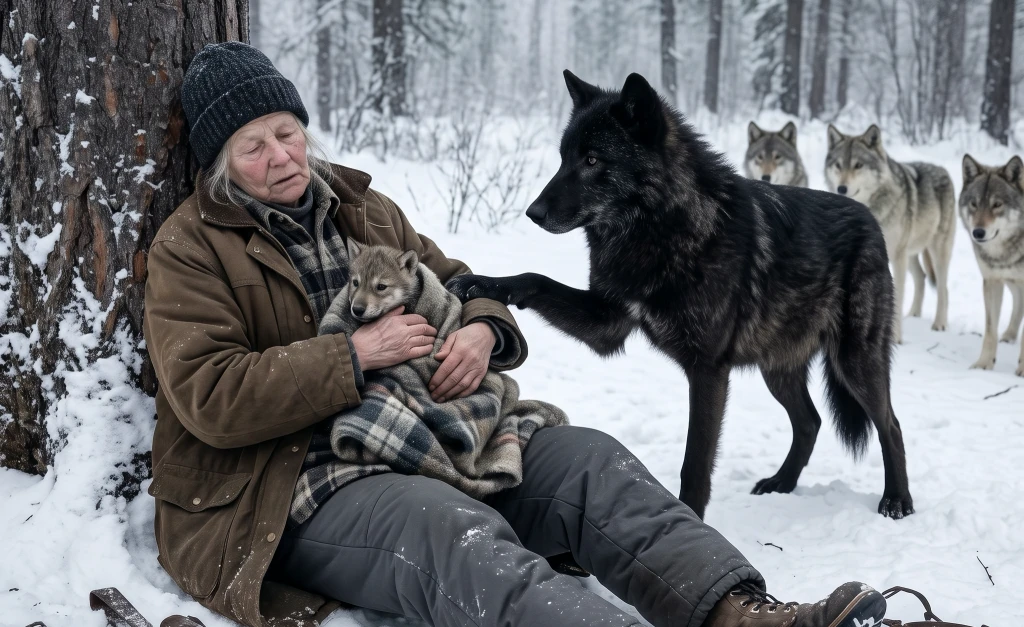
At first she saw only two pale reflections among the fir trunks. Then a large wolf stepped out of the snow. Its coat was dark along the back, silver over the chest and muzzle. It stood more than forty feet away with its head low, taking in the smoke, the steel trap, the human, and the injured youngster beneath her hand.
Nora reached for the cracked hickory stick as the young wolf gave a broken, breathy whine. The silver wolf’s ears came forward. Its gaze shifted from Nora to the red scarf, and it took one silent step into the firelight…
To read the rest of the story – CLICK the NEXT button 👇👇👇