


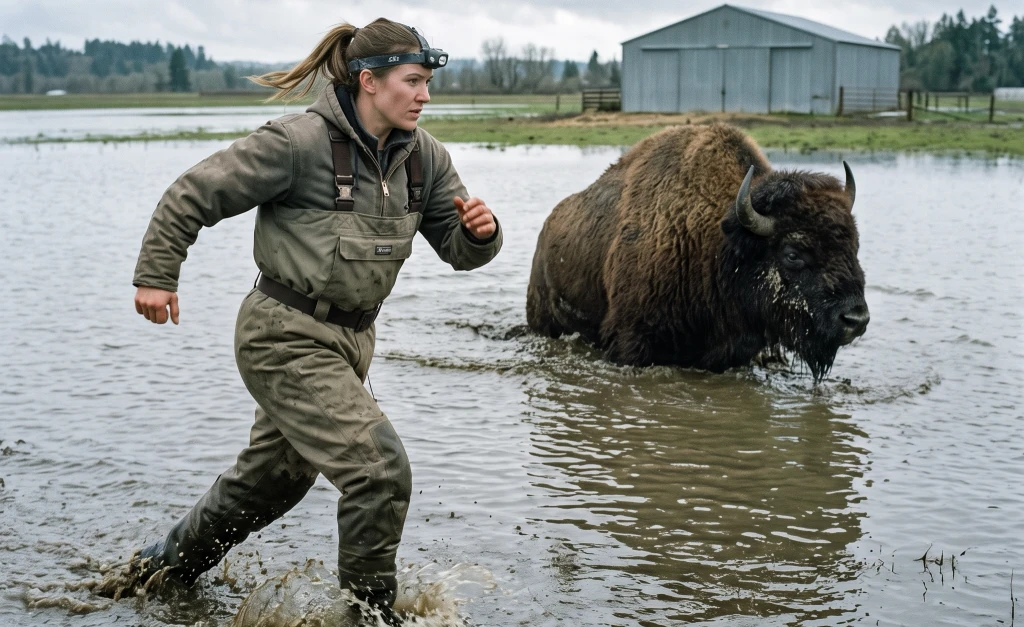
By the time I reached the north fence, the bison had stopped fighting. He stood chest-deep in brown water with four strands of high-tensile wire folded around his shoulder and belly, his head hanging so low that his beard dragged in the current. Every few breaths, one dark eye rolled toward me and then away. That stillness frightened me more than thrashing would have. A grown bull can tear a fence apart without noticing, but this one had let the fence hold him.
My phone buzzed inside the freezer bag in my coat. I knew it was June before I looked. My thirteen-year-old daughter had called six times since dawn from my mother’s house two counties west, where I had sent her before the low crossing disappeared.
“Tell me the truth,” she said as soon as I answered. “Grandma says Cotton Creek is over the highway.”
“The highway crew has it blocked. You’re staying there.”
“That wasn’t what I asked.”
Rain struck the hood of my coat and hissed on the water between us. June had inherited my habit of hearing the gap between an answer and the truth, which was useful when she aimed it at other people.
“I’m fine,” I said.
“You’re doing the fine voice.”
“I have to call Whitmore.”
She was quiet for half a second. “Why?”
The bull’s yellow ear tag showed when he lifted his head: 17. June had seen him the previous fall in Preston Whitmore’s display pasture and privately named him Atlas because, she said, anything carrying that much head deserved a myth.
“One of his bison is in our fence.”
June sucked in a breath. I ended the call before she could turn fear into instructions, then stood there feeling mean and relieved in equal measure.
My name is Raina Cole. I was thirty-seven that spring, and June and I were the whole household on thirty acres outside Prairie Hollow, Kansas—the only home she remembered. Whitmore Land and Cattle owned nearly four thousand acres around us, a broad reach of pasture, ridge, and creek bottom that made my place look like a postage stamp somebody had failed to peel off.
Preston had tried for eighteen months. His offers always arrived in cream envelopes and always came with the same patient explanation: the north ten acres held water, my cattle operation was too small, and a woman carrying a farm note alone ought to recognize rescue when it stopped at her mailbox.
I had recognized it as a purchase offer. That was one reason I kept saying no. The other was asleep in my mother’s spare room with graph paper, colored pencils, and a seventh-grade watershed project built around the question of why our north field flooded when the fields beside it did not.
Preston answered on the fourth ring. Half an hour later, his crew-cab truck stopped on the crown of my lane. He and his ranch foreman, Wade Sutter, got out in rain gear already smeared with mud; they had spent the night moving cattle off the lower pastures and helping the volunteer fire crew sandbag the nursing-home road.
Preston was fifty-two, broad through the shoulders, gray beginning at his temples. When Prairie Hollow Elementary’s roof leaked, his crew had covered it before the district found a contractor; after the drought, he bought hay from three widows who needed cash more than he needed the bales. The same man had spent eighteen months explaining my own field to me from the dry side of his truck window.
Wade walked far enough down the slope to study the current. He had handled bison most of his adult life, and when the bull shifted, Wade lifted one palm without thinking, the way some men quiet horses.
“Wire’s under his brisket,” he said. “If he rolls, it opens him up.”
“Can you bring your skid steer around from the ridge?” I asked.
Preston looked at the water crossing my lane. “No.”
“Your winch, then. I need to pull the posts, not the animal.”
“The bank won’t hold a truck.”
“Mine will hold the tractor.”
His eyes went past me to the old green machine under my loafing shed. I had rebuilt its hydraulic pump at my kitchen table the winter before, with the manual spread beneath the parts so I would not lose a spring. Preston knew that because he had driven in while I was testing it and told me not to spend money on equipment I would not own long enough to wear out.
“Raina,” he said, and for once there was no amusement in his voice. “That bull can kill you without ever deciding to. I can lose livestock. June can’t lose her mother.”
He was right about the second part. While he spoke, a fresh strip of grass caught on the corner post two inches above the old water mark. Waiting had acquired a measurement.
“Then spot me from high ground,” I said.
Preston’s jaw tightened. Wade looked at him, not at me. After a moment, Preston gave one short nod.
“She stays upstream of the legs,” he told Wade. “If that bank moves, you pull her out.”
I backed the tractor onto a gravel shoulder above the field and set the brake. We ran my logging chain through a snatch block around the hedge tree, then clipped it to the first steel post, keeping forty feet between the tractor and the bull. I was not going to touch him or put a line on him. I only needed to take the fence apart in the direction the flood already wanted it to go.
The first pull bowed the post and made the wire sing. Atlas came alive all at once, flinging his head and driving a horn through the lower strand. Wade shouted for me to stop, and I stopped. We waited while the bull spent what little strength he had left, then settled again with water foaming against his ribs.
On the second pull, a brace tore loose. On the third, the upstream post came out trailing a black root of mud, and two strands sagged away from the animal. I moved closer only once, from the upstream side, long-handled cutters out in front of me while Wade kept talking in a low, ordinary voice about the hinge on his stock trailer.
The cutters bit through the last wire. I scrambled backward, my right boot stuck, and for one ugly second the current turned me sideways. Wade caught the shoulder strap of my waders from the bank and hauled until the mud released me.
The bull remained still. Then he leaned forward, found bottom with one forefoot, and heaved himself through the opening we had made.
Wade did not cheer. He kept both hands raised and watched the bull’s hind legs while Preston called for the trailer gate to be opened on high ground.
He staggered toward the high lot beside my shed. At the field edge, his left rear hoof punched through the sod to the hock. There was a crack beneath him, hard and hollow, followed by a sucking sound that did not belong to mud. Atlas wrenched free and kept moving while a dark whirl tightened in the water behind him.
Wade saw it too. He stared at the hole until Preston told him to get the trailer ready for when the road reopened.
“Old concrete,” Preston said when I asked. “Every farm in this county is buried over somebody else’s mistakes.”
He took a clean shop rag from his truck and held it out. Only then did I see the blood running from my palm where the fence had nicked me.
“You got lucky,” he said.
“So did your bull.”
His face closed again. “The offer on your place is still good through the end of the month. After this flood, it won’t be the same offer.”
He left me with the rag in my hand and the bull breathing beneath my shed roof.
Three days later, the water began to release the valley. June came home with my mother as soon as the highway opened, angry that I had kept her away and angrier that I had not told her about the rescue until it was over. She put on rubber boots without speaking to me and followed while I inventoried sixty feet of lost fence, a silted chicken run, and nine acres of grass laid flat in one direction.
The north field still wore two inches of warm gray water. June was ten yards ahead when she stopped so abruptly that I nearly walked into her.
“Mom,” she said. “Those fish aren’t stranded.”
At first I saw only flashes. Then my eyes adjusted, and the field resolved into hundreds of small fish scattered through a narrow diagonal band. They were not gasping on their sides. They were holding their heads into a current I could not see, tails working steadily, all of them facing southwest toward the hole Atlas had opened.
June knelt and lowered her fingers into the water. “It’s moving under the floodwater.”
We followed the line. Near the broken sod, clear water welled through the brown skim and made our fingers ache with cold. June took the kitchen thermometer from the pocket of her raincoat; she had brought it because she had learned not to trust me when I called something interesting.
The field water measured seventy degrees. The water rising from the hole was fifty-four.
“Mr. Pike said contour lines don’t lie,” June whispered. “Maybe water doesn’t either.”
Everett Pike, the retired county surveyor who volunteered in her school’s map room, had looked at June’s watershed drawing in March and told her our drainage pattern made no sense. I had dismissed it as an old man’s way of encouraging a child.
I sent June for a spade. She returned with two, and this time I did not tell her to wait at the house. We widened the shallow hole together, staying back from the broken edge. Eighteen inches down, my blade struck something under the mud.
It did not thud like limestone. It rang…
To read the rest of the story – CLICK the NEXT button 👇👇👇