


The old gelding planted his feet at the entrance to the sale ring and refused to take another step. Nate Mercer noticed because he was standing ten yards away with a bidder card in his coat pocket, pretending not to see the third missed call from his land broker. The horse handler pulled once on the lead rope, then stopped before the struggle became ugly. The gelding merely raised his head and looked past him. Straight at Nate.
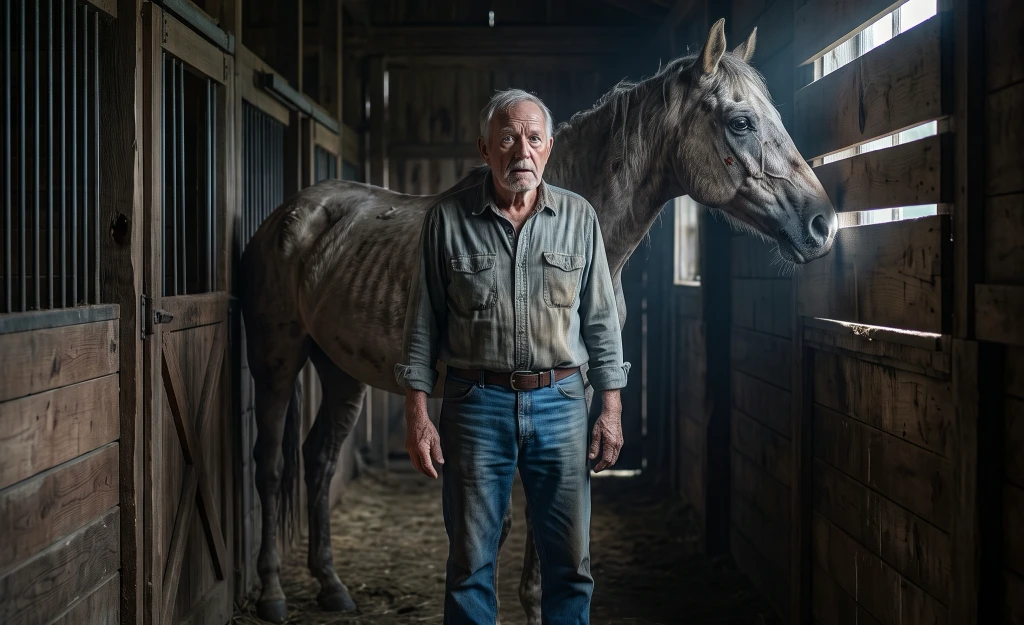
Nate had come to the Sorrell farm dispersal for a set of pallet forks and two rolls of deer fencing. He had hitched his old stock trailer that morning because both would fit inside it. The trailer had carried fencing, orchard bins, and a neighbor’s calves in recent years, but no horse of Nate’s own.
He had forty-three acres of apple trees outside Bedford, Virginia, a right shoulder that no longer liked ladders, and an unsigned listing agreement on his kitchen table. An old horse belonged nowhere in that arithmetic.
“You still thinking about selling the north block?” Cal Henley asked beside him.
Cal farmed the adjoining property with his sister, Laura. He was thirty-two, hardworking, and young enough to believe that adding another twenty acres would solve more problems than it created.
“Still thinking,” Nate said.
“If you split it off, Laura and I want to talk before you take another offer.”
“I haven’t decided to sell it to anybody.”
Cal glanced at the phone in Nate’s hand but let the subject drop.
The Sorrell place had once bred Thoroughbreds. You could see it in the long shedrow barn and the rail fences, though half the rails had been patched with wire and the training oval had grown up in broom sedge. The owner had died in July. His nephew was selling everything before winter: tractors, tack, tools, six horses, and the kitchen appliances from the farmhouse.
Five of the horses had brought respectable prices. The sixth was the bay gelding now refusing the ring.
He was tall but diminished, his backbone sharper than it should have been and his hindquarters hollowed by age. Gray had spread through his mane until only a dark streak remained beneath it. One white sock rose higher than the others on his left hind leg, and a narrow star faded into the hair above his eyes.
A battered leather halter hung loosely on his head. An aluminum tag tapped against one cheek buckle, its lettering hidden beneath grime and a strip of dirty tape.
The auctioneer consulted his sheet. “Late twenties, according to the paperwork. Quiet. Companion sound. Stiff behind. No guarantees beyond that.”
A woman near the rail asked whether he could still be ridden.
“Not represented as rideable.”
The bidding opened at two hundred dollars. No one raised a card.
At one hundred, a man in a canvas vest leaned forward, studied the horse’s legs, and stepped away. The auctioneer tried fifty.
The gelding’s gaze remained on Nate. It was not the bright, anxious stare of an animal searching for escape. He looked as though he had heard something at a distance and was waiting for it to come again.
Nate remembered another bay horse standing at the eastern fence of his orchard before sunrise. He pushed the memory down so quickly it left a pressure behind his ribs.
The handler loosened the rope. The horse took one step—not toward the ring but toward Nate.
“Seventy-five,” Nate heard himself say.
The auctioneer pointed. “Seventy-five. Do I have a hundred?”
No one answered.
“Ninety,” called the man in the canvas vest.
Nate should have let him have the horse. He had no pasture ready, no recent supply of senior feed, and no good reason to add a large, fragile animal to the week in which he might decide whether to sell his farm.
“One hundred,” he said.
The man shrugged.
The auctioneer brought down his gavel.
At the folding checkout table, Nate signed a bill of sale that listed the gelding as Red, barn name unverified. The Sorrell nephew could tell him only that the horse had arrived two years earlier with several boarders from a closed lesson stable.
“He never caused trouble,” the nephew said. “Mostly kept the other horses settled.”
“Who owned him before the lesson stable?”
“Don’t know. Uncle handled that.”
The gelding loaded into Nate’s stock trailer without hesitation. Before Nate closed the rear bar, the horse stretched his neck toward him and breathed against the front of his work coat. The exhale was warm and smelled of hay.
For an instant Nate saw Ellen’s hand on a dark neck, her wedding ring dulled by dust from the grooming brush. Then the horse withdrew, and Nate secured the trailer.
The drive home took forty-five minutes. Each time the trailer shifted behind him, Nate imagined calling Claire. His daughter lived in Charlottesville, less than two hours away, but lately their conversations had become negotiations conducted under the disguise of ordinary concern.
Had he scheduled the shoulder surgery? Had he answered the broker? Had he considered moving closer to her? Was he still eating supper over the sink?
Nate had learned that if he gave short enough answers, Claire would eventually begin talking about work instead. She had learned to recognize what he was doing and resent it.
He did not call.
By the time he turned into the orchard lane, late October light had flattened across the western ridge. Fallen Stayman apples lay beneath the trees, sweetening as they softened. The sorting shed was locked for the season, and the old barn stood behind the house with one half of its roof newly silver and the other half still rusted red.
Nate backed the trailer to the paddock and lowered the ramp.
The gelding stepped down carefully. He lifted his head toward the orchard, nostrils widening, ears making small separate movements as he took in the creek, the crows in the north block, and the loose hinge knocking against the equipment shed.
Nate waited for him to settle. Instead, the horse walked past the water trough and directly toward the barn.
“Easy,” Nate said, keeping slack in the rope.
The center aisle held four stalls on each side. Only the first two had been used recently, mostly when a neighbor needed somewhere to keep a mare overnight. Nate had swept them that morning and filled the nearer water bucket.
The gelding ignored both.
He continued to the final stall on the left, where the door hung open beneath an empty brass holder. A long strip of cleaner wood showed where a nameplate had once been. The stall’s east window was covered by three boards Nate had nailed across it years ago.
The horse stopped at the threshold.
Nate’s hand tightened around the rope. That had been Milo’s stall.
He told himself the choice meant nothing. The stall was larger than the others. It held the strongest trace of old hay. A horse could prefer the darker end of a barn for reasons no person would ever understand.
Then the gelding stepped inside and went to the covered window.
He touched his nose to the lowest board, precisely where a narrow gap admitted the last pale line of evening. His eyes closed as he drew in the cold air.
Nate remained in the aisle. He had not spoken the name in years, not even to Claire, and it felt less like a word than something lodged behind his teeth. “Milo?” The horse turned so quickly that the lead rope slid across the floor. He crossed the stall, lowered his head, and placed his muzzle against Nate’s open hand…
To read the rest of the story – CLICK the NEXT button 👇👇👇