


The dog came out of the snow carrying a puppy in her mouth. Graham Holt saw her at the edge of his headlights, a black-and-tan shape stepping over the berm where County Road 16 disappeared beneath six inches of fresh powder. He braked without thinking. The plow on his pickup bit into the drift, the rear end swung toward the ditch, and a steel thermos rolled under the pedals.
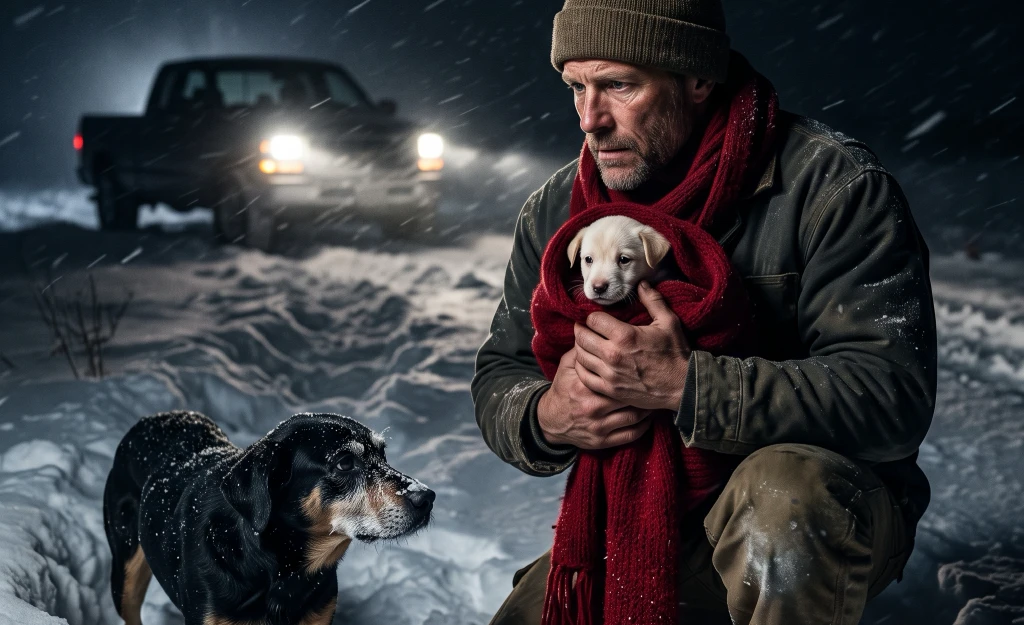
The dog stopped in the center of the road. One ear stood straight; the other folded at the tip. Snow silvered her muzzle and packed the fur between her toes, but she held the puppy gently, as if the storm had given her one job and she had no strength left for a second.
Graham eased his boot off the brake. The truck settled with its right tires against the rumble strip. Behind him, his newly cleared track was already whitening over.
“All right,” he said, though the dog could not hear him through the glass and the heater fan. “Show me.”
At forty-four, Graham had been out of the Navy for seven years, after spending most of his adult life in the SEAL teams. People in Alder Creek had mostly stopped calling him Chief.
He repaired snowplows and backup generators now, machines that failed in visible ways. A cracked belt could be replaced. A fouled line could be cleaned. The county fire station’s generator had taken him three hours that afternoon, which was why he was on the pass after dark when every radio bulletin said to stay home.
The dog turned toward the ditch. Graham pulled on gloves and opened his door. Wind shoved loose snow into the cab and lifted the end of the red wool scarf lying on the passenger seat. He caught it before it fell. Graham had kept Anna’s scarf in the truck since the night she died, although he could not have explained why without sounding superstitious or unwell.
Outside, the cold worked through his jeans at once. He followed the dog to a break in the guardrail, where rabbitbrush and scrub pine bent under the weight of the storm. She lowered the puppy into a hollow she had dug beneath the branches. A second pup lay there, lighter than the first, its paws twitching against an exposed root.
The mother braced herself over both of them. Her lips drew back when Graham crouched, but the sound in her throat had no force behind it.
“You’re right,” he said. “You don’t know me.”
He turned sideways instead of reaching. Years ago, his body had learned how to inventory danger before fear could name it: the slope below the brush, the ice glazing the shoulder, the mother dog’s left hind leg held slightly off the ground. Now he noticed the smaller things, too. The torn red collar. The milk dried into the fur beneath her belly. The tremor traveling from her shoulders to her jaw.
The dark puppy gave a thin, bubbling cry. Graham looked at the truck, then at the dog. He had a moving blanket behind the seat, two chemical hand warmers in the tool bag, and no cell service on this side of Larkspur Pass. The veterinary clinic in town was twenty-two miles away. The last eleven were downhill, and the county had closed the road at five.
He laid Anna’s scarf across his knees and reached for the lighter puppy. The mother snapped at the air beside his wrist. Graham froze. He did not pull back, and he did not look her in the eyes.
“I can leave,” he said. “That’s one option.”
Snow collected on his lashes. After a few seconds, the dog lowered her head, not in surrender but because she could no longer hold it up.
Graham slid one hand beneath the puppy’s chest and the other under its hips. It weighed almost nothing. He wrapped it in the scarf, tucked the bundle against his coat, and walked backward until the mother could see where he was going.
He set the puppy on the passenger floor, where the heater blew warmest, then went back. The mother had picked up the dark pup again. She tried to climb the berm, stumbled, and caught herself with her front legs.
Graham opened the rear door wide. “Your choice.”
She stared into the cab. Warm air rolled out around him, carrying the smells of coffee, grease, old wool, and the other puppy. Her nose worked. She tried once to jump and could not.
Graham knelt a few feet away and put his bare hand on the running board. He had taken off his right glove without noticing. The metal burned cold against his palm.
The dog came close enough to smell his fingers. Her breath touched his knuckles, quick and shallow. Then she set the puppy in his hand.
For one disorienting second, Graham was back inside the crushed cab of Anna’s station wagon, holding weight that should not have been his to carry. He heard sleet ticking against broken glass. He heard Anna trying to say his name around blood and breath. His body locked as completely as it had that night.
The dog nudged his wrist. Graham drew in air, put the puppy inside his coat, and slid both arms under her. She weighed perhaps fifty pounds when she should have weighed sixty-five. Her ribs moved too fast against him, but she did not struggle. He lifted her into the back seat, spread the moving blanket beneath her, and placed the dark pup between her front legs.
The lighter puppy had worked one small paw free of Anna’s scarf. The mother leaned over the console, counted it with her nose, and only then lay down.
Graham drove the last four miles with the plow raised and the hazard lights on. He radioed county dispatch from the crest, where the signal came in broken but usable, and asked them to tell Dr. Lila Moreno that he had a hypothermic nursing dog and two pups. The dispatcher, a woman who had known him since high school, asked where he had found them.
“North shoulder below mile marker nine.”
“You bringing them to town?”
He looked at the road falling away ahead of him, already smooth with windblown snow. “Not tonight.”
“Lila says get them dry, warm them gradually, and don’t feed the puppies until they’re warm enough to swallow. Call from the house.”
“Copy.”
He almost thanked her. The radio clicked dead before he managed it.
His cabin sat above Dry Creek in a stand of lodgepole pine, a square log house with a tin roof and a workshop attached by a covered breezeway. The porch light should have been dark. Instead it shone through the snow, and a gray hatchback sat beside the woodshed with Denver slush frozen along its wheel wells. Graham stopped at the foot of the drive.
The last time he had seen Sophie Reed was thirteen months earlier, at a breakfast neither of them had eaten. She had asked him what he planned to do with her mother’s things. He had said, “I don’t know,” once too often, and she had left cash under her coffee cup as if he were somebody she could settle with.
Now she opened the cabin door wearing the old green parka she had left in the hall closet after college. Her dark hair was pulled into a knot, and she held one of Graham’s flashlights against her shoulder. At twenty-five, she had Anna’s narrow face and none of Anna’s patience when she was frightened.
“Where have you been?” she called. “The county said the pass was closed.”
Graham shut off the engine. The sudden quiet released a chorus of weak whimpers from the cab.
Sophie came down the steps. She stopped when Graham opened the back door and the mother dog raised her head from the blanket.
“Oh my God.”
“Get the laundry basket from the mudroom. Put towels in it.”
Sophie did not move. She was looking past him, through the open passenger door, at the red wool wrapped around the pale puppy. Her flashlight lowered an inch. “That’s Mom’s scarf…”
To read the rest of the story – CLICK the NEXT button 👇👇👇