


The black cat had one paw buried in the sleeve of my canvas work coat before I understood what he was protecting. His other foreleg was braced across the neck of a young Canada lynx. The wildcat lay curled in the bottom of a cardboard apple box, her smoke-gray fur wet with melted snow, her mouth opening and closing around breaths she could not quite catch. The black cat stood over her with his ribs showing and ice crusted into his whiskers, prepared to spend whatever was left of him keeping my hands away.
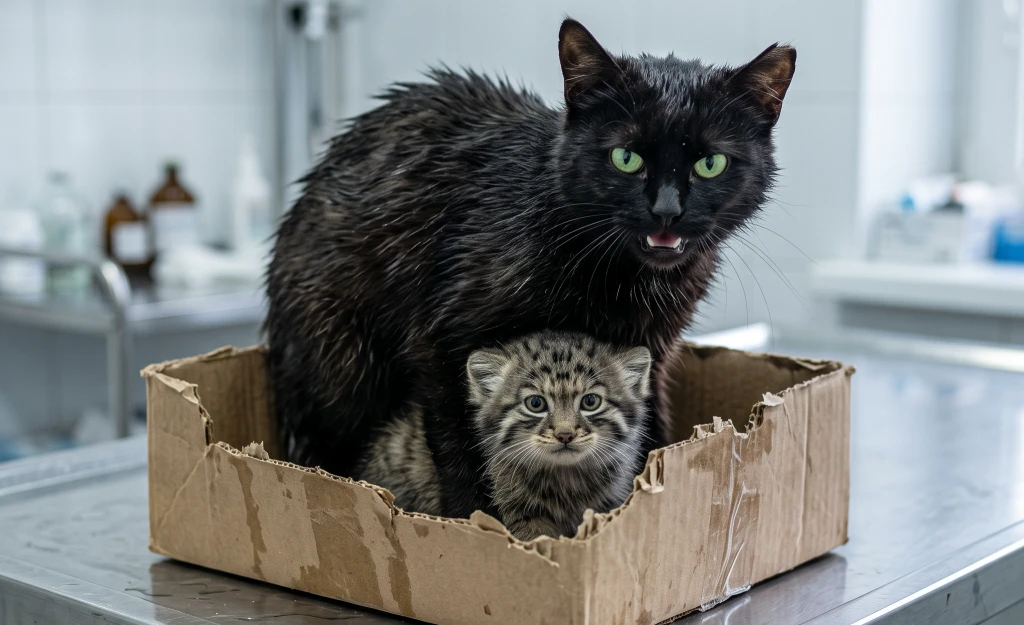
I stopped moving. So did Cal Bennett, who had carried the box into my clinic under a horse blanket and now stood behind me with snow thawing off his boots.
“That’s what I was trying to tell you,” he said.
“You told me there were two cats.”
“I told you one was the black stray from my feed room. I didn’t know he was going to try to take your arm off.”
The cat’s claws had not reached skin, but they had opened four neat seams in the sleeve. I eased my wrist backward without looking away from him. His eyes were green, not bright green in the decorative way people describe cats, but the hard bottle-glass green of something found intact after a fire.
Outside, wind drove snow against the front windows of Kootenai Valley Veterinary in flat white sheets. Pine Crossing, Montana, had been under a winter storm warning since the previous afternoon. The temperature that morning was fourteen below zero, and the county road crews had advised everyone without livestock or an emergency to stay home. Cal had both.
He owned a small cattle place six miles north of town. While checking a drifted fence line, he had heard a rasping sound inside an abandoned tack shed on the far end of his lease. The shed roof sagged low enough to touch his hat. In the driest corner, tucked behind two broken salt blocks, he found the apple box.
“The black one was inside with her?” I asked.
Cal nodded. “Wouldn’t leave. I slid plywood over the top and wrapped the whole thing in that blanket. Figured I could lose a finger there or lose one here, where at least you’ve got bandages.”
The lynx made a wet, whistling sound. Her abdomen tightened as she tried to pull air past the discharge crusted around her nose. The black cat looked down at her, and for half a second the violence left his face. He licked once between her low, rounded ears.
Then he looked at me again and bared his teeth.
I had practiced mixed-animal medicine for eighteen years. In winter, that meant calves born too early, dogs cut by barbed wire hidden under snow, barn cats with frostbitten ears, and wildlife carried in by people who had crossed a legal or practical line because leaving it outside felt worse. I knew what an injured cat could do. I also knew the bluish cast gathering along the lynx’s gums.
“Cal, lock the front door and close the exam-room door behind you.”
“You expecting company?”
“I’m expecting him to get loose.”
I lowered the overhead light and turned on the small oxygen unit beside the treatment table. The hum changed the room. The black cat’s ears flicked toward it, but his body stayed stretched over the lynx.
I opened a can of warmed recovery food and set it just outside the box. The smell usually reached an animal before reason did. His nostrils moved. His empty belly pulled tight with one visible contraction, and he shifted an inch toward the food.
The lynx coughed. The cat stepped back over her and planted himself more firmly than before.
“He’s starving,” Cal said.
“I know.”
“Then why won’t he eat?”
I watched the cat tuck his chest over the lynx’s head so that her next weak breath stirred the loose fur beneath his throat. “Because every time he moves toward the food, she coughs and he comes back.”
The pulse oximeter and oxygen hood were three feet away. They might as well have been across the state. I could not assess the lynx, much less treat her, while the cat guarded every approach. I could not wait for exhaustion to settle the argument; the lynx’s breathing was already slowing, and in respiratory failure, quieter did not mean better.
I called the emergency number for Montana Fish, Wildlife & Parks and put the phone on speaker while it rang. No one answered before the recording began. I left my name, license number, the species, and the words immediate life-threatening distress. State and federal rules allowed emergency stabilization. Beyond that, the animal would need to go to a permitted wildlife rehabilitator.
First she had to survive long enough for rules to matter. I brought out the thick capture blanket and the smallest amount of reversible sedative I was willing to risk in an animal that thin. Cal’s face tightened when he saw the syringe.
“Will that hurt him?”
“Less than what happens if I reach past him barehanded. Less than what happens to her if I do nothing.” I wished the answer felt cleaner than it did.
We moved the box into a large floor kennel so that a failed attempt would not send the cat into the rest of the clinic. I worked slowly until the lynx gave another open-mouthed gasp. Then slow was no longer available to us.
The black cat launched before the blanket touched him. For an animal whose hip bones looked sharp enough to cut his skin, he struck with astonishing force. I caught him in the folded fabric, protected the lynx with my forearm, and made the transfer in a blur of claws, weight, and a raw cry that sounded less like fury than terror.
“Easy,” I kept saying, though nothing about it was easy. “I’m taking her because you brought her to help. I know you don’t believe me.”
Within minutes he lay drowsy in a covered carrier, breathing steadily but watching me through the wire door. His expression had changed. Rage I understood. What I saw then looked like betrayal.
I lifted the lynx from the ruined box. She was a juvenile female, perhaps six months old, but she weighed barely over six pounds. Her body was cold at the feet and fever-hot through the chest. Thick discharge obstructed both nostrils, and every breath pulled the skin tight between her ribs.
Cal held the oxygen tubing while I cleared her upper airway and settled her beneath a clear oxygen hood. I placed a catheter, started warmed fluids cautiously, collected the samples I could without stealing too much time, and gave the first emergency medications after checking the dose twice. A portable chest image showed severe pneumonia in more than one lobe. It did not tell me whether she would live through the hour.
Her oxygen reading rose by three points, then stalled. Adding more treatment then could have done harm, so I watched the monitor and wrote down numbers I could not improve by staring harder.
From the carrier on the floor came a scraping sound. The black cat was awake enough to drag himself against the door. He could not see the treatment table from there. He began to call—not a house cat’s ordinary demand, but a long, rough sound that climbed until his breath broke.
The lynx’s monitor jumped. Her forepaw twitched beneath the oxygen hood. She raised her head less than an inch, opened her swollen eyes, and answered him with one broken chirp…
To read the rest of the story – CLICK the NEXT button 👇👇👇