


The white bison came into the sale ring backward, one broad hip pressed to the steel gate while two handlers tried to turn her without making her panic. The crowd at Harlow Livestock in western South Dakota had been drifting toward the exits after four hours of bred cows and feeder calves. Now men stopped in the aisles. A few lifted their phones.
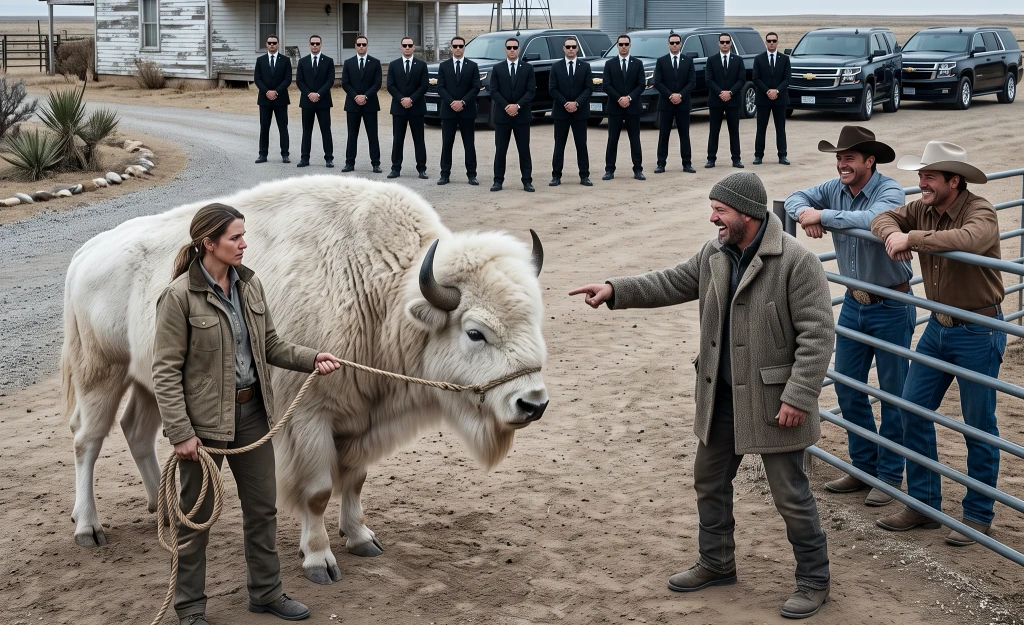
Rae Mercer set down the bidder card she had promised her daughter she would use only once. They had come to buy an older bred Angus cow, nothing unusual, nothing that ate money faster than it ate hay. The envelope inside Rae’s coat held fifteen hundred dollars. Eleven hundred had come from selling two late calves; the rest had been sitting under the flour bin for Tess’s community-college deposit.
Beside her, Tess leaned forward until the frayed knees of her jeans touched the seat ahead. “Mom. Is that really a buffalo?”
“Bison,” Rae said automatically.
The animal found the opening at last and swung into the ring. She was young, perhaps three, narrow through the ribs after a hard winter, and white from the blunt rise of her shoulders to the brush of her tail. Not cream. Not the dirty gray of an old coat shedding out. White enough that the overhead fluorescents flattened her against the sawdust.
Her eyes were brown.
Rae noticed because her grandfather had kept seven bison on the Mercer place when she was a girl, and because one of them had put him through a cottonwood gate when he forgot that bottle-fed did not mean tame. She knew the set of a bison’s head before a charge and the difference between stillness and calm. She also knew that an albino animal did not usually keep black skin around its nostrils, dark hooves, and eyes the color of walnut shells.
The auctioneer, Wes Morrow, shuffled the papers on his stand. Wes had sold calves for Rae’s family since before Tess was born. That afternoon he would not look toward her row.
“Lot two-fourteen,” he called. “Female American bison from the Amos Bell estate. Three years, give or take. Consignor notes possible albino, possible commercial cross. Sold as-is, no breeding guarantee, no health representation beyond the yard certificate.”
The phrase possible commercial cross moved through the buyers more efficiently than a gate closing. A white hide might bring tourists. Cattle ancestry brought questions no serious bison breeder wanted to buy.
All morning, Rae and Tess had used a folded sheet divided into three columns: lot number, visible concerns, stopping price. Tess had caught a bad rear foot on one cow before Rae did and crossed out another whose calf record did not match the auctioneer’s announcement. Rae had told her twice that two sets of eyes were the only advantage a small buyer got for free. Now Tess wrote 214, drew a firm line through the entire row, and rested the pencil there. Rae left her own column blank.
Caleb Stroud stood at the far rail with his forearms resting on the top pipe. At forty-nine, he had the gray beginning at his temples and the easy posture of a man who expected a room to make space for him. Stroud Range ran more than two thousand bison on land that crossed three county roads. Caleb had donated the new scale house, paid the 4-H premiums at the county fair, and once hauled a neighbor’s cattle six miles through a blizzard when the man’s heart gave out. People did not merely know him in Harlow. They had learned to take his judgment as weather.
He watched the white cow turn. For one moment, his attention fixed not on her eyes or feet but on the hair high on her left hip. He bent closer to the rail.
Then he smiled.
“Wes,” he called, “you selling feed bills by the head now?”
The first laugh came from behind Rae. Caleb waited for it, then tapped the rail with one gloved finger.
“True albino, she’ll burn in summer and run up a vet tab all year. Crossbred, nobody will want her calves. Either way, she’d be prettier on a Christmas card than in a pasture.”
More laughter. A man near the coffee counter said somebody ought to buy her for the school mascot. Another asked whether she came with sunglasses.
Tess’s shoulders drew inward. At seventeen, she could survive cruelty directed at herself by going cold and quiet. Cruelty directed at Rae still reached her before she could hide.
“Let’s go,” she murmured.
Rae kept looking at the cow. The animal tracked a handler along the boards without squinting. When he flapped a sorting flag near her shoulder, she stepped away from it cleanly. No stumble, no uncertain swing of the muzzle. A loose strip of white hair lay along her flank, and beneath it Rae saw a change in the grain of the coat—two characters, perhaps three, too faint to read from the bleachers.
“Open at three thousand,” Wes said.
Nobody answered.
He tried twenty-five hundred, then two. Caleb said something to the rancher beside him. The man laughed without taking his eyes off Caleb.
Rae had spent most of her adult life learning what silence cost. It had cost her a fair lease when a neighbor assumed she would not challenge the acreage on the contract. It had cost her calves at a sale where a buyer called them underweight before they crossed the scale. Every time, she had told herself that getting through the day mattered more than being right in public.
This time the silence was being built around an animal.
“Fifteen hundred?” Wes called. His cadence had begun to fray. “Anybody at fifteen?”
Rae raised her card.
Tess caught her wrist too late. “That isn’t what we came for.”
“I know.”
Wes looked relieved and miserable at once. He called for sixteen. No one moved. Caleb turned his head toward Rae, and his expression changed so briefly she might have imagined it: not amusement now, but calculation.
“Fifteen going once. Fifteen twice. Sold, lot two-fourteen, bidder sixty-eight.”
The strike of the gavel seemed much smaller than the thing Rae had done.
Tess released her wrist. “Please tell me you have a plan.”
“The north pen will hold her for quarantine.”
“That’s a location.”
Rae picked up the bidder card. “It’s what I have so far.”
At the loading alley, the white cow refused the first chute. She planted her front feet, swung her head, and made six men rediscover their respect for her. Rae stayed outside the boards. She asked the yard crew to lower the solid panel on the left, clear the noise behind her, and give her one open line toward the trailer. Caleb, watching from the catwalk, told a young hand to stop rattling the gate before Rae had to.
It was good advice. That irritated her almost as much as the laughter had.
With the pressure eased, the cow moved. Her shoulder brushed the chute; then the hump passed into the trailer, followed by the narrow hips and white tail. As she stepped up, a draft lifted the hair over her left side.
The mark was a freeze brand, almost erased by the coat: C7 above a short bar.
Rae looked up. Caleb was no longer smiling.
He came down from the catwalk while the yard hand secured the rear gate. Tess stood near the truck with her arms folded tightly enough to hide her hands.
“Your granddad’s old pen still standing?” Caleb asked.
“Standing better than some new ones.”
“One bison isn’t a herd.”
That, at least, was true. Rae waited.
Caleb glanced at the trailer. “I’ll give you twelve thousand for her. I’ll have my truck here in twenty minutes…”
To read the rest of the story – CLICK the NEXT button 👇👇👇