


Bixby hit the brakes before Dana did. The old Lab mix threw his weight against the passenger door as Dana’s pickup rolled past the western berm of Mercer Orchard. Thirty miles south, a tropical storm was pushing warm water toward Bellwether Parish. The sky above the pecan trees had already gone the color of a bruise.
“We’re leaving,” Dana told him. “The surveyor can argue with the mosquitoes by himself.”
The surveyor’s orange stakes traced the eighty acres Dana was supposed to sell at five the next afternoon. The buyer planned to raise the low ground and build climate-controlled warehouses. Dana had spent four months clearing her father’s house and servicing the loans he left behind. The $1.8 million closing would pay off what remained and give her a retirement she had not otherwise prepared for.
Near the equipment shed, her excavator sat under a tarp. Beyond it, an eight-foot earthen berm curved around the old floodplain swale. Cal Mercer had built that barrier before Dana left for college, turning wet pasture into profitable pecan rows. Two nights earlier, Celia Ward had emailed to ask whether the swale could still hold stormwater if the berm were opened. Dana, busy with the sale, had promised to call after closing.
Now Bixby shoved the door handle with his nose.
Dana stopped. The moment she cracked the door, he squeezed past her and ran into a stand of cane beside the drainage road. His back legs were stiff with age, but he disappeared into the green before Dana could catch him.
“Bixby.”
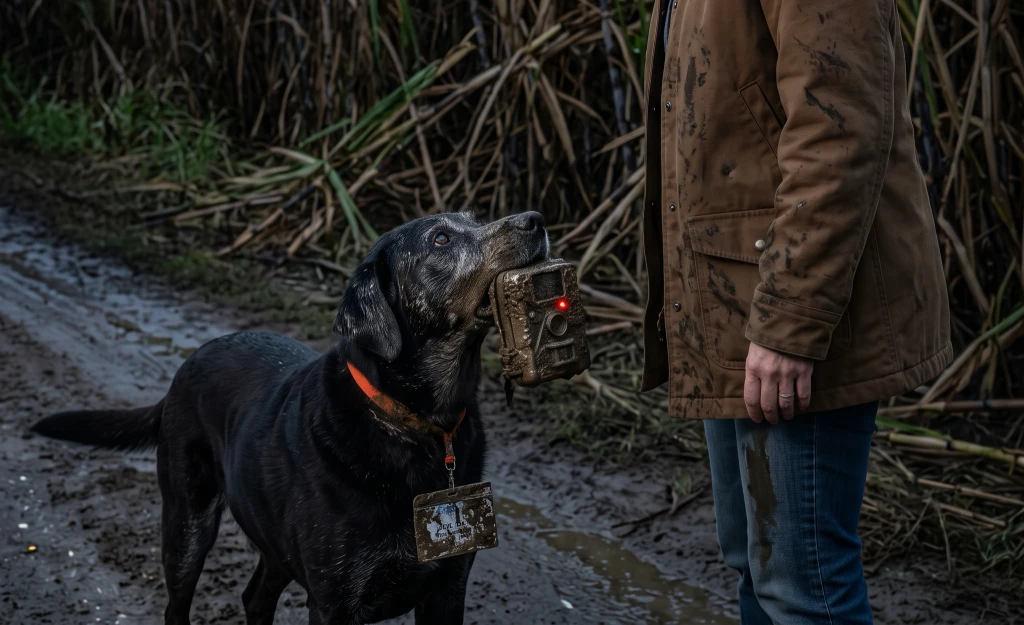
He returned carrying a strip of orange nylon. A plastic badge swung from it and tapped against his chest.
Dana took the lanyard from his mouth. Mud covered the photograph, but the printed name remained clear.
CELIA WARD — BELLWETHER WATERSHED VOLUNTEER.
Celia had hired Dana into the parish engineering office thirty-one years earlier. She had taught her to walk a site after rain because water showed which calculations had been honest. She had retired six years ago after a public fight with parish president Nolan Pike.
The lanyard had been torn, not unclipped.
Bixby lowered his nose and moved back into the cane. Dana followed. Twenty feet from the road, tire tracks crossed the soft shoulder and ended beside a patch of flattened grass. One track had the wide chevron tread used on parish maintenance trucks. A silver field camera lay beneath a palmetto leaf, its housing cracked but its status light still blinking.
A narrow bicycle track ran beside the truck tread, then vanished beneath it. Dana did not touch the camera. She called 911, photographed the location from several feet away, and kept Bixby out of the tracks.
Deputy Marisol Quinn arrived twelve minutes later in a sheriff’s cruiser, followed by an ambulance that staged at the road.
“You know the missing person?” she asked.
“She was my mentor. I didn’t know she was missing.”
Quinn checked dispatch. No report had been filed. She put on gloves, documented the tracks, and lifted the camera into an evidence bag. Its cracked screen woke when she touched the power button. A video thumbnail filled the display.
“We view it here,” Quinn said. “We don’t copy or send anything until it’s logged.”
The forty-seven-second recording showed Celia inside Old Orchard Pump Station. She aimed the camera at two open shipping boxes and read their serial numbers aloud. “These starter relays are rated below the contract load. If they’re installed before the storm—”
A man’s voice interrupted from behind her.
“That equipment is no longer your concern, Celia.”
Celia turned. The image swept past a drainage department jacket before she lowered the camera. The recording ended while she was still inside the station.
Dana recognized the voice, though she did not say the name until Quinn replayed it once and asked directly.
“Wade Pike. Nolan’s nephew. He supervises the parish pump stations.”
Quinn radioed for deputies to check Wade’s home, the station, and every parish maintenance yard. She requested Celia’s phone location and asked the state police to issue an endangered-person alert. Dana called Celia’s attorney in Baton Rouge. Nobody had heard from her since the previous afternoon.
Bixby paced the edge of the flattened grass, sneezing at the smell of diesel. Dana wanted to put him in the truck and search every shed herself. Quinn stopped her.
“If Wade took her, he knows this parish better than either of us. Let people with radios cover the roads.”
The first call came forty minutes later from a truck stop six miles north. A delivery driver had found an injured woman walking along the service road behind a closed fertilizer warehouse. She had cut a plastic tie from her wrists on a broken roof panel and kicked through rotted plywood after her captor left. The driver had already called an ambulance.
Dana reached Bellwether General as Celia was taken into an examination room. Bruises darkened the left side of her face. A thin red line circled each wrist, and her right ankle had swollen above her boot. She looked at Dana, then at the muddy lanyard Quinn carried in an evidence sleeve.
“Bixby found that?” Celia asked.
“In the cane behind my drainage road.”
“Wade didn’t take me at the station. I got out through the west service door on my folding electric bike and rode toward your place because you’d promised to check the swale. He followed in his truck, forced me onto the shoulder beside your drainage road, and pulled me from the bike. I dropped the lanyard and camera in the cane. He folded the bike and threw it in the truck bed before he tied my wrists.” Celia closed her eyes while the physician checked her pupils. “I hoped someone would walk that shoulder before the storm.”
Quinn took Celia’s statement after the doctor cleared a short interview. Celia described photographing the relays, leaving through the west door on her bike, being forced off the road three miles later, and waking in the fertilizer shed with her wrists bound. The sheriff’s office sought warrants for Wade’s arrest and the search of his work truck. Wade, his truck, Celia’s bike, and his parish service tablet were gone.
Near midnight, Celia sat propped against two pillows with an IV in her arm. Hospital security had restricted visitors to Quinn, Dana, and Celia’s attorney. Bixby waited downstairs with a security guard who had smuggled him half a turkey sandwich.
“Those relays were only one piece,” Celia said. “Nolan has spent three years buying options on Larkspur Bend through his brother’s company. Every bad flood lowers another appraisal.”
Larkspur Bend sat in the lowest bowl of Bellwether Parish, three hundred and eighty-seven modest houses built around a church, an elementary school, and streets that flooded ankle-deep in ordinary summer rain. Dana had reviewed complaints from residents when she still worked for the parish. Official logs always blamed rainfall beyond design capacity.
“A storm big enough to condemn the neighborhood would bring state investigators,” Dana said.
“Nolan is counting on that. They’ll find the undersized pumps your father installed, missing sensor data, and a parish evacuation order issued early enough to prevent deaths. He expects the equipment failures to look old, the flood to look inevitable, and the property options to look like rescue offers.”
Dana stared at the IV drops falling through the chamber.
“The storm reaches us tomorrow night,” Celia said. “They plan to make Larkspur Bend look like a natural disaster…”
To read the rest of the story – CLICK the NEXT button 👇👇👇