


At 12:47 a.m. on a Thursday, June Mercer lifted a yellow rain slicker from a wire trap and found an old gray cat staring past her shoulder. Rainwater ran from the trap onto the intake-room floor. The construction worker who had carried him in stood dripping beside the counter, turning his hard hat in both hands. He said he had found the cat by a drainage culvert behind the old carpet store, crouched beneath a loading dock while runoff rose around him.
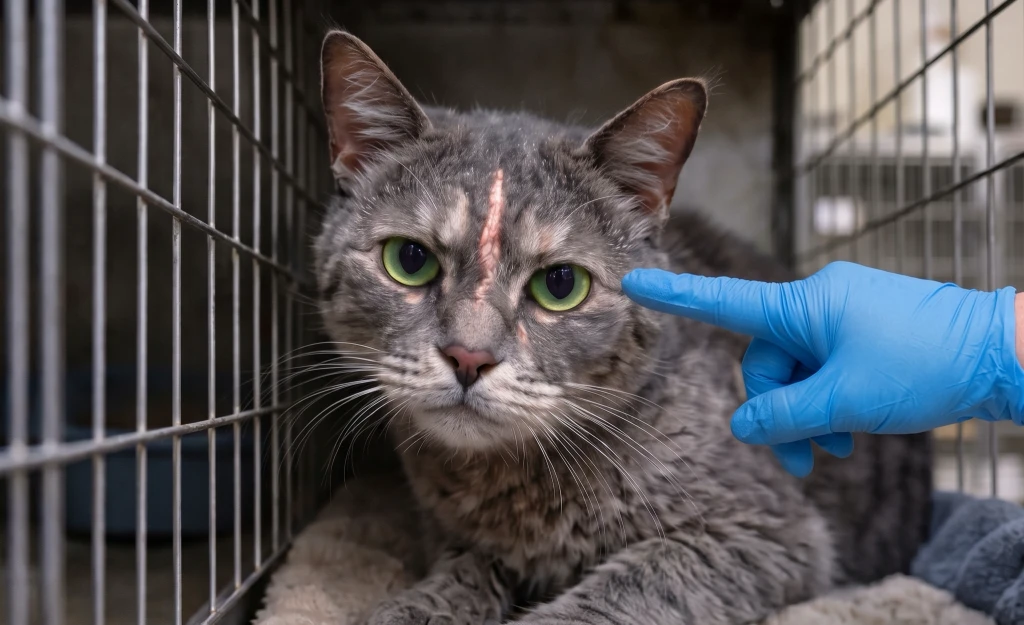
“He let me get close enough to drop my jacket over him,” the man said. “Never made a sound.”
The cat was narrow under his patchy coat, with two pale scars crossing his face. One divided the bridge of his nose. The other drew the skin tight beside his left eye, giving him a permanent look of suspicion. Mud had dried between his toes, and a torn pad left small rust-colored marks on the newspaper lining the trap.
June had worked intake at Merritt County Animal Center for twelve years. She knew how frightened animals made themselves small, how sick ones saved their strength, and how feral ones measured every available exit. This cat did none of those things. He sat with his front paws together and looked at the cinder-block wall as if the room ended there.
June crouched beside the trap. “Easy, sweetheart.”
His ears did not turn toward her voice.
She slid a shallow dish of water through the trap door. He remained fixed on the wall until the dish touched the wire floor. Then his head snapped toward her hand so sharply that June stopped moving.
For a second, they studied one another. His eyes were green beneath the clouded lights, older than the rest of him and far more awake than his stillness suggested.
The outer door banged in the wind. The overnight phone began ringing, and a beagle in recovery pulled loose an IV line. By the time June returned to the intake form twenty minutes later, the detail about the water dish had joined a hundred others she meant to remember.
The box marked NAME could not be left blank. She wrote OLD TOM—gray, male, senior—and told herself it was only until someone thought of something better.
Dr. Lena Park arrived shortly after sunrise. She found dehydration, flea dirt, healed damage around both ears, and no fresh injury worse than the split pad. When she moved behind Old Tom and touched his flank, he whipped around so violently that a metal tray skated off the examination table.
Lena caught it against her hip. “Strong startle response.”
The cat pressed his belly to the table, eyes fixed on her hands.
“Given those scars,” she said, “I’d assume somebody taught him that hands are bad news.”
There were two emergency kittens waiting in oxygen and a shepherd mix vomiting blood in the next room. Lena treated what she could see, ordered fluids and quiet housing, and estimated the cat at nine to twelve years old. June carried him to recovery with a towel over the carrier so he would not have to watch the hallway move around him.
For the first four days, Old Tom ate only after people left. He used the litter box neatly, never yowled, and slept pressed against the back wall. On the fifth evening, June found him awake after closing time, watching the strip of light beneath the recovery-room door.
She had twelve charts to finish, so she brought in a folding chair and sat outside his cage with the clipboard across her knees. June had always talked to animals while she worked. She read medication names aloud, complained about Caleb’s handwriting, and told Old Tom that his temporary name was not meant as an insult.
He watched her mouth. After several minutes, he edged toward the food dish and began to eat.
June lowered her voice, believing the softer tone had reassured him. When she stood to leave, the chair legs scraped against the floor. Old Tom kept eating. The cage door rattled as she latched it, and his head jerked up.
“See you in the morning,” she said.
He stared at the moving shape of her face until she switched off the light.
After two weeks, his blood work had steadied and his paw had closed. A cat with a fractured pelvis needed the recovery cage, so June moved Old Tom to cage fourteen in the adoption hall.
The first scratch happened three days later. Seth, a college volunteer with quick hands and a habit of humming while he worked, opened the cage to replace the water bowl. Old Tom seemed to be facing away. Seth reached past him, and the cat spun, struck twice, and flattened himself against the bars.
The cuts across Seth’s knuckles were shallow, but his shock was not. “He didn’t even warn me.”
June watched the cat’s sides pump. His pupils had swallowed almost all the green in his eyes, and a tuft of gray fur clung to the water dish where he had knocked into it. She could see fear. She could also see Seth’s bleeding hand and the next volunteer who might not pull away in time.
On the cage card, beneath Old Tom’s estimated age and medical notes, she wrote: UNPREDICTABLE DEFENSIVE BEHAVIOR. EXPERIENCED ADULT HOME ONLY. APPROACH WITH CAUTION.
The words were accurate enough to protect people. June did not ask what they would do to the cat.
There were other incidents, though never without a person close to his cage. A kennel attendant came around the open door from the blind side, and Old Tom screamed and hit the back wall. A visitor bent close to read his card, then jerked away when he launched at the bars. The woman’s daughter began crying; the woman filed a complaint saying a dangerous animal should not be displayed near adoptable pets.
Caleb Harlan, the shelter director, read the complaint twice. He was a quiet man who disliked easy solutions, which was why June respected him. He had already refused one staff suggestion that Old Tom be euthanized, but he could not ignore the effect on visitors or the risk to volunteers.
“Move him to the far end,” he said. “Less traffic may help.”
June moved cage fourteen beyond the cheerful adoption posters, where one fluorescent tube flickered and most families turned around before reaching the wall. She told herself it was quieter there. She did not say out loud that it was also easier.
The potential adopters came mostly on weekends. They stopped first in the kitten room, then drifted among the younger adults whose paws reached through the bars. A few walked all the way to cage fourteen. They saw the scars, read June’s warning, and moved on before Old Tom had done anything at all.
One couple paused long enough for the man to say, “Poor guy.” His wife answered, “Not with the grandchildren,” and they adopted an orange one-year-old from cage six.
June could not fault them. She would not have recommended Old Tom to that household either. Still, each time she replaced the card in its plastic holder, her own block letters seemed darker.
By late February, Old Tom had been at Merritt County for four months. Nobody had requested a visit. He no longer struck at the bars every time someone appeared, but he spent more hours facing the wall, where no unexpected hand or face could enter his vision.
Tessa Reid began volunteering that month as part of her veterinary-technician program. At forty-three, she was older than most of the students and slower than the teenagers June usually trained. She had spent nineteen years filling prescriptions before deciding she wanted a job that required her to look at the patient, not only the label.
June liked her, though Tessa’s habit of pausing could make a morning cleaning round last forever. She watched a cat eat before replacing its bowl. She noted which dogs backed away from blue mop handles and which ones relaxed when a blanket covered half the kennel door.
On her third Tuesday, Tessa took the cleaning cart to the far end of the adoption hall. One wheel caught on a lifted seam in the linoleum. The bucket went over with a metallic crash, and soapy water struck the floor in a broad silver sheet.
Every cat in the hall reacted. A calico shot into her hide box. Two kittens climbed their cage fronts. A black tom gave a startled howl that set three others answering.
Old Tom did not move.
He remained in the back corner of cage fourteen, looking toward the wall. Tessa stood in the puddle, one scrub pant soaked to the knee, and stared at him. Then she stepped behind the edge of his cage, where he could not see her, and clapped once.
Nothing. She clapped again, hard enough to sting her palms. His ears did not turn.
June came down the hall carrying a roll of paper towels. “Are you hurt?”
“No.” Tessa kept her eyes on the cat. “Watch.”
She waited until Old Tom looked away. Then she rapped her knuckles three times against the cage frame. He turned immediately—not toward her face, but toward the faint tremor traveling through the metal beneath his paws.
Tessa looked at June. “When was his hearing tested?”
June opened her mouth. In her mind she saw the intake sheet, each tidy box she had completed, every warning she had added later. There had been no box for hearing…
To read the rest of the story – CLICK the NEXT button 👇👇👇