


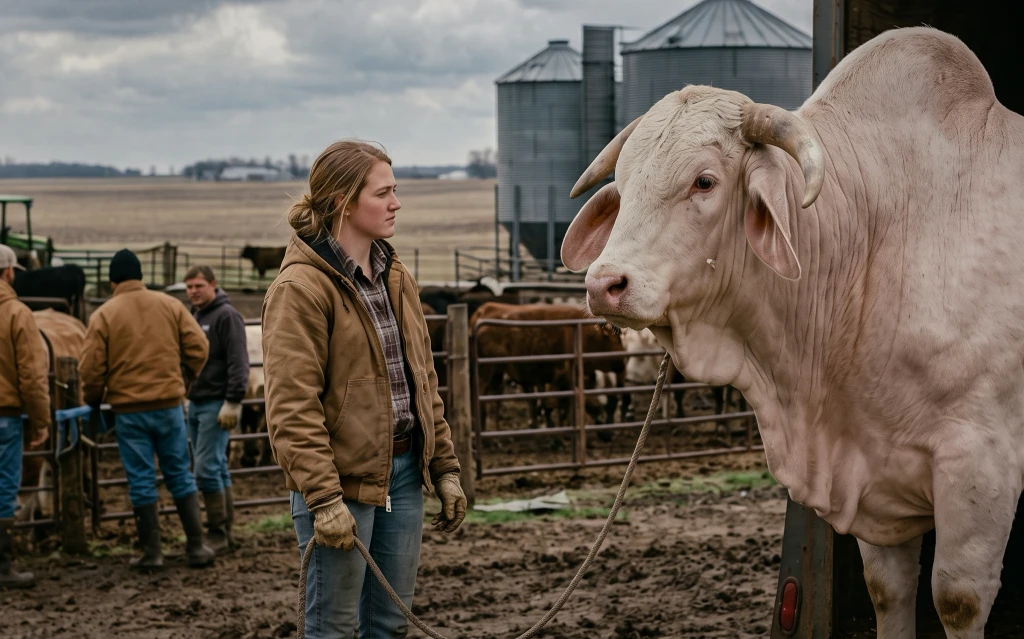
The white bull came off the trailer backward, with a dark scrape at the base of one horn and four men shouting as if volume could make two thousand three hundred pounds obey. Ruth Calder stood outside the receiving pen at Calder Stock Station, one hand on the chain latch. At fifty-eight, she had spent most of her life watching cattle before deciding what they meant. The bull’s nostrils were wide, but his tail was not switching. His forefeet kept testing the edge of the trailer floor. Each time the diesel engine shuddered under him, he threw his weight toward the wall.
“Kill the motor,” Ruth said.
The driver leaned from the cab. “He’ll come when we put the prod on him.”
“Kill it.”
Garland Kersey, owner of High Mesa Seedstock, had arrived in a polished pickup behind the trailer. His company raised expensive bulls on twelve thousand acres west of Wichita. He looked at Ruth’s weathered pens, her patched barn roof, and the red loading gate nobody had used in seven years.
Calder Stock Station had once received four hundred head on a busy fall weekend. Since the new auction complex opened near the interstate, Ruth survived on quarantine cattle, overnight hauls, and animals other yards considered inconvenient. She had closed half the pens after her son died and kept the rest because selling them felt too much like agreeing that one terrible afternoon had explained her whole life.
“We have a deadline,” he said. “Bishop injured a man Monday. My insurer will exclude any further handling claim after thirty days. I’m paying you for an assessment, not a seminar.”
Ruth kept her eyes on the bull. “Then let me assess him.”
The engine stopped. The vibration left the trailer floor. Bishop stood still so suddenly that the men stopped shouting.
Ruth opened the outer pen and moved to the side, where the bull could see her without turning. She held up a square of blue sorting cloth. His pale face followed it. When she lowered the cloth, he lowered his head. When she took one step back, he tested the ramp again and came down.
Mud struck the panels under his weight. He crossed the receiving pen without charging, kicking, or looking for a place to fight. At the water tank, he turned and studied every person along the fence. His coat was not truly white. Cream darkened to biscuit along his neck, and gray dust lay in the fold behind his shoulders. A raw scrape marked the base of his right horn where the trailer roof had caught him.
One of Kersey’s men let out a breath. “That’s the calmest he’s been all week.”
Kersey gave the man a look that ended the conversation. He handed Ruth a folder through the rails. Bishop was a five-year-old Charolais-Brahman cross, fertile on his last examination, heavy but sound. Three attempted collections had failed. Two hauling crews had refused him. The injured employee, Devon Pike, had needed surgery to repair his wrist after a hydraulic gate struck him.
The final page was High Mesa’s disposition order. If Ruth could not document ten safe handling sessions and obtain an independent veterinary opinion within twenty-one days, Kersey intended to send Bishop directly to a livestock processor. He had shortened the coverage deadline because, he said, his employees would not work near the bull again.
Ruth’s name appeared on High Mesa’s list because she had handled difficult cattle before Eli’s death and because her back pen had eight-foot pipe panels set in concrete. Kersey had not mentioned the old accident when he called. Ruth had not volunteered it. The boarding fee would cover two months of payroll, but she knew even then that money was only the respectable reason she had said yes. The private one was harder: she wanted to learn whether experience still meant anything after the worst thing it had failed to prevent.
“You understand he’s not a gift,” he said.
“I understand you want a clean decision.”
“I want nobody else hurt.”
That answer was honest enough to trouble her. Ruth signed the temporary-care receipt. Kersey left without looking back at Bishop.
By noon, the wind had turned south and warm. Bishop explored the pen in an orderly circle. He drank, tested the pipe fence with his nose, and stopped whenever Ruth crossed his view. Yet he did not flick an ear when a stock truck rattled over the cattle guard. He did not turn when a metal bucket fell behind the barn. When Ruth clapped once from beyond the fence, he kept drinking.
She was about to try again when a gray SUV came hard down the lane.
Dr. Leah Calder stepped out wearing navy scrubs under a canvas coat. High Mesa had emailed her clinic that morning seeking an outside evaluator; CALDER STOCK STATION in the subject line had sent her straight to the farm. Ruth had not seen her daughter in eleven months, though they lived only sixty-seven miles apart. Leah had her father’s height and her brother’s habit of closing a car door gently when she was furious.
They exchanged birthday cards and practical messages about taxes, storms, and Ruth’s blood-pressure refills. Leah never entered the station. Ruth never visited the veterinary clinic unless she knew her daughter was away. Both women described this arrangement as giving the other time, although neither had said what the time was supposed to accomplish.
“Tell me that isn’t Bishop,” she said.
Ruth set down the sorting cloth. “You know him?”
“Every large-animal vet in three counties knows him. High Mesa called our clinic after the second collection failure. We declined because they wouldn’t send his handling records.” Leah walked to the fence, then stopped when she saw the red gate at the far end of the alley. “You put him here?”
“The back pen is the strongest one I have.”
“That alley killed Eli.”
The words crossed the yard more cleanly than any shout. Ruth looked at the unused hydraulic chute beyond the gate. Seven years earlier, her twenty-nine-year-old son had been caught between a swinging panel and the concrete curb. The investigators called it a sequence of ordinary errors. Leah had called it preventable. Ruth had called nothing by its proper name since.
“He isn’t going through that chute,” Ruth said.
“He shouldn’t be on this property.”
Bishop had moved closer. Leah shifted automatically until two fences stood between them. The bull watched her face. She spoke sharply, testing him.
“Bishop.”
He did not move an ear.
Leah struck the flat of her hand against the steel rail. The impact traveled through the posts into the ground. Bishop lifted his head at once and stepped away.
Mother and daughter looked at each other.
Ruth picked up the blue cloth and raised it where the bull could see. Bishop stopped. She lowered it. He relaxed.
“He didn’t hear those men,” Ruth said.
Leah’s anger gave way to the wary concentration Ruth remembered from veterinary school. She walked ten yards along the fence while Bishop tracked her with his eyes.
Behind his shoulder, Ruth dropped the chain from her hand. It struck the dirt without a sound from him. Leah closed her eyes for a moment.
“If we’re right,” she said, “everybody has been punishing him for commands he never received.”
To read the rest of the story – CLICK the NEXT button 👇👇👇