


By the time Nora’s rental car reached the cattle guard, Tess Harper had already decided which lie she would tell first. She could say the county tax notice had arrived late. She could say the money from their mother’s care account had only been borrowed. She could say the For Sale packet on the kitchen table was not an answer but a conversation.
None of those things would survive her sister’s first question.
Tess watched the white car come over the rise through heat that made the Sandhills look loose at their edges. August had burned the grass down to the color of old rope. Even the windmill behind the calving shed turned without conviction, giving one dry click each time the tail changed its mind.
She wiped grinding dust from her forearms and set the welding hood on the porch rail. A portable water manifold lay on sawhorses beside her, one flange cracked where the fire-district nurse tank had dragged it last spring. Dale would have replaced the whole assembly. At fifty-five, Tess had spent the morning cutting a new flange from scrap plate because replacing what could be repaired still felt like a kind of betrayal.
Nora parked beside the lilacs their mother had planted forty years earlier and got out in city shoes already powdered with dust. At fifty-one, she had the same narrow Harper face as Tess, but she wore it differently—chin level, mouth composed, every expression given time to clear customs before it appeared.
“You didn’t answer last night.”
“I was in the shop.”
Nora looked at the dead phone clipped to Tess’s belt. “For eleven hours?”
Tess picked up the flange. “Coffee’s on.”
“The realtor is coming at one.”
“Then we’ll have bad coffee with company.”
A tan pickup crossed the cattle guard before either sister reached the porch. A magnetic STATE BRAND INSPECTION sign covered the driver’s door. Owen Bell stepped out carrying a tablet and the hurried courtesy of someone asking for help he had no authority to command.
“Mrs. Harper?”
“Tess.”
“Les Kelley said you have a thousand-gallon nurse trailer and know the Vale lease along your eastern line.”
Nora stopped beside the porch. “What happened?”
“Nothing yet. That’s why I’m here.”
The estate of Warren Vale had sold its last cow twelve days earlier. One bull remained in the twenty-acre catch pasture on the leased ground. The temporary caretaker’s contract had ended at midnight, and the estate’s next arrangement began with a veterinarian at seven the following morning.
“A veterinarian for what?” Tess asked.
Owen did not soften the answer. “On-site euthanasia.”
The catch pasture’s concrete tank was still working, but yesterday’s wind had filled the float cage with tumbleweed. The morning photograph showed six inches of water and falling. Owen had cleared the debris, yet the slow well would need hours to recover. He wanted enough hauled water on site to remove thirst from every decision that came next.
“Whose bull?” Tess asked.
“Warren Vale’s estate. His name is Rook.”
“Why can’t they move him?” Nora said.
“Come see the animal before I give you a stack of reports written by people who have already made up their minds.”
Tess looked at Nora. The realtor would arrive in ninety minutes. The tax pages sat beneath the sale packet. Driving away from that table was exactly the kind of useful emergency she no longer trusted herself to accept.
“Twenty minutes to look,” Tess said. “Then back to the accounts.”
“The accounts now,” Nora replied, “and the bull on the way to wherever the truth is.”
They hitched the nurse trailer to Tess’s flatbed. Nora rode with Owen so she could photograph the meter reading and ask questions without Tess answering for anyone. Tess drove behind them, the repaired manifold strapped beside two coils of hose.
The Vale lease began along Harper’s eastern line. Kelley’s harvested field bordered both properties farther east. The lease catch pasture lay on a low bench where the county road met Harper’s hay meadow, with no trees, only a pipe corral around the tank and an old loading alley at the far end. The fences stood straight. Every latch Owen showed them was closed and intact.
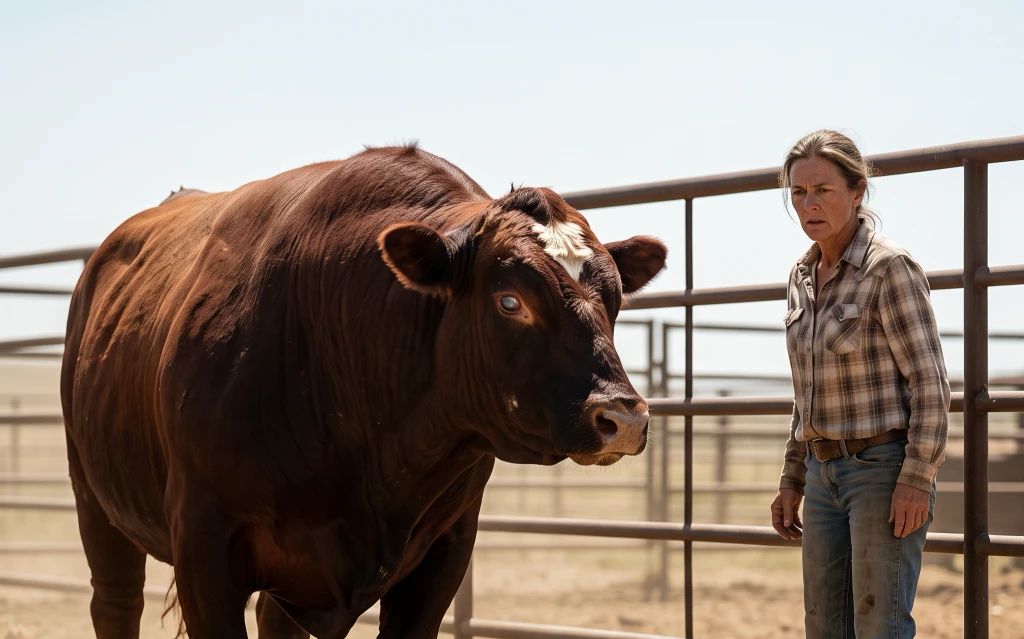
Rook stood at the concrete tank with his muzzle buried to the eyes. He was dark red over the ribs, black at the legs and neck, with a blunt white star between his eyes. Heat had dried mud in plates along his belly. No horns. No halter. A yellow tag in his left ear carried the number 417.
He lifted his head. Water streamed from his chin. He looked at the three people outside the pipe, then past them toward the open pasture, measuring distance rather than offering a challenge.
Tess stopped well beyond the fence. His deep middle and heavy neck put him above twenty-four hundred pounds.
“How long has he been alone?” she asked.
“Twelve days.”
“How long since someone stayed through a full water cycle?”
Owen checked the caretaker log. “Yesterday morning.”
Nora looked at Tess. “You were right to bring the tank. That does not make the rest of this yours.”
“I know.”
They connected the nurse trailer outside the fence and ran the hose through a protected sleeve to the tank. Tess opened the valve at half pressure so the sudden rush would not startle Rook. He moved away while the concrete filled, keeping thirty feet between himself and the new sound.
When Nora crossed the right side of the corral to check the meter, Rook turned until his left eye faced her. A pale crescent clouded the outer edge of the other eye. Tess noticed it and said nothing yet.
Owen opened the dispersal summary. Rook was a seven-year-old Simmental-Gelbvieh cross. The first crew had called him immovable at a bright trailer. The second said he spun away when the approach narrowed. A third hauler watched the video and declined the job without unloading. No person had been struck and nothing broken. Four commercial haulers and three possible placements had now refused him.
“Unsafe to transport alone,” Nora read from the final line.
“He’s the only animal the estate has left,” Owen said.
“How much does he weigh?” Tess asked.
“Two thousand four hundred sixty at his spring workup.”
The bull drank when the tank stopped roaring. He did not approach the loafing shade or test the pipe. He stood with his clear eye toward the people and the cloudy one toward empty pasture.
“Did anyone examine that eye before the loading attempts?” Tess asked.
Owen searched the file. The spring workup listed both eyes as present and free of active infection. It said nothing about field of vision or old opacity.
“I can ask Marian Vale to delay the veterinarian if a qualified person accepts emergency care here,” he said. “The estate keeps title. You document water, feed, and every person on the lease. No one represents the bull as safe.”
“Qualified by whom?” Nora asked.
“Dr. Ivy Chen knows Tess’s handling record. Marian can decide whether that is enough for forty-eight hours.”
Tess watched Rook choose the far side of the water rather than force the people to give it back. What she felt was not trust. It was the recognition of an unanswered practical question, dangerous precisely because she preferred such questions to the ones waiting at home.
“You promised the accounts,” Nora said quietly.
“I did.”
“If you take this on, we do both. No disappearing into the animal.”
Tess looked at the shallow well gauge, the heat, and the lone bull whose next appointment had already been reduced to a time on a page. Then she looked at her sister.
“Call Marian Vale,” she told Owen. “I’ll cover water and feed for forty-eight hours, and Nora gets a copy of every term. The veterinarian does not come at sunrise.”
To read the rest of the story – CLICK the NEXT button 👇👇👇