


The first trailer reached Mercer Farm with fourteen calves behind its slats and a red quarantine placard wired to the gate. Naomi Mercer stood in the lane with a clipboard authorized only that morning as dust lifted and the calves called in thin voices. Six more trailers waited on the county road. By sundown, sixty-seven abandoned dairy-cross calves would belong to nobody and depend on her.
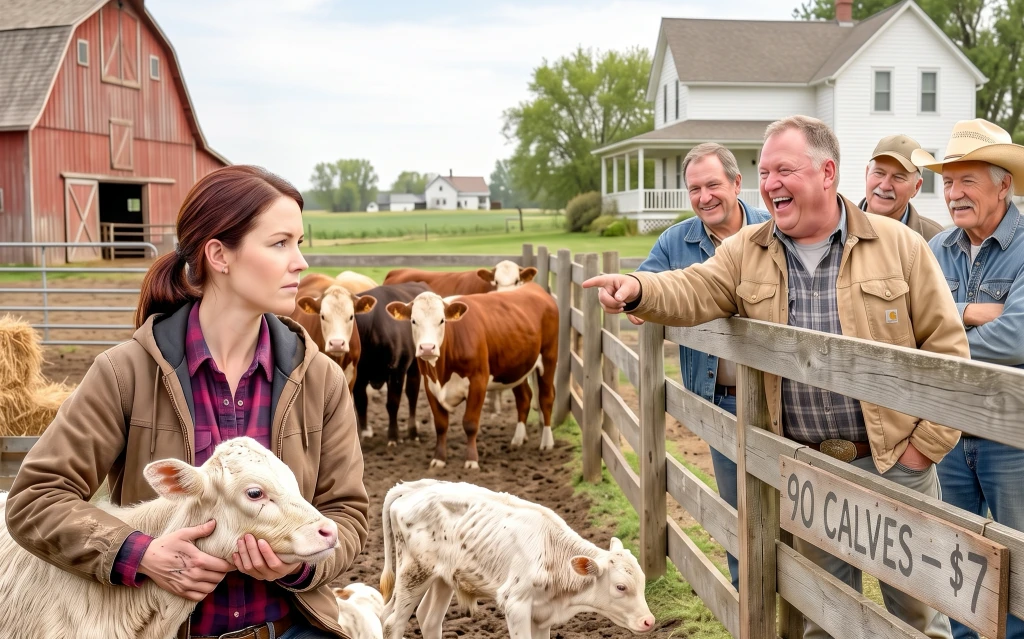
Three days earlier, a sheriff’s deputy had found them at a contract calf barn outside Colby after the operator disappeared. The county could seize animals from dangerous conditions, but it had nowhere built to hold that many young cattle. Dr. Lena Ortiz, the veterinarian assigned to the emergency response, had called Naomi because she remembered both the empty loafing shed on Mercer land and the woman who had once ridden beside her on farm calls.
Naomi had said yes before walking all seventy-two acres.
Now she watched the first driver ease toward a loading alley whose bottom hinge had rusted through. She had braced it with a chain and two fence posts at dawn. The repair looked solid if nobody studied it, which was how most of the farm looked after five dry years and one wet spring.
“Slow on that corner,” she called. “The alley narrows past the cottonwood.”
The driver leaned out his window. “You sure this place passed?”
“It passed for temporary placement.”
That was accurate in the narrowest possible way. Lena had approved two quarantine pens, the loafing shed, and a route that kept the arrivals from neighboring stock. She had also written three repairs in red ink, including the north fence, and given Naomi forty-eight hours to finish them. Naomi had completed the gate, patched the shed roof, and told herself the fence could wait until the calves were settled.
Her great-aunt June sat in the shade of the porch with a canvas hat on her silver hair and the cordless phone beside her. At seventy-nine, she no longer crossed rough ground without a cane, but she could direct a truck through the farm’s old lanes better than Naomi could. She raised one hand, sending the second trailer toward the east lot before its driver had time to ask.
Naomi had returned to Kansas eleven days ago with two duffel bags, a box of veterinary textbooks, and the conviction that she could make herself useful without explaining why her last job ended. June had offered the south bedroom and no questions. Their affection had always traveled best through practical things: clean sheets, sharpened tools, a plate kept warm under another plate.
The first calves came down the ramp with their heads low. They were Holstein and beef-cross animals, mostly five to eight months old, long-legged and underweight. Several had scours staining their tails. Two coughed, though neither cough had the deep, repeated pull Naomi feared.
She did not touch a syringe. She watched gait, breathing, eyes, and willingness to drink, marking tag numbers while Lena examined each animal and the county crew moved them in groups of ten. One black-and-white heifer stopped halfway down the ramp, trembling hard enough to shake the metal.
“Give her room,” Naomi said.
The men behind the heifer lowered their sorting boards. Naomi stepped to the side, where the animal could see open ground instead of bodies. After a moment the heifer came down on her own, one careful hoof at a time, and followed the others toward water.
Lena glanced at Naomi over the top of her mask. “You still know how to make yourself small.”
“Somebody had to remember.”
“Remember this too: observation isn’t a diagnosis. Anything changes, you call me.”
Naomi heard the warning beneath the instruction. At the clinic she had been good at anticipating a veterinarian’s hands, sometimes so good that she resented needing the veterinarian attached to them. Then she had missed a swollen joint on a ranch call after covering two shifts, written “normal” on an intake sheet, and tried to correct the record before Lena saw it. The calf recovered. Naomi’s certainty had not.
“I’ll call,” she said.
By noon, twenty-nine calves had been unloaded, scanned, and sorted into cohorts that would remain separate pending test results. The county supplied temporary troughs, feed for ten days, and labor through the afternoon. After that, the daily work would be Naomi’s under a custodial agreement whose reimbursement covered less than June’s last electric bill.
A white ranch pickup stopped outside the quarantine ribbon. Grant Rourke got out wearing clean work gloves and an expression that suggested he had already measured the distance between every calf and his cattle. His family’s operation wrapped around the Mercer place on two sides, eleven hundred acres of cow-calf pasture running down toward Sand Creek.
June had described him that morning as “useful when usefulness and Grant’s interests happen to point the same direction.”
He nodded to Lena, then looked at Naomi. “Your north line is four strands of tired wire and one strand of hope.”
“The calves aren’t going near it.”
“Cattle specialize in going where they aren’t going.” Grant kept his voice level. “My herd lost thirty-two calves to BVD six years ago. One persistently infected animal came through a backgrounding lot and taught me what trust costs.”
Lena stepped between the quarantine ribbon and the alley. “We’re screening these calves. Until results are back, they stay double-fenced from outside livestock. Naomi has my conditions in writing.”
Grant’s eyes went to the repaired hinge, then beyond it to the north pasture. “Does she have the fence in writing too?”
Naomi could have said it was on the list. Instead she said, “It’ll hold.”
The words left a sourness behind them. Grant did not accuse her of lying; he only looked at the line long enough to show that he knew a promise was not a repair.
“If one crosses,” he said, “my insurance carrier will treat every exposed animal as a separate problem. That isn’t me trying to run you off. That’s arithmetic I’ve already paid once.”
He returned to his truck. Naomi watched him drive toward the Rourke loading pens and hated that he had spoken to the part of her already keeping count.
June had come down from the porch. “North line still bad?”
“It’s not part of the quarantine pens.”
“That wasn’t what I asked.”
Naomi handed her the clipboard. “I need the tag list checked against the groups. Can you do that?”
June accepted the paper, but her mouth tightened. Naomi recognized the expression from childhood visits, when June had let a subject go only because she intended to meet it again with better leverage.
The remaining trailers arrived in the heat of the afternoon. One steer went down in the sixth load and would not rise. Lena examined him where he lay, administered fluids and medication from the county’s emergency supply, and directed the crew to slide him onto a low sled rather than force him to his feet. Naomi stayed by his head, keeping the shade tarp from snapping above him.
“Temperature’s high, lungs are rough,” Lena said. “We isolate him and reassess tonight. No heroics. If he declines, you call.”
“I know.”
Lena held her gaze. “Knowing and calling are two different jobs.”
At six-thirty, the last calf cleared the last trailer. Sixty-seven animals stood in four small groups with clean water, hay, shade, and space between them. The steer on the sled had lifted his head. June read every tag number aloud while Naomi checked it, her voice steady across the dusty pens.
The county trucks left one by one. Their departure changed the farm’s size. The loafing shed, the lots, even the sky seemed to draw closer around the two women and the animals breathing under their care.
Naomi walked the groups before dark. The black-and-white heifer followed her along the inside of the panel fence, not tame enough to approach but unwilling to let her disappear. Naomi marked her tag—418—with a note to watch her left hind leg, then resisted the urge to turn the note into a conclusion.
June waited at the kitchen table with two bowls of chicken and noodles. She had put the county agreement beside Naomi’s place and the farm ledger beside her own. Its green cover was worn white along the edges.
“We did it,” Naomi said as she sat. Her hands shook now that there was nothing in them. “All sixty-seven are watered and sorted. Lena thinks most have a fair chance.”
“Then today was worth doing.” June pushed the bread plate across. “Tomorrow will send its own bill.”
Naomi ate three bites before noticing June had not opened her ledger. “How far behind are the property taxes?”
“They’re paid.”
“Then what bill?”
June folded her napkin into a smaller square. In the barn, a calf called once, and another answered from the east lot.
“I signed a note against the land, Naomi,” June said. “The balloon payment comes due in March.”
To read the rest of the story – CLICK the NEXT button 👇👇👇