


The hatchery driver had already tipped three crates into the South Road ditch when Clara Whitlock saw one of the eggs move. It was not much of a movement. The goose egg lay half sunk in dead grass, its white shell crossed by a hairline fracture, and rocked once against a clod of March mud. Clara had been replacing a staple in the fence twenty yards away. She set the hammer on a post and climbed through the wires before the egg became still again.
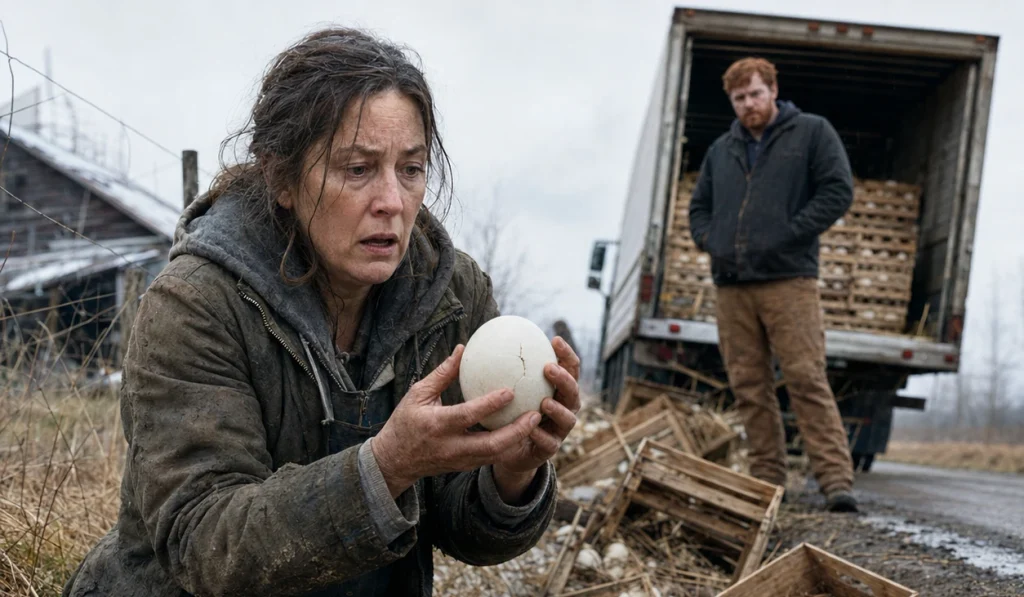
“Ma’am, you don’t want to step in there,” the driver called. “Some of them are leaking.”
The truck stood crooked on the shoulder, one rear tire soft enough to explain the broken cargo. Inside the open cargo compartment, wooden flats had shifted into one another. Eggs rolled in straw, some crushed, some marked only by thin gray cracks. Warm air rose from the crates into a morning cold enough to show Clara’s breath.
She picked up the egg that had moved. Through the break in the shell, the membrane beneath looked unbroken.
“How far along are they?”
The driver took off his cap and wiped his forehead with his sleeve. He was perhaps thirty, red-haired, and already tired of the day. “Seventeen days. Give or take. The north unit lost part of its heating system, so we were moving them to the main hatchery. Then a cargo strap broke. Cedar Run told me to dispose of the load and get back.”
“Cracked isn’t the same as empty.”
“They’re not going to hatch out here.”
“No,” Clara said. “They won’t.”
She carried the egg up the bank. The driver was Owen Mercer; his name was stitched over the pocket of his work shirt. He did not object when she asked to take the eggs, but he did object when she asked him to put it in writing. He had a tire losing air and a dispatcher who had already told him to clear the roadside and return.
Clara stood by the cab while he called anyway. She listened as he explained that the adjacent landowner would accept the rejected load at her own risk. After a pause, he wrote an authorization number on the back of a pink delivery exception sheet. Under it he added, in block letters, CEDAR RUN RELINQUISHES LOAD AS ABANDONED—NO COMMERCIAL VALUE, then signed his name.
“You planning to sue me if one explodes?” he asked, handing her the carbon copy.
“I’m planning not to argue later about what you threw away today.”
He studied her as if deciding whether that was humor. Then he gave a short laugh and helped lift the next crate down instead of dumping it.
By noon the truck was gone and 350 eggs lay in the ditch or in the padded containers Clara had scavenged from the farm. She used dairy crates lined with feed sacks, two galvanized tubs packed with straw, and the wool blanket that usually covered the bench in her mudroom. Every trip to the old barn took her past the mailbox where the bank’s envelope had arrived six days earlier.
October 31. The date of the annual payment on the farm’s operating note. Seven months was time enough to plant, cut hay, sell what she could, and still fail. Clara had written the amount on the calendar above the kitchen sink, though she no longer needed to look at it.
The old dairy barn offered little encouragement. Its north room had a stone floor, two broken panes, and roof boards darkened by slow leaks. Rusted stanchions remained where her father had milked twenty-six Holsteins before his stroke. Ruth had sold the herd that same spring. Clara had been nineteen, furious, and certain that a person who loved a place did not empty it so efficiently.
Twenty-five years later, she was still using that spring as evidence against her mother. Clara carried the last salvageable crate inside shortly before four. Then she went to the wall phone in the kitchen and dialed Ruth Calder’s number from memory.
Her mother answered on the fourth ring. “What broke?”
“Why do you assume something broke?”
“You haven’t called since Christmas.”
Clara looked through the window at the barn. “A hatchery truck lost a load on South Road.” Ruth let the silence sit. She had worked at Cedar Run for twenty-seven years, first on candling tables and later supervising the incubation room. Clara had spent the morning knowing exactly whom she needed and postponing the cost of saying so.
“How old are the eggs?” Ruth asked.
“Seventeen days, the driver thinks.”
“How long were they outside?”
“Hours, not all day. They were warm when they came off the truck.”
“And the shells?”
“Every one cracked. Some worse than others.”
Ruth exhaled near the receiver. “I’ll bring my lamp.”
She arrived forty minutes later in a brown coat Clara remembered from childhood, carrying a wooden case with a black metal candling lamp inside. Ruth was sixty-eight and small enough that strangers mistook her economy of motion for frailty. She walked past Clara’s explanation, washed her hands at the barn sink, and lifted the first egg without greeting it or mourning it.
“This one’s gone.” She placed it in an empty pail. “Membrane is torn.”
The next showed dark leakage beneath the shell. The third smelled faintly sour before Ruth raised it to the light. The fourth made her stop.
In the candling lamp’s circle, a network of vessels spread through the egg in branching red lines. A shadow shifted inside.
Ruth turned the shell a fraction. Her expression did not soften, but she lowered her voice. “That one has a chance.”
They worked until the north room was dark except for the lamp and one bare bulb overhead. Clara recorded the count in an old farm ledger: seventy-four with torn membranes, thirty-one leaking or spoiled, nineteen clear and undeveloped. Ruth did the subtraction twice.
Two hundred twenty-six remained.
“A chance isn’t a promise,” Ruth said. “Cracks let moisture out and bacteria in. Moving them again adds stress. If you begin this, you’ll lose some.”
“How many?”
“Nobody honest can tell you.”
Clara glanced at the surviving eggs arranged in straw at their feet. “Can this room hold them?”
Ruth looked at the missing panes, the low ceiling, the cold stone, and the old iron stove that had not been lit in years. “The room can. I’m less sure about you.” They began before Clara could turn that into a fight. First they enclosed two old calf pens with boards and wool blankets, creating a temporary warm holding area around the stove while Clara rebuilt the rest of the room in sections.
Over the next three days, she cleared loose junk from the north room and scrubbed years of grit from the stone. She patched the windows with salvaged glass, leveled three broad shelves, and set shallow metal trays above pipes she rerouted from the old wash system. The iron stove supplied heat. Baffles made from scrap lumber moved warm air toward the far corners. Four thermometers hung at shelf height, each with its own column in a chart Ruth taped beside the door.
For the finest cracks, Ruth showed Clara how to brush a narrow film of warm paraffin over the damaged line, leaving the blunt end and as much shell exposed as possible. The worse cracks stayed out. Every egg received a pencil mark for position. Turning, ventilation, brief cooling, water trays, inspection—each task went onto the chart.
“Follow the numbers, not your nerves,” Ruth said.
Clara heard the old accusation beneath it. Ruth had said nearly the same thing when she sold the dairy cows: feed bills did not care how much the Whitlocks loved them. Clara answered by reaching for another egg.
For three nights she slept on a cot outside the room and woke every two hours. She fed the stove, checked all four thermometers, turned eggs, recorded numbers. The shells seemed too thin for the weight of her hope. Whenever she saw a sealed crack, she imagined it opening after she left.
On the third evening, she reheated the paraffin. Ruth had shown her a film so thin it dulled as soon as it touched the shell. Clara added a second pass to twenty-six eggs, then another to a row whose cracks looked darker than they had that morning. She told herself she was reinforcing only the damaged places.
That night the temperature fell to eighteen degrees. Wind pressed through the repaired window frames and made the roof hatch knock against its chain. Clara checked the far thermometer at eleven. It had dropped by two degrees.
She shortened the hatch chain until the vent shut. At one in the morning, the room felt close, but the thermometers had recovered. At three, condensation pearled beneath the upper trays. Clara wiped it away with a towel and added less wood to the stove. She did not reopen the hatch until daylight.
Ruth arrived before seven. She stopped in the doorway, took off her glasses, and wiped the lenses on her blouse. Moisture had beaded on shells across the first shelf. One egg carried a gray bloom beneath the wax.
Neither woman spoke while they candled the row. In egg after egg, vessels that had been red the day before had dulled toward brown, with no movement behind them. Ruth set every suspect egg aside and checked the group again after the last tray. Eighteen showed the same pattern, and she marked them as lost.
Ruth held one of the sealed eggs between finger and thumb. “You put more wax on these.”
“The cracks looked open.”
“They weren’t.” Ruth set the egg down. Her eyes moved to the rope hanging beside the door. “Did you close the roof vent?”
Clara rubbed a wet place from the tray with the edge of her sleeve.
“Clara.” Ruth waited until her daughter looked at her. “Did you close it…”
To read the rest of the story – CLICK the NEXT button 👇👇👇