


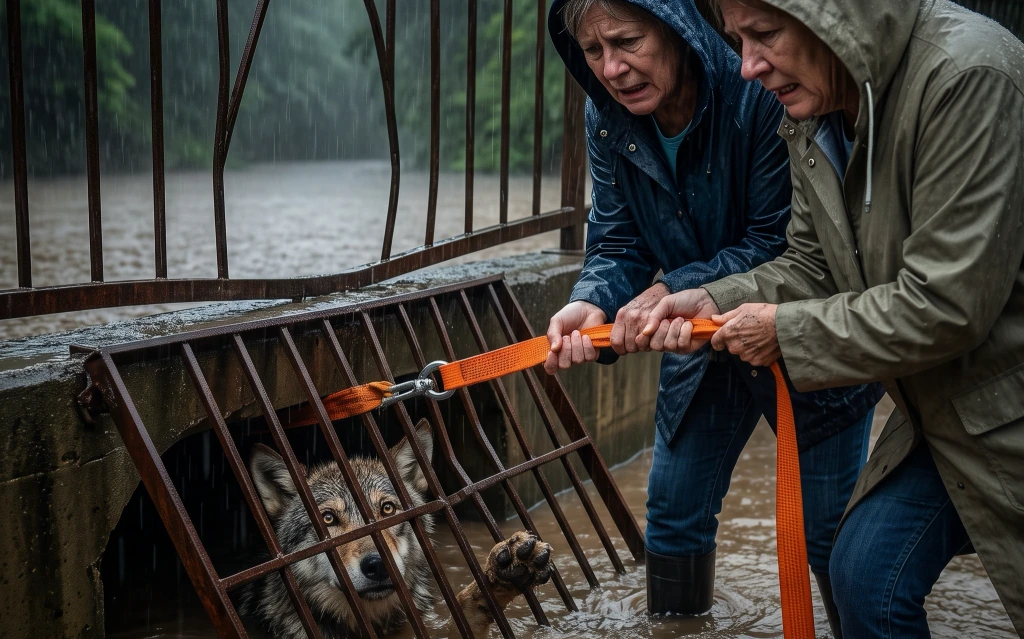
At first June Calder took the gray shape under the county-road culvert for a soaked alder root. Then it blinked. She leaned closer to the kitchen window, one hand still on the roll of flood-zone maps she had corrected in red pencil. Brown water crowded the concrete opening below the orchard. Wedged behind the bowed trash rack, a young wolf stood on a shelf no wider than a dinner plate, its chest pressed to steel while runoff climbed its legs.
Behind June, packing paper stopped rustling.
“What now?” Tessa asked.
“There’s an animal in the east culvert.”
Her sister came to the window with one of their mother’s blue bowls against her sweater. Tessa had driven from Spokane that morning with twelve empty boxes. In four hours they had filled three, and June had already returned objects from two of them to the shelves.
Tessa’s phone sounded again: rain on early snow, runoff from the August burn scar, voluntary evacuation below Black Alder Road. June had dismissed the first alert because the map used a drainage that had not carried water since 2007.
The wolf’s forelegs slipped. Its shoulder struck the rack, and the steel gave a low metallic bang June felt through the window glass.
Tessa set down the bowl. “Call it in.”
“You call. I’m going down.”
“June.”
June was already pulling on her rubber boots. “If that rack lets go, it’ll pin him under the road.”
“You don’t know it’s a him.”
“I know what twelve hundred pounds of bent steel can do.”
She took the utility-room keys from their hook. Tessa snatched her raincoat and followed, dialing as she came.
Outside, rain blurred the lower trees into dark bars. Water moved where grass had been at breakfast, and the last hard apples knocked together in the branches.
June kept to the crown of the lane. At sixty-seven, she still walked grades by feel, placing each boot where the ground returned rather than swallowed weight.
“Fire and rescue are coming,” Tessa called. “So is the road department. They said stay uphill.”
“They always say that before they know the site.”
“Ben Salazar knows the site. You trained him.”
“I trained him to look before he repeated dispatch.”
The culvert carried Black Alder Creek beneath the county road and emerged above the orchard in an old concrete apron. Branches, burned bark, and pasture fence clogged its rusted trash rack. The wolf was trapped on the downstream ledge, where water forced through the bars struck its flank.
It turned its head when the women stopped. Rain flattened the fur along its narrow face. One ear was torn cleanly near the tip, not fresh, and a bloody line marked its left foreleg. It showed its teeth without making a sound.
June stayed twenty feet away. “The lower anchor is pulling out.”
Tessa looked at the rack, then at June. “Translate.”
“It may fold downstream. If it does, the debris goes with it.”
“Can we move the wolf?”
“Not without making him move first.”
The county had installed a maintenance eye above the apron after the 1996 flood. June remembered the loop because she had rejected its first weld. It was still there beneath the moss.
She pointed to the red farm truck parked beside the equipment shed. “Bring me the recovery strap from behind the seat.”
“The people with rescue in their name are four minutes away.”
Water slapped the wolf’s belly. Its rear paw lost the ledge and found it again.
“The rack is moving now. I’m not going in the channel. I need to hold the steel until they get here.”
Tessa did not agree. She ran for the truck.
June clipped the farm winch line to the strap and crawled along the dry edge only far enough to throw the loop over the maintenance eye. The wolf struck the rack when the orange webbing crossed its view. June backed away at once.
“That’s all. I’m done near you.”
Tessa returned with the winch controller sealed in a plastic bag. “Tell me where to stand.”
The question checked June’s impulse to take the controller. Tessa had spent twenty-eight years rebuilding furniture frames other people declared ruined. She understood tension.
June handed it to her. “Beside the rear tire. Take up slack only when I raise my fist. If the strap starts sawing at the concrete, stop.”
Tessa nodded once.
June guided the strap around the upper frame from the bank with a pruning pole. Tessa feathered the winch until the line firmed. The rack stopped shuddering, though one lower bar kept creeping from its anchor.
Red lights washed the trunks. Ben Salazar came down the lane in a county slicker, followed by two fire-rescue volunteers. At forty-six, he still approached a structure as June had taught him: looking first at what had moved around the loudest failure.
He took in the truck, the strap, and Tessa’s position. “Good temporary hold. Nobody adds load.”
June disliked the relief that moved through her.
Dr. Priya Shah arrived in the state wildlife van. She studied the wolf through binoculars. “Young male, probably last year’s litter. Alert. The cut is not our main problem. Water and entrapment are.”
“Can you sedate him?” Tessa asked.
“Not while he can fall into moving water. First we lower the flow and give him one dark exit.” Priya looked at Ben. “Can you divert without sending a surge through here?”
Ben pointed uphill. “There’s supposed to be an east relief swale and a hand gate above the bend.”
June looked toward the lower orchard. “The hand gate won’t help.”
Ben glanced at her, but the rack groaned before he could ask why.
The team anchored a second line and built a narrow panel tunnel from the ledge to a canvas-covered transport crate. No one crowded the opening.
Ben opened the small bypass a quarter turn at a time while a firefighter watched the downstream gauge. Water dropped from the wolf’s belly to its knees, then stalled.
“That’s all the bypass can take,” Ben said.
Priya waited. The wolf did not move toward the panel tunnel. It pressed harder against the rack, eyes fixed on the six humans who had made the open bank smaller.
“Back up,” Priya said. “Everyone except me and the shield handler.”
June stepped away with the others. When Tessa reached for her sleeve, June nearly shook her off. Then the lower anchor spat a chip of concrete into the water.
“Take my elbow,” June said.
They climbed five yards up the bank and turned.
Priya’s technician raised an opaque shield behind the rack, blocking the wolf’s view of the creek. Priya tapped one panel, making the enclosed space less desirable than the dark square ahead. The wolf crouched.
Then the lower bar tore free.
The rack lurched against the strap. Tessa gripped the controller without touching a button. The wolf sprang through the tunnel, its injured foreleg buckling once, and struck the back of the crate as Priya dropped the door.
The impact rocked the crate. Ben and the firefighter steadied it from the sides. Priya covered the remaining opening and waited until the animal’s frantic movement slowed before giving a sedative through the crate wall.
“He’s breathing well,” she said after a minute. “Nobody open anything until I say.”
Tessa let out a breath that ended like a laugh but was not one. June realized her own nails had cut crescents into her palms.
The wolf’s eyes remained open as the drug took hold. They followed Priya, then Ben, then settled briefly on June. She knew better than to turn that look into gratitude. The animal had found the only available exit. That was enough.
With the crate secured in the wildlife van, Ben ordered the crew off the apron and walked the bank again. Lowering the water had exposed a pale band of concrete east of the culvert, too straight to be native stone. Three round lift holes showed above the mud.
Ben crouched and scraped away wet leaves. Beneath them lay the capped mouth of the old relief channel, packed solid from wall to wall.
June knew every mark in that concrete. She had specified the mix, signed the work order, and planted the first apple tree over the finished grade.
Ben stood slowly. Rain ran from his hood onto the paper map in his hand.
“June,” he said, “who filled the east relief?”
To read the rest of the story – CLICK the NEXT button 👇👇👇