


The bear came to Claire Bennett’s porch carrying something that did not move. It was not yet full daylight. Rain ticked through the balsams and ran from the cabin roof in silver cords, and Claire had opened the door because she had heard three slow scrapes across the boards. At sixty-one, after thirty-four years of waking to police scanners, newsroom calls, and the small mechanical cough of camera shutters, she still came instantly awake when a sound did not belong.
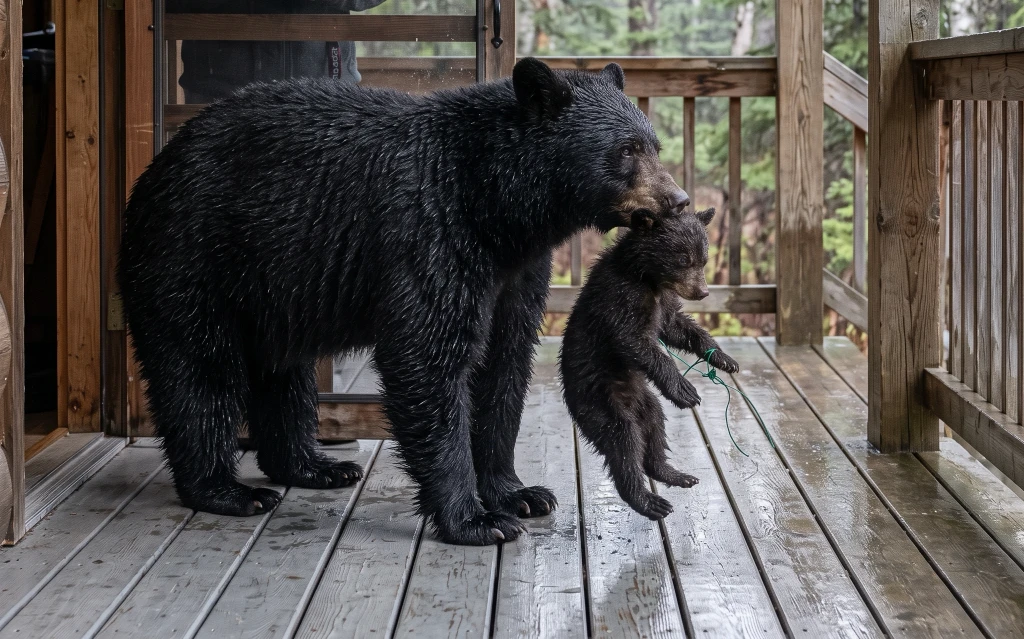
The black bear stood beyond the woodpile, no more than fifteen feet from the screen door. Water had flattened the fur along her shoulders. One ear was split at the rim, and a faint pale blaze marked the center of her chest. In her mouth, held by the loose skin behind its neck, hung a cub the size of a barn cat.
Claire’s hand found the doorframe. The bear’s eyes looked wet because everything in the woods was wet; Claire knew that, even while some older and less disciplined part of her tried to name the look as grief. The sow did not growl. She shifted her weight, lowered her head, and laid the cub on the porch between the boot scraper and the blue enamel kindling bucket.
Then she backed into the rain.
Claire closed the solid door without latching it and stood with her palm against the wood. Her old Nikon rested on the hall table where she had left it after photographing loons the previous evening. Before she reached for the phone, she lifted the camera.
The movement was older than judgment: thumb to power, finger to shutter, eye to the rectangle that made terror manageable. Through the narrow glass beside the door, she took three frames. In the first, the sow was a dark wall beyond the railing. In the second, her head had turned toward the trees. In the third, the cub lay alone on rain-blackened boards, one front leg crooked beneath it. Only then did Claire call the state wildlife emergency number.
“There is a sow outside,” she told the dispatcher. “She put a cub on my porch. The cub may be dying.”
The woman on the line did not waste time asking whether Claire was sure it was a bear. She asked for the address, the distance to the nearest occupied house, whether the sow still had a clear route to the woods, and whether Claire had touched the cub.
“No.”
“Good. Stay inside. Don’t open the door, don’t feed it, and don’t try to move it. The mother may be just out of sight.”
Claire looked through the side pane. The cub’s ribs moved once, too quickly, then seemed to stop. A narrow length of green-coated wire trailed from its foreleg and disappeared under its belly.
“How long?” she asked.
“An environmental conservation officer is coming from Long Lake. We’re also trying to reach the wildlife veterinarian on call.”
Claire already knew who that would be on a Thursday in May. The knowledge tightened something under her breastbone.
“Dr. Mara Bennett?”
There was a pause while keys clicked. “Do you know her?”
“She’s my daughter.”
The dispatcher’s voice softened by half a degree. “Then let us contact her through the proper channel. Keep this line available.”
At the dispatcher’s request, Claire used the card reader in her camera bag to copy the third frame to her phone and forward it. Then she set the Nikon facedown.
Claire did as she was told for eleven minutes. She watched rain pool beneath the cub’s muzzle. She watched one hind paw twitch and felt relief so sharp it bordered on pain. At the edge of the yard, between two balsam trunks, the sow appeared and vanished as she paced a line no wider than twenty yards. The phone rang.
“Mom.” Mara’s voice was clipped, professional, and breathless around the edges. “Tell me exactly where you are.”
“In the hall.”
“Inside?”
“Yes.”
“And you haven’t touched it?”
Claire knew that the answer mattered beyond the animal on the porch. “I haven’t.”
“Good. Keep the front of the house quiet. No lights, no coffee grinder, nothing. Officer Ortega is twenty-five minutes out. I’m behind him with the field kit.”
“It’s barely breathing.”
“I know.”
“You haven’t seen it.”
“You sent the dispatcher a picture.”
Claire glanced at the Nikon. “She asked for one.”
“A phone picture, Mom. Not a portfolio.”
The old injury in Mara’s voice was there and gone before either of them acknowledged it. Nine months had passed since she had last come to the cabin. Four months since she had answered anything from Claire with more than a line or two. Still, when the call came, Mara had left the North Country Wildlife Center before sunrise and was driving into cold rain because an animal needed her.
“The wire is tight around the foreleg,” Claire said. “Green plastic coating, maybe sixteenth-inch cable. There’s swelling above it.”
Mara exhaled. “That’s useful. Now step away from the window. A sow with a hurt cub can change her mind about you very quickly.”
The call ended. Claire went to the kitchen, poured coffee grounds into the filter, then remembered and stopped before switching on the machine. Quiet, Mara had said. Claire stood in a cabin that had been too quiet for two years and listened to the cub breathe on the other side of the door.
Tom had built the porch with boards salvaged from an old church hall. He had left the square nail holes visible because he liked objects that admitted they had been used before. After his cancer moved into his spine, he spent his final summer in a cedar chair beside the blue kindling bucket, watching warblers work the serviceberry bush. Claire had photographed him there only once. She had photographed Mara with him many more times than Mara knew.
A low sound came from the porch—not a cry exactly, but a breath forced through a throat too small for it. The sow answered from the trees with a deep, pulsing moan. Claire’s fingers closed around the edge of the counter.
Twenty-five minutes became thirty-five. Rain thickened. The cub stopped making noise. Claire imagined circulation failing under the wire, tissue cooling past recovery, every wasted minute entering the body as damage. She had spent her career learning that institutions moved faster when people could see what delay looked like.
She opened the local North Woods Neighbors group on her phone. The group had found lost dogs, cleared storm-fallen trees, and once located an oxygen concentrator during a three-day power outage. Claire attached the least dramatic of the three photographs and wrote: Injured black bear cub on a porch off Stillwater Road. Mother is present. DEC is responding. Please stay away from the area and secure pets and trash.
She hesitated over the blue button.
The cub’s paw jerked against the wire.
Claire posted.
The first truck arrived six minutes later, dark green with the state seal on the door. Environmental Conservation Officer Luis Ortega parked sideways at the end of the short drive, using the vehicle as a barrier between the porch and the road. He stayed inside until he had scanned the tree line, then stepped out with bear spray at his belt and a long gun secured in the cab rather than displayed in his hands.
Mara’s mud-spattered SUV pulled in behind him. She emerged in waterproof field pants, her dark hair twisted into a knot, carrying a hard-sided medical case. Claire had forgotten how much her daughter moved like Tom when there was practical work to do: no wasted motion, no announcement that she was afraid.
Ortega raised one hand toward the cabin, palm out. Stay inside.
He and Mara spoke beside the truck. Mara studied the porch through binoculars, then the woods. The sow had disappeared, but the wet grass along the tree line shook without wind.
Ortega positioned a plywood shield beside the porch steps and opened the rear door of his truck. Mara removed a dark transport crate, towels, and a compact oxygen unit. They waited another minute. Claire understood the delay only when the sow broke from the hemlocks, bounded ten yards across the yard, and stopped.
She did not charge. She stood broadside, blowing hard through her nostrils, her head low.
Mara froze behind the shield. Ortega spoke in a firm, even voice—not words meant to be understood, only human sound announcing a boundary. The sow clacked her jaws once, wheeled, and crashed back into cover.
Claire pressed both hands to the cold glass.
The next movement was fast. Ortega guarded the tree line while Mara climbed the three steps, knelt, and slid a folded towel over the cub’s head. One gloved hand found its chest. The other lifted the loop of green wire.
The cub convulsed once. A raw, astonishing bawl tore out of it.
From the woods came the mother’s answer.
Mara looked toward the sound, then bent lower over the cub. She gave an injection, cut the trailing wire, and transferred the small body into the padded crate. When she carried it down, one tiny paw protruded from the towel. Claire saw the pads flex. It was the first good thing the morning had given them.
Then Claire’s phone began to vibrate across the hall table.
One message followed another. The local group administrator. A former colleague in Albany. Someone she had not spoken to since Tom’s memorial. On the screen, beneath a screenshot of her post, a regional news page had added a headline: MOTHER BEAR BRINGS DYING CUB TO FORMER PHOTOJOURNALIST’S DOOR. Her photograph was already underneath it. So was the name of the lake.
Mara stepped into the mudroom while Ortega secured the crate. Her gaze moved from Claire’s camera to the bright phone screen. “Tell me,” she said, “that you didn’t give them the road.” Headlights turned between the trees…
To read the rest of the story – CLICK the NEXT button 👇👇👇