


The third family did not reject Arthur. That was the word people used because it made the afternoon easier to explain, but no one had brought him forward and said no to his face. They had simply chosen a yellow puppy two pens away, and Arthur had watched the red leash leave in a little boy’s fist. Then he turned, carried his blue blanket back to the cinder-block wall, and lay down with his back to the room.
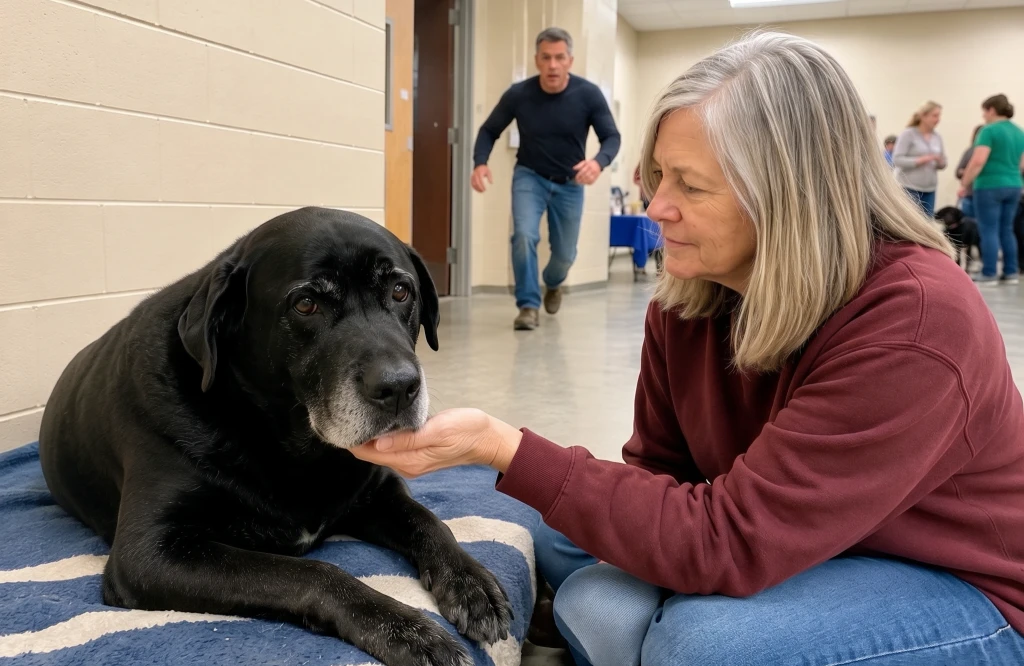
At five adoption events before, Lily Morales had watched him do the same thing. The first time, he had stayed upright until the last folding table was carried out. By the fourth, he had begun taking himself to the same corner as soon as the crowd thinned. He reacted to the scrape of stacked chairs, the snap of empty kennels being folded, the cheerful voices people used when they were trying not to look at the dogs who remained.
No one could know whether Arthur understood more than the simple sequence: those sounds came before another ride in the shelter van. Lily did not pretend otherwise. She documented what he did and left the stories people wrapped around it out of his file.
Arthur’s evidence was plain enough. He was a seventy-six-pound black Lab mix with gray frosting his muzzle, arthritis in both hips, and a habit of placing his chin in an offered palm. He had done it for the little girl who wanted the puppy, for a woman who asked three sensible questions about veterinary costs, and for a runner who needed a trail dog. Each time, Arthur had waited without wagging. Each time, when the person moved on, he had returned to the blanket.
At four-thirty on Sunday, volunteers began taking down the paper paw prints taped to the windows of the Marston Community Hall. Seven dogs had left with adoption folders. Two were going back to Hawthorn County Humane Society.
Arthur faced the wall.
Lily crouched beside him, one knee protesting against the tile. She had managed foster placements for eight years and had learned not to make promises over an animal’s head.
“We’ll get you out of here,” she said anyway.
The outer door opened hard enough to strike the rubber stop. A woman came in carrying a leather purse, a rolled set of condominium plans, and the expression of someone who had spent the drive arguing with herself. Her silver hair had been cut blunt at the jaw, but one side had flattened beneath a rain hood. She paused when she saw volunteers mopping around empty pens.
“I’m too late.”
Lily stood. “Carol?”
Carol Vance looked from Lily to the far wall. She had donated twenty dollars a month since her husband died, always by check, always in an envelope addressed in the narrow, upright hand of someone who had written thousands of customer invoices. Three months earlier, she had asked Lily what happened to old dogs nobody chose. Lily had answered honestly and then left the question alone.
That morning, she had texted Carol a photograph of Arthur on the blue blanket. Sixth event today. No pressure. I just thought you should see him.
Carol had not replied. Now she set the rolled plans on a chair. “Is that him?”
Arthur’s right ear turned. The rest of him did not.
“That’s him,” Lily said. “The room was a lot today. Give him space.”
Carol approached until she was six feet away, then stopped. She had spent thirty-seven years repairing upholstered furniture, and she noticed the blanket before she noticed the dog: navy acrylic worn almost white along one fold, two corners neatly bound with mismatched thread, a small brown burn near the edge. It was not shelter property. Someone had kept it after it ceased being worth keeping.
“Did it come with him?”
“Yes.”
“From where?”
“His owner went into memory care in May. Her nephew surrendered him. That’s all I can share.”
Carol’s mouth tightened, not at Lily, she thought, but at the shape of the sentence. An older creature moved for his own good. A relative completing forms. One familiar thing allowed to come along.
“Don’t make him into you,” Lily said quietly.
Carol gave her a sharp look.
“I mean it kindly. He doesn’t need someone to feel sorry for him. He needs a person who can manage a big senior dog on good days and bad ones.”
“I know the difference.”
Lily’s eyes moved from Carol to the rolled condo plans. The pause made her doubt plain, but she did not argue. “Sit sideways. Don’t call him.”
Carol lowered herself to the floor with more care than she wanted anyone to notice. She sat a few feet from the blanket, legs folded to one side, and rested both hands in her lap.
Volunteers worked around them. A kennel latch clicked. Someone rolled a plastic bin toward the storage closet, the casters ticking over grout lines. Arthur kept his head down.
Carol did not speak. She studied the old repairs in the blanket and resisted the urge to fix them. After a minute, she moved one hand to the floor, palm up.
Arthur lifted his head. His eyes were darker than his coat and clouded faintly at the edges. He looked first at the hand, then at Carol’s face. When she remained still, he pushed himself upright. His hind legs trembled once before they held.
He crossed the space slowly. Carol’s fingers curled against the tile so she would not reach. Arthur stopped close enough that she could smell dry kibble and the medicinal sweetness of shelter shampoo. He lowered his broad head and placed his chin in her palm.
The weight surprised her. It was not a trick or a dainty touch. He gave her the full heaviness of his head and stood there waiting to see what she would do with it.
Carol’s thumb moved once over the gray hair below his lip. Across the room, a volunteer began to say something. Lily lifted a hand without looking away, and the room continued to empty around them.
Arthur stayed until his back legs tired. Then he turned, picked up the blanket, and carried it to Carol. He dropped one corner against her knee before lowering himself beside her.
“Well,” Carol said, and her voice had gone rough. “That’s not subtle.”
Lily smiled. “No.”
The shelter used a thirty-day foster-to-adopt period for senior dogs with incomplete medical histories. It gave the dog time to settle and the adopter time to arrange a full veterinary exam before ownership became final. Carol had filled out most of an application online weeks earlier, then stopped at the question about future housing.
At the folding table, Lily pulled up the unfinished form. “You’re still on Sycamore Street?”
“For now.”
Lily looked at the rolled condo plans on the chair. “And after now?”
Carol smoothed a wrinkle in the foster agreement. Her house had sold in eleven days. In seven weeks she was supposed to close on a two-bedroom unit at Cedar Ridge, where exterior maintenance, snow removal, and every other problem Claire worried about would belong to someone else. The sales agent had described the pet rule as generous. Carol had not mentioned that the generosity ended at forty pounds.
“I have options,” she said.
“Which options allow a seventy-six-pound dog?”
“I haven’t signed the condo closing papers.”
“That wasn’t what I asked.”
Arthur stood against Carol’s leg, the blanket gathered loosely in his mouth. She felt the pressure of his shoulder through her slacks. At the far end of the hall, two volunteers lifted a stack of metal chairs. The legs knocked together.
Arthur flinched so hard that his teeth tightened on the fabric.
Carol laid her hand against his neck but did not restrain him. “Thirty days,” she said. “You told me that’s what the foster period is for.”
“It’s for seeing whether the home works. Not for hoping a home appears.”
“I own one today.”
Lily held her gaze. “And I need you to promise me you won’t make him leave it on moving day because you were too embarrassed to tell somebody the truth.”
Carol had been married to Sam for forty-one years. He had known exactly when her silence meant agreement and when it meant she was building a wall brick by brick. Lily had no such map, but she waited.
“I promise I won’t wait until moving day,” Carol said.
It was less than Lily had asked for. They both knew it. Her hand remained over the keyboard while Arthur’s kennel-stress notes filled the screen beside Carol’s completed home and reference checks. After a moment, she printed the agreement.
Carol signed. Lily reviewed medication, feeding, the two-week veterinary deadline, and the requirement to call before any return. Then she folded the blue blanket once and held it out.
“This belongs to him,” she said. “Wherever he goes, it goes.”
Carol took it with both hands. Arthur rode in the back seat of her Subaru, secured in a borrowed harness. He remained standing for most of the twelve-minute drive, braced against each turn, until Carol reached back at a stoplight and let her hand rest open on the seat. He did not put his chin in it. He watched the windows.
The SOLD rider on her front-yard sign flashed white in the headlights. Inside, Arthur inspected the living room without crossing its center. He sniffed the baseboards, the legs of Sam’s empty recliner, and the taped boxes stacked beside the piano. Carol placed the blanket near the couch. Arthur took one corner, dragged it to the narrow space between the wall and the recliner, turned twice, and lay facing the front door.
Her phone rang before she had removed his leash. Claire’s name lit the screen.
“The buyers got their financing cleared early,” her daughter said when Carol answered. “They want to move closing up to October seventeenth. Five weeks from tomorrow. I told Greg not to answer until I talked to you. Is that okay?”
Arthur sighed against the floor, a deep, human-sounding exhale that made Claire stop. “Mom,” she said. “Who is breathing next to you…”
To read the rest of the story – CLICK the NEXT button 👇👇👇