


June came through the boxwood hedge ten minutes before the hearse, black ears forward and a length of broken wire dragging behind her. Corinne Vale, fifty-eight, saw the sow from the funeral-home porch. The family was inside choosing hymns, her assistant Robin was arranging water beneath the awning, and the crew was rolling the lowering device toward the Webb plot. No one else had noticed six hundred pounds of hog on the service lane.
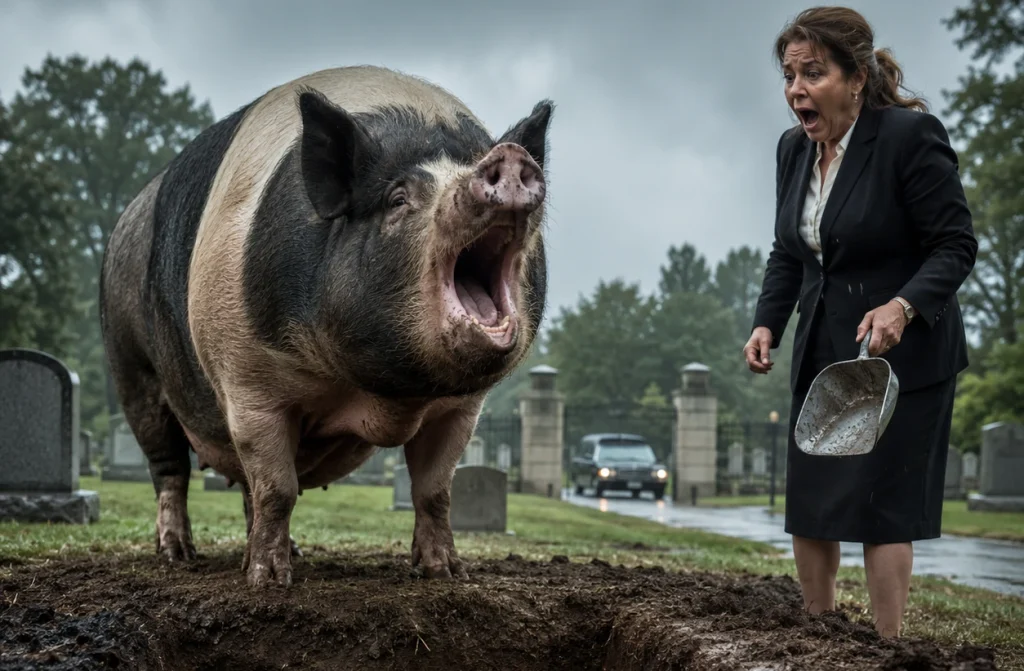
“Robin,” Corinne said, without raising her voice. “Keep them inside.”
Then she took the galvanized feed scoop from the mudroom and walked down the porch steps. Nine-year-old June had lived behind Vale Funeral Home for seven years. Children liked the white band over her shoulders; adults called her sweet. Corinne trusted buckets, fences, and space more than borrowed human virtues.
Today the bucket worked. June turned at the rattle of pellets and followed Corinne away from the front drive. Mud plated the sow’s snout. Water shone above her hooves, although the rain had stopped before dawn.
“Easy,” Corinne said.
She angled toward the orchard gate, taking the shorter route across the east edge of the cemetery. June followed until they reached a strip of grass no wider than a dining table. Then she stopped.
Corinne shook the scoop again. June stretched her neck, sniffed, and shifted her weight backward. She did not bolt or squeal. She simply refused to set a front foot on the darkened turf.
The hearse turned through the stone pillars at the end of the drive. Corinne looked from June to the approaching car. Behind it came three sedans carrying Eloise Webb’s daughters, grandchildren, and one sister who had flown in from Arizona. They were not there to watch a funeral director negotiate with a loose pig.
She stepped off the grass and circled toward the gravel path. June came with her at once.
At the orchard, Corinne opened the gate and backed away. June entered. Runoff had loosened the corner post; Corinne chained the mesh, tested it twice, and returned with mud on her skirt.
Robin met her behind the hearse. “Please tell me nobody saw.”
“Mrs. Webb’s grandson is filming the rain gauge with his phone.”
“That is not an answer.”
“Then assume the whole county saw.”
They settled the family. Corinne knew how to lower the temperature of a room without announcing that it had risen.
The service began under a pale break in the clouds. Eloise’s older daughter read a letter about her mother teaching third grade for forty-one years. A wren called from the cedar tree. The wet ground held beneath the folding chairs.
When the last prayer ended, the cemetery crew rolled the empty flower cart toward the maintenance shed. Its left wheel crossed the strip June had refused.
The tire dropped to the axle. The man pushing it pitched forward and caught himself on the handle. Brown water welled around the wheel. A shallow bowl opened in the grass, not dramatic enough for a scream, but deep enough that every person still standing beside the grave heard the soil give with a soft, packed sigh.
Corinne reached him first. “You hurt?”
“Only my pride.” He looked at the sunken wheel. “That wasn’t there this morning.”
It had been there. It had simply been wearing grass.
Corinne sent the family inside for coffee while the crew pulled the cart free. She did not mention June or speculate about the ground.
By noon, the video was online: June at the hedge, Corinne with the scoop, the hearse behind them. The caption read: ONLY AT VALE’S, followed by three laughing faces.
At one fifteen, Malik Sanders from county code enforcement arrived with rubber boots, a camera, and the careful expression of a man entering a place where the living expected him to respect the dead. Corinne took him to the east strip. The hole had partly filled with cloudy water.
“The pig do this?” he asked.
“She has rooted along the orchard fence. Not here.”
“I need what you know, not what you prefer.”
Corinne pointed to the intact turf around the depression. “No fresh rooting. No hoof cuts. The grass folded from underneath when the cart crossed.”
Malik photographed and measured the site, then followed the fence uphill. June chewed beneath the pear trees. Damp soil ridged the outside of her pen where she had pushed beneath the wire.
“That is fresh,” he said.
“Yes.”
“And the corner post is loose.”
“Also yes.”
He wrote an order requiring Corinne to repair the enclosure within forty-eight hours and keep June away from the cemetery pending inspection. He also marked the eastern burial block for a geotechnical review before another interment could be scheduled there.
“I have one on Friday,” Corinne said.
“Then put the family somewhere else.”
“Their parents are in that row.”
“I didn’t make the ground move.”
Neither had June, Corinne thought, but she kept that inside her mouth.
Malik was still photographing the retaining wall when a silver SUV parked beside the hearse garage. Andrea Cole stepped out in loafers too pale for the mud. She was the regional acquisitions director for Hearthline Memorial, the company scheduled to buy Vale Funeral Home in eleven days.
Andrea looked at the flagged depression, the code truck, and June behind the orchard mesh. “I came for the environmental disclosure.”
“You came early.”
“Your pig is trending locally.”
Andrea never used June’s name. She called her livestock or the animal to be removed before closing. Hearthline wanted six profitable acres, not an aging sow beside its planned remembrance garden.
In Corinne’s office, Andrea placed a revised affidavit on the desk. The language was concise. Corinne was being asked to attest that she knew of no subsurface instability, unmanaged water intrusion, or condition likely to impair continued cemetery use.
“I can’t sign that today.”
“The county has not found instability. It found one soft spot beside a pig enclosure.”
“The cart sank.”
“Then disclose the cart.” Andrea tapped the signature line. “But if this becomes a site-wide investigation, our lender will pause. You know what a pause does to the debt extension.”
Corinne did. Vale’s owed $268,000 at month’s end. Hearthline’s purchase would clear it, protect Robin’s job, and let Corinne leave the upstairs apartment after twenty-seven years.
Andrea capped her pen. “Monday at nine. Signed disclosure, repaired fence, and a written plan to relocate the animal. Otherwise I cannot promise the closing date.”
After she left, Corinne returned to the east strip. The clouds had closed again. June watched from the orchard while Corinne pressed the heel of one sensible black shoe against the ground.
Water rose around the leather. On the porch, the office printer released a clean copy of the affidavit. Corinne could hear it through the open window, one page settling neatly into the tray.
To read the rest of the story – CLICK the NEXT button 👇👇👇