


The smallest calf had gone down before the trailer reached the arena. Eve Rourke could see one russet ear through the slats and, below it, an eye filmed with exhaustion. Every turn of the calf’s head ended against the aluminum floor. The other animals stood over her because there was nowhere else to stand, their narrow bodies packed into the trailer under a sky already whitening with November cold.
“How long has she been like that?” Eve asked.
Megan Bell, the county’s livestock-welfare coordinator, looked at the driver instead of answering. The driver stared at his boots.
The sheriff’s deputy had found the trailer behind a shuttered sale barn six hours earlier. Thirty-one dairy-cross calves, no feed, two empty water drums, and paperwork that named a dealer whose phone had been disconnected. The state field veterinarian was still driving in from Pueblo. Until she arrived, nobody could say more than what was visible: the calves were cold, dehydrated, and running out of time.
Behind Eve stood the Rourke sisters’ old indoor riding arena, forty-eight feet wide, ninety feet long, and empty since their mother’s last lesson horse died. It had a sound roof, washable concrete along one wall, two frost-free hydrants, and doors wide enough for livestock panels.
It also belonged half to Eve’s younger sister.
Sadie had changed the padlock in September after Eve let a roofing contractor inside without asking. She had texted the new combination, then replaced it with a keyed lock after their argument. The message had been plain: no one entered their shared property on one sister’s word again.
Eve called her for the fourth time. The call went to voicemail.
“The fairgrounds?” Eve asked.
“Full electrical inspection after last month’s fire,” Megan said. “No animals inside until it passes. Every foster site I have is full. If we unload here, this becomes a controlled holding location until Dr. Cross decides what these calves need.”
“For tonight?”
Megan’s pause was answer enough.
The calf inside the trailer stretched her neck, tried to bring one rear leg beneath her, and fell sideways again. Her hoof struck the wall once. The sound was light, almost polite.
After twenty-two years managing school heating and ventilation failures, Eve understood what cold, moisture, and thirty frightened bodies could do to a building. She also knew her habit of calling urgency responsibility. Seven years earlier, she had signed their mother’s rehabilitation papers before Sadie arrived. The bed had been sound. The choice had not been hers alone.
She looked through the slats again.
“Bolt cutters are in my truck,” the deputy said quietly.
Eve tried Sadie once more. She left a message this time.
“There are thirty-one calves at the arena. One is down. I know what I promised. I also know waiting may kill her. I’m opening the building. Call me as soon as you hear this.”
She ended the call before she could turn explanation into permission. The lock snapped on the second bite of the cutters.
Cold dust lifted when Eve rolled the arena door open. The place smelled faintly of old hay and saddle soap, of years when their mother had stood in the center ring telling nervous children to loosen their hands. Sunlight entered in one long gray bar. The calf in the trailer made no sound at all.
They worked fast without pretending speed was the same as care. Eve and Megan built a receiving lane from stored horse panels. The deputy spread clean straw from a stack Sadie had bought for winter. The driver backed to the threshold, where the animals would be protected from the wind but would not yet enter the main ring.
Dr. Imani Cross arrived as they lowered the ramp. She was compact, silver-haired, and unsentimental. She watched the standing calves before touching any of them: their breathing, the set of their ears, the manure on their tails, the way they shifted weight.
“No chasing,” she said. “Let the ones who can walk choose the ramp. We’ll make space around the one who can’t.”
The first calf hesitated at the change from metal to straw. Eve turned her shoulders away and lowered her eyes, remembering how her mother approached frightened horses. The calf took one step, then another. The animals behind her followed in a loose, uncertain line—black-and-white, red, dun, each too angular for its hide.
Eve counted aloud as they passed. At thirty, the trailer looked suddenly enormous around the calf on the floor.
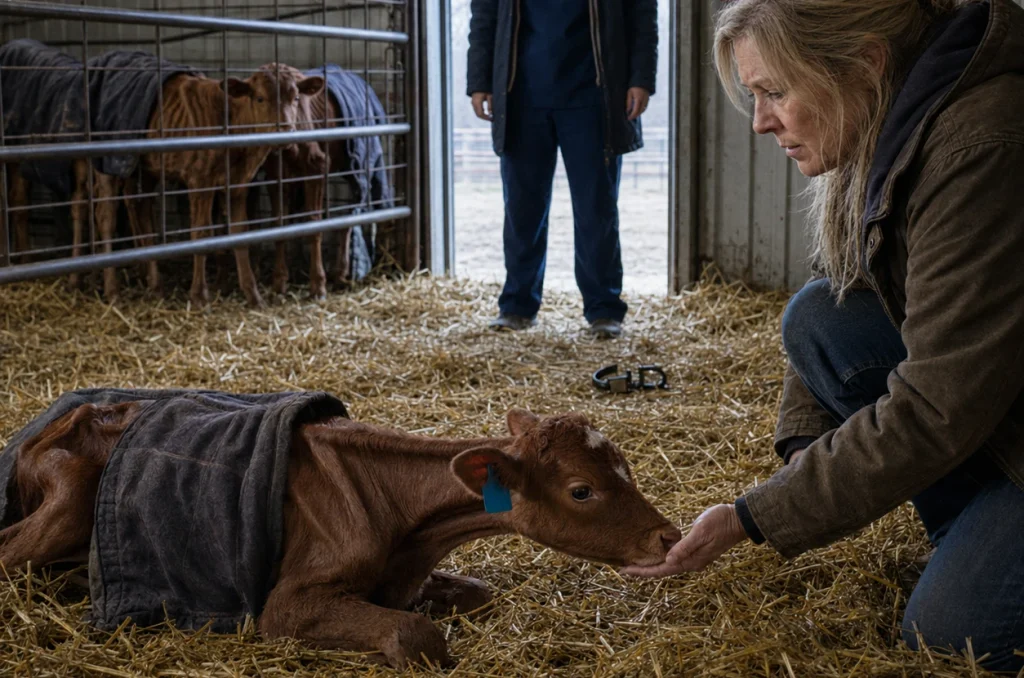
She was smaller than Eve had thought. A red heifer with a white spot no bigger than a thumbprint between her eyes, she wore a blue plastic tag stamped 214. Dried milk replacer crusted the hair under her jaw. Her breathing was shallow but regular.
Dr. Cross knelt without crowding her. “We lift only when she tries. Chest first. Keep her head free.”
Four people held a canvas sling while the heifer gathered herself. For a moment her legs hung uselessly. Then her front feet found the straw, slipped, and found it again. Eve felt the animal’s weight change through the sling—not lighter, but participating.
“That’s it,” Eve murmured. “You do your part. We’ll do ours.”
The heifer stood for six seconds. Then she folded, but this time she folded onto deep bedding in still air, not aluminum over frozen pavement.
Dr. Cross divided the arena into three zones. Calves with stronger posture went to the far end. The weakest stayed near the wash wall where they could be observed without repeated handling. She took temperatures and blood samples, assessed hydration, and marked charts that Megan taped above each pen. Nobody called the animals healthy. Nobody called them doomed.
Eve set the exhaust fan to the fixed rate Dr. Cross specified and left it there. They hung calf blankets on the smallest animals, set buckets at different heights, and mixed warmed electrolyte solution under the veterinarian’s direction.
Tag 214 would not suck from a bottle. Dr. Cross stopped Eve after two attempts.
“Don’t force it. Fluid in the lungs will finish what the cold started.”
The veterinarian used a feeding tube after checking placement, then showed Eve the written schedule. The heifer swallowed around it, eyes half closed. When it was done, Eve sat on an overturned bucket outside the pen and kept her hand where the calf could smell it without having to accept it.
Around them, the arena changed character. Hooves shuffled in straw. Buckets knocked against panels. One calf bawled and another answered from ten feet away. The building was no longer an asset waiting to be sold. It was holding thirty-one frightened lives, each making heat, waste, noise, and a claim on the next hour.
At 4:17 p.m., tag 214 lifted her head and touched Eve’s knuckles with a cold, damp nose. The arena door opened behind them.
Sadie stood on the threshold in navy scrubs under an unzipped winter coat. She was forty-seven, four years younger than Eve, and usually moved with the contained precision of the physical-therapy aide she had become after the horse business failed. Now she did not move at all.
Her eyes traveled from the broken lock to the red quarantine placard Megan had wired beside the door. Then she looked across the pens, the feed sacks, the county truck, and the calves wearing blankets cut from colors their bodies did not yet fill.
“How long?” she asked.
Dr. Cross answered because Eve could not. “Minimum twenty-one days if the initial tests exclude reportable disease. Longer if they don’t. Nobody enters or removes livestock without authorization.”
Sadie looked at Eve. “The buyer’s inspection is in ten days.”
“I know.”
“The payment on this place is due in twenty-six.”
“I know that too.”
The red heifer pushed her nose weakly against Eve’s hand again. Sadie saw it. For one hopeful second, Eve thought the sight might explain what she had done.
Instead, Sadie stepped fully inside and shut the door against the cold.
“You didn’t save them alone,” she said. “You spent my yes before I could give it.”
To read the rest of the story – CLICK the NEXT button 👇👇👇