


The bobcat stepped into the northbound lane of U.S. 83 as if the yellow line belonged to her. Sergeant Sarah Winters saw her first as a low shape between two columns of heat, no bigger than a feed sack and moving with the uneven confidence of something not yet fully grown. Then the pickup in front of Sarah braked. Its empty stock trailer swung six inches across the centerline, and the sedan behind it went onto the shoulder in a plume of pale dust. Sarah angled her cruiser across the lane, lit the bar, and reached for the radio.
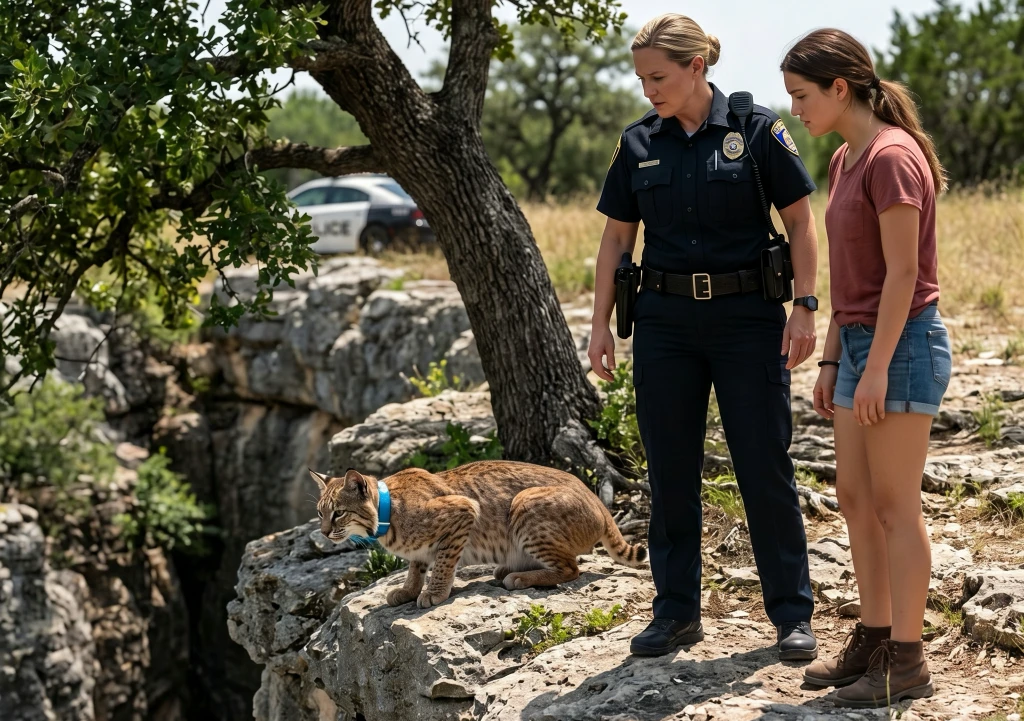
“County, shut down eighty-three at the River Bend turnout. Animal in the roadway. Start the south unit this way.”
The dispatcher asked what kind. The bobcat turned her head. Her ears were black-tipped, the white spots on their backs stark against the tawny brush. Around her neck was a narrow blue collar with a short antenna lying along one shoulder.
“A bobcat somebody’s been handling,” Sarah said.
By the time she stepped out, three motorists already had their phones raised. A man in a red fishing shirt had left his SUV running in the lane and was advancing with both hands out, making the kissing noise people used on house cats.
“Back in your vehicle,” Sarah called.
“She’s just a baby.”
“She’s a wild cat standing in traffic. Get back in your vehicle.”
The tone worked. It usually did. The man lowered his phone but kept recording as he retreated.
Sarah moved slowly along the cruiser’s passenger side, using the steel and open door as cover. The August sun had driven the temperature above a hundred before noon. Tar softened in the cracks of the pavement. Beyond the guardrail, live oaks and juniper crowded a limestone slope, their shadows too thin to look useful.
The bobcat did not hiss or crouch to spring. She looked past Sarah toward a white pickup parked in the gravel turnout. Then she crossed the lane in four quick bounds, slipped under the guardrail, and vanished.
Sarah let out the breath she had been holding and began clearing the traffic knot. She moved the abandoned SUV, took names from the two drivers whose vehicles had nearly touched, and ordered everyone else north at twenty miles an hour. The man in the fishing shirt—Dale Briscoe, according to the license in the wallet he produced without being asked—wanted to know whether she had ever seen anything like that.
“No,” Sarah said, “and neither did your followers. Don’t post my location until the road is open.”
“Already live.” His face changed when he saw hers. “I can take it down.”
“Do that.”
She knew he would not. People liked danger better after glass had been put between them and it.
When the last car passed, Sarah walked to the turnout. The white pickup was old enough to have two shades of paint on the hood. A removable sign on the door read HIGH MESA WILDLIFE RECOVERY, and behind the windshield lay a spiral notebook, a pair of leather gloves, and a handheld radio receiver with its antenna collapsed.
Sarah knew the logo. Nineteen days earlier, her daughter had sent her a photograph from the center: a spotted kitten standing on a log in a roofed enclosure, blue tracking collar bright against its neck. Wren’s message had said, Nova passed her live-prey assessment. If the weather holds, Robert wants to start her release trial next month. Sarah had typed, That collar looks loose.
Wren had replied that it was designed to break away. Sarah had asked whether the center’s insurance covered fieldwork. Wren had stopped answering before Sarah found a way to ask the thing she had meant: Will you be out there with her?
The pickup’s registration came back to Robert Hale, fifty-eight, founder of High Mesa and Wren’s employer. No warrants, no alerts. Sarah called Texas Parks and Wildlife first and learned that Game Warden Mae Alvarez was already driving in from a ranch inspection twenty-six miles away.
“Already?” Sarah asked.
“A woman from the rehab center called about a missed check-in,” dispatch said. “Wren Hale—no, sorry. Wren Winters.” Sarah looked at the phone in her hand for a moment before selecting her daughter’s number.
Wren answered on the first ring. “Did you find his truck?”
No hello. Her voice was level and fast, the voice she used when emotion had been put somewhere it could not interfere.
“I found a truck and a juvenile bobcat in the roadway. Blue collar.”
Silence, then the scrape of a door slamming. “That’s Nova. Don’t approach her. Don’t let anyone between her and cover.”
Sarah watched the juniper line. “I know not to pet a bobcat.”
“I didn’t say you would.”
There it was: the small hard space in which their conversations had lived since spring. Sarah tightened her grip on the phone.
“Where is Robert supposed to be?” Sarah asked.
“On the east side of the highway, monitoring her release. He opened the acclimation pen at dawn. He was supposed to text me at nine and be back by ten-thirty.” It was now 12:17.
“Why didn’t he carry a partner?”
“Because I was meant to go, and he told me to cover intake after the freezer failed.”
Sarah heard the accusation even though Wren did not shape it as one. Two weeks earlier, Sarah had called the center “a collection of emergencies held together by extension cords.” Wren had said that at least the emergencies there got admitted. Sarah had answered with something about health insurance and a real credential, and Wren had walked out of the diner before their coffee arrived.
“Where are you?” Sarah asked.
“Seven minutes south. I have the spare receiver and his release map.”
“Pull in behind my unit. Stay in your vehicle until I clear you.”
“Sarah.” Wren had begun using her mother’s first name at fourteen, but only when she wanted to remind Sarah that a badge did not extend into the family.
“There are civilians on the shoulder and a wild cat loose,” Sarah said. “Give me seven minutes of cooperation.”
“You can have seven.”
The call ended. Sarah walked around Robert’s truck without touching it. The passenger window was open an inch. A half-full thermos sat in the cup holder. On the ground near the rear tire, two round-toed boot prints crossed the gravel and continued through the dust toward a gap in the guardrail. Smaller prints overlapped them for several yards—the wide heel pad and four toes of a cat, no claw marks.
The boot prints went east. The bobcat’s prints came back.
Sarah photographed both and was dictating the observation into her phone when a flicker moved below the road. Nova emerged under the guardrail thirty yards south of the truck. She did not look at Sarah. She sniffed the gravel where Robert’s pickup had dripped condensation, moved to the rear bumper, and stood with her nose lifted toward the truck bed.
Then an air brake coughed on the hill. Nova flattened, shot across both empty lanes, and disappeared down the west embankment. She had crossed the road twice in less than ten minutes.
Wren arrived in a dented green Subaru that Sarah had helped her buy for community college. She parked exactly where directed and got out before Sarah could walk over. At twenty-four, Wren was nearly six feet tall and had Sarah’s habit of tying her hair too tightly when she was worried. Dust coated her work boots above the ankles. She carried a receiver in one hand and a folded wire transport crate in the other.
“Leave the crate,” Sarah said.
“If she’s road-seeking, Mae may order a recapture.”
“We don’t know what she’s seeking.”
Wren looked at her then—briefly, sharply—as if surprised to hear the distinction. She set the folded crate on the gravel.
Sarah pointed to the tracks. Wren crouched without stepping into them. She studied the cat prints, then the truck, then the slope on the east side.
“Nova was raised in a remote enclosure,” she said. “She doesn’t come for people. Robert fed through a blind. The truck is familiar, though. He transported her in it.”
“Could she be returning to the vehicle?”
“Once, maybe. Not back and forth across a highway.”
Sarah called county fire and requested a hasty-search team staged at the turnout. She gave Robert’s name, the elapsed time, the terrain, and the heat. The dispatcher began the checklist. Wren extended the receiver’s antenna and turned a dial until static broke into separate textures.
A faint pulse sounded. Then another.
“That’s her collar,” Wren said. “Northwest.”
Nova was somewhere below the far side of the road. Wren rotated slowly. The pulse strengthened, weakened, then strengthened again as the antenna crossed the west slope. She took three steps toward it.
“No,” Sarah said.
“I’m only getting direction.”
“And traffic will reopen as soon as the south unit gets here. We search where Robert’s tracks go.”
“If Nova moves, she may show us where she came from.”
Sarah almost answered that animals did not show people things. Then she looked at the two sets of tracks: the man’s going east, the cat’s returning. Not a message. A route.
The south patrol unit arrived, followed by a volunteer engine carrying three members of the county’s rope-rescue team. Sarah assigned the road to Deputy Nolan, updated the team leader, and told Wren she could bring the receiver if she stayed behind Sarah and followed every instruction.
As the engine settled across the closed lane, Nova broke from the west embankment, crossed behind it, and vanished through the guardrail gap on the east. Wren turned with the pulse as the signal shifted from west to east. Sarah marked the third crossing in her notebook before anyone entered the brush.
“You need the receiver,” Wren said.
“That wasn’t the condition.”
Wren tightened her mouth. “Understood.”
They crossed through the guardrail gap and followed Robert’s prints into the juniper. The ground dropped away from the highway in shelves of white stone. Cicadas pressed one continuous sound into the heat. Fifty yards in, Sarah found a place where the boot prints had skidded, recovered, and continued east.
The receiver pulsed behind her, louder now. Nova appeared on a limestone rise ahead. She was bigger than she had looked on the road, long-legged and lean, her spotted coat already losing the softness of kittenhood. She stood broadside for two seconds. Then she slipped over the rise.
Wren did not call to her. She lowered the antenna and waited.
“What?” Sarah whispered.
“She’s been using that path. See the hair on the cedar?”
Sarah saw it only after Wren pointed: three tawny strands caught low on a broken twig. Beneath them, the dust held overlapping tracks. Nova had traveled this way more than once.
They climbed the rise. Beyond it, the land fell into a narrow limestone draw that the highway concealed. The receiver’s pulse grew so loud Wren turned down the gain.
At the edge, Nova crouched under an oak twenty yards below them. She faced deeper into the draw, not back toward the people.
Then, from somewhere beyond the first bend, came a thin two-note whistle. It was answered by the radio pulse in Wren’s hand and by nothing else. Sarah stepped to the rim and called Robert Hale’s name. The first sound died against the limestone. The whistle came again—human, weak, and far below…
To read the rest of the story – CLICK the NEXT button 👇👇👇