


By the time Mara Ellison understood that the bobcat was coming up the porch steps, it was close enough for her to see the raw band beneath its jaw. She had been sitting with one boot unlaced, coffee cooling beside the October invoices spread across her lap. The animal crossed the last three boards without taking its eyes from her. It was female, lean through the flanks, with burrs caught in the pale fur of her belly and a short length of blue plastic cord dragging from her neck.
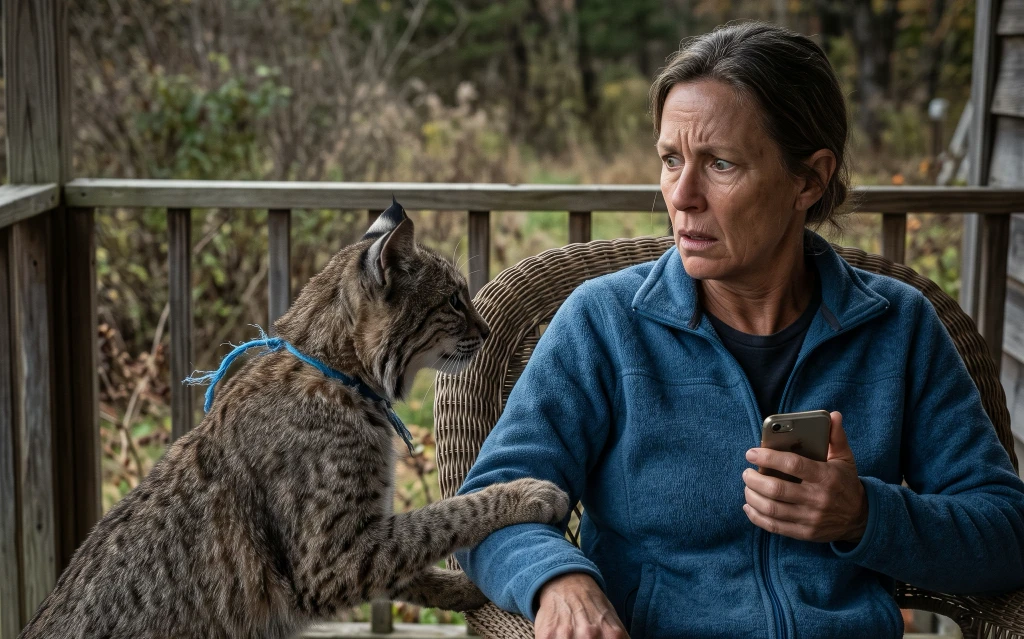
Mara did not move. At fifty-five, she knew enough about bobcats to know how little she knew. They passed through the far corners of her land at night, appearing on trail cameras as pairs of eyes and then as nothing. They did not climb onto porches at eight in the morning. They did not stand three feet from a woman in a blue fleece while the red light on her door camera blinked above them.
The cat sniffed the cuff of Mara’s sleeve.
“Easy,” Mara said, though she was not sure which of them she meant.
One forepaw rose. It landed on her arm with enough weight to press the fleece against the bone. The claws stayed sheathed, but the gesture was not gentle in any human sense. It was learned. Somewhere, the cat had discovered that sleeves, chairs, and the smell of people led to food. That frightened Mara more than its teeth.
She eased her free hand toward the phone lying faceup on the invoices. The bobcat’s ears flattened at the movement. It dropped back to the porch, made a rough sound low in its throat, and turned toward the cottonwoods along Copper Creek. Then it looked back. Mara called her daughter.
Clare answered on the fourth ring, already talking. “I’m going into intake. If this is about Sunday, I can call after—”
“There’s a bobcat on my porch.”
The silence lasted less than a second. “Get inside.”
“It has something around its neck.”
“Inside, Mom. Now.”
Mara stood slowly. The cat retreated to the top step but did not run. Up close, Mara could see that the blue cord had rubbed away fur along one side of its neck. Its teats were enlarged beneath its belly.
“I think she’s nursing.”
Clare’s voice changed. It lost the flat impatience it had carried for the past six weeks. “Can you close the door without going toward her?”
“Yes.”
“Do that. Send me a picture through the glass.”
Mara backed inside and slid the door shut. The bobcat remained on the other side, close enough that her breath briefly clouded the lower pane. Mara took three photographs. In the second, the animal turned, and the cord showed clearly against its ruff.
Clare opened the images while Mara listened to the sounds of the wildlife clinic around her: a cabinet shutting, a dog barking twice, a man asking where the clean towels had gone.
“That isn’t cord,” Clare said. “It looks like the end of a kennel lead. Maybe coated cable. And she’s too used to the house.”
“Not this house.”
Another pause. “Is the south barn still locked?”
The question landed exactly where Mara had known it would. Across the creek, beyond a mile of lodgepole pine and abandoned pasture, stood the old calving barn Owen Kessler had rented from her since spring. The lease said equipment storage and two nonreleasable education birds. Clare had called the rent suspicious. She had called the new padlock suspicious too, and the freezer truck she saw on the county road in August.
Mara had called her ungrateful. Owen had helped Ben rebuild that barn before Clare was born. He had sat beside Mara through the last two nights of Ben’s life and paid six months’ rent in advance when the property-tax notice arrived. There were people whose word had weight because of what they had carried for you. Mara had believed that—or had needed to.
“I don’t know what this has to do with Owen,” she said.
Outside, the bobcat walked to the porch steps. It gave the same rasping cry, then moved across the yard toward the creek.
“Mom, listen to me. Don’t follow it.”
The animal stopped at the first cottonwood and looked toward the house.
“I’ll call the county,” Clare continued. “I’m leaving now. It’ll take me forty minutes, maybe fifty. Stay inside until someone gets there.”
“All right.”
Clare knew the shape of that answer. “Say the whole sentence.”
“I’ll stay inside.”
Mara watched the bobcat slip between the trees. She kept her promise for almost three minutes.
Then she saw the blue cord catch on a fallen branch. The cat twisted, freed itself, and vanished along the trail that led toward the footbridge. Mara thought of the swollen teats and whatever might be waiting to nurse. She thought of the August freezer truck, its white box body shuddering beside Owen’s locked gate while he told her it held meat for a raptor program. Clare had asked to see the paperwork. Mara had told Owen about the question before she answered it herself.
She put on her second boot. Mara texted Clare: Following only far enough to see direction. Sharing location. I have spray. I will not approach. She sent the same location to the county dispatch number posted inside her kitchen cabinet—one of the emergency contacts Clare had taped there years ago and Mara had never removed.
She took binoculars, a whistle, bear spray, and the old canvas field coat Ben used to keep by the door. She did not pretend that this made following a distressed wildcat sensible. It only made the decision look prepared.
The bobcat was waiting beyond the cottonwoods. It stayed thirty or forty yards ahead, sometimes invisible except for the movement of grass. Mara followed the familiar fence line rather than the game trail, keeping trees between them. At Copper Creek, the cat crossed on the narrow footbridge Owen and Ben had built from two peeled logs and rough planks. The creek was high from three days of rain, brown water shouldering around the center support.
Mara tested the cable handrail before stepping onto the first plank. She had crossed that bridge for twenty-seven years, but not since Owen changed the lock on the south barn. Halfway over, she looked down and immediately wished she had not. Water pressed flat against the upstream side of the logs, then tore loose in white folds below her boots.
The bobcat waited on the opposite bank. Not for Mara, she told herself. For safety. For distance. For whatever lay beyond the hill.
When Mara reached the far side, it was gone. She found one print in the mud and then another. The trail climbed through lodgepole pine, passed the collapsed remains of a sheep shed, and opened onto pasture gone silver with frost. The south barn stood at the far end, its red siding weathered almost gray. Owen’s truck was not beside it. Neither was the small cargo trailer he usually left under the lean-to.
Mara smelled the place before she heard it. The odor was not simply manure. It held the sourness of spoiled meat, damp straw, and an ammonia sting that tightened her throat. From inside came a metallic scrape, followed by the rhythmic thud of something pacing against wire.
The main doors were padlocked. A lower board near the northwest corner had been pulled away from its nails, leaving a dark gap. The blue cord lay snagged on the splintered edge.
Mara walked around the building, keeping several yards back. Through a missing pane in the tack-room window, she saw chain-link panels dividing the center aisle into narrow enclosures. Two tall spotted cats moved in synchronized circles. Servals, she thought, remembering photographs from Clare’s clinic. In a stall beyond them, a young lioness lay with her chin on the dirt, one foreleg stretched toward an empty stainless-steel bowl.
The bobcat slipped through the broken board. From inside came two high, urgent cries. Mara moved to the next window. In the nearest enclosure, two half-grown bobcats pushed against the wire while the female paced outside it. One youngster held its left front paw clear of the ground. The mother pressed her face to the mesh, pulled away, and pressed again.
She had not brought Mara here. She had come back because she had young here, and because captivity had taught her that houses contained food and human hands opened doors.
The truth was less miraculous than a plea. It was also worse.
Mara climbed the rise behind the barn until one bar appeared on her phone. She called 911, gave her name, the property coordinates, the number of animals she could see, and the words young lion twice. The dispatcher told her not to enter and to move away from the building. Mara was repeating the gate combination for the north access road when the connection failed. She started downhill, then heard a bowl strike the stall wall.
The outside hydrant stood near the lean-to. Its handle moved, but no water came. Beside it were three capped five-gallon containers. Mara opened one and smelled clean water. A length of white pipe ran through the siding to the cages, with funnels fixed at the outer ends. Owen had built a way to fill bowls without opening an enclosure.
That evidence of planning made her angrier than neglect alone would have. This had not happened in a single bad night.
She poured water slowly into the first funnel. Inside, metal rattled, then went still except for drinking. She was halfway through the second container when an engine sounded beyond the pasture.
Owen’s green pickup came over the rise too fast, bounced through a rut, and stopped between Mara and the north road. He got out without shutting the door. At sixty-two he was still broad through the shoulders, but his face looked smaller than it had six weeks ago. A feed-store cap hid most of his gray hair. His eyes moved from Mara to the open water container, then to her phone.
“Tell me,” he said, breathing hard, “you didn’t call Clare…”
To read the rest of the story – CLICK the NEXT button 👇👇👇