


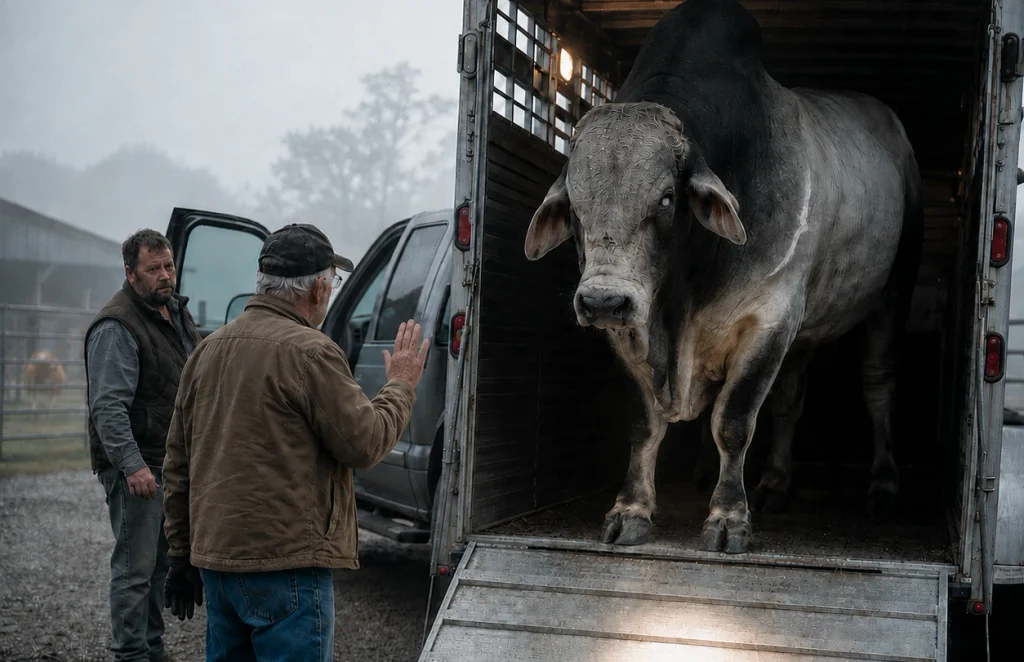
By the time Walter Hale saw the gray hump moving behind the aluminum slats, the driver had already backed a forty-foot livestock trailer through the wrong gate. Fog lay over Willow Gate Dairy in long white strips, hiding the far fence and softening the roofline of the empty calf barn. Walter stood beside the feed cart with one glove on and one hand bare, staring at the trailer tires pressed into gravel he had raked smooth the evening before. The black lettering on the cab said PRUITT LIVESTOCK TRANSPORT. The papers in the driver’s hand said Willow Gate Cattle Company.
“That’s not here,” Walter said. “They’re twelve miles east, off Route 57.”
Leon Pruitt looked from the bill of lading to the dispatch screen mounted in his cab. He was a broad, tired man in a quilted vest, with three days of beard and the careful movements of someone whose lower back hurt. “App sent me to this address. Farm name matches.”
“The part after the name doesn’t.”
A heavy thud came from inside the trailer. The aluminum wall flexed once and went still.
Leon rubbed his face. “I’ve been on the road since yesterday afternoon. He was loaded before midnight, and this was supposed to be his delivery. Dispatch isn’t answering, my driving clock is nearly gone, and I’ve got four heifers due in Lexington by ten.”
Walter stepped close enough to look through the slats without putting his hands on them. The bull inside was a gray Brahman, tall at the shoulder, with a dark neck and a loose fold of skin beneath it. Even folded into the trailer’s last compartment, he seemed to occupy more space than the metal had intended. A white scar crossed his left flank. Another ringed the bridge of his nose where a rope halter had rubbed. His right eye followed Walter. The left had a pale haze across it.
“What’s his name?”
Leon checked the paper. “Red Clay Gideon Four-Twelve. Says Gideon in the notes.”
The bull shifted again. Walter heard the scrape of a hoof, then a low breath through the slats.
At sixty-eight, Walter had spent most of his life moving cattle through places they did not want to go. His father had believed a loud man could make an animal obey. Walter’s wife, Maggie, had believed the quickest route through a gate was often to quit filling it with people. Between them, Walter had learned to watch an animal’s ears before he watched its feet.
Gideon’s right ear was fixed on his voice. The left kept turning toward the traffic on the road.
“He needs water,” Walter said. “But he doesn’t go in with my herd, and he doesn’t go behind a board fence.”
“You’ve got somewhere?”
Walter looked toward the old maternity lot behind the milking barn. The lot had a concrete wall on two sides and six heavy pipe panels across the front. It had held dairy cows in labor, not a two-thousand-pound breeding bull. Maggie had made him stop using it seven years ago after one of the hinges began pulling out of the block.
He knew all of that before he said, “For an hour or two.”
It was the sort of decision Walter had become skilled at making alone: temporary in the sentence, harder to undo in the world.
He called May Benton next door. She arrived in eight minutes with two livestock panels chained flat in the bed of her pickup and did not waste time asking why a Brahman bull was parked behind Walter’s barn. May ran a boarding stable and a small horse rescue on thirty acres that seemed to produce an endless supply of gate chains, old blankets, and animals no one had planned to keep.
“Your front panel bows,” she said after one look at the lot.
“I know.”
“Knowing isn’t bracing.”
Together they doubled the front line, chained the corners to the concrete posts, and left an empty lane between Gideon’s enclosure and the nearest pasture. Walter shut his Jerseys in the north lot. His oldest cow, Mabel, remained on the other side of the barn, complaining about the change in routine with long, offended bawls.
Leon lowered the trailer ramp. Morning light struck the aluminum and made a hard white rectangle at Gideon’s feet. The bull backed into the front wall instead of stepping toward it.
“Come on, big man.” Leon slapped the side of the trailer. Gideon raised his head, and the metal answered with a hollow boom.
Leon reached into the cab and came back with a red electric prod.
“Put that away,” Walter said.
“You know this bull?”
“No. I know what he’s looking at.”
Leon glanced at the ramp. “It’s a ramp.”
“To you. To him it’s glare with a black hole under it.”
Walter stayed outside the bull’s path. He scattered a thin layer of used bedding over the bright metal, then asked May to swing the loose blue tarp away from the opening. When Mabel bawled again from the barn, Gideon’s ears moved forward. Walter opened the inner barn door so he could see her through two sets of rails.
For nearly four minutes, no one pushed him.
Gideon lowered his head to study the ramp. One forefoot came down, then the other. He backed out slowly, keeping his right eye toward Walter and his body angled away from Leon. When his hind feet reached gravel, he stood trembling so hard the skin along his shoulder quivered.
Walter did not approach. He opened the lane from behind the outside rail and let Gideon find the water trough on his own. The bull drank, lifted his wet muzzle, and looked through the barn doorway at Mabel.
“That the killer?” May asked quietly.
“Don’t know what he is yet.”
Leon received a call from dispatch while Walter signed a temporary-custody form. The transport company had entered Willow Gate Dairy’s address under Willow Gate Cattle Company in its system. The intended farm had expected Gideon that morning, but Leon had reached the end of his legal driving hours, and Gideon needed water and rest before another loading attempt. A replacement driver would collect him the next morning.
“Owner’s calling you,” Leon said. “I gave him your number.”
Before leaving, he stood at the double panel and watched Gideon drink again. The prod remained on the passenger-side floor of his cab.
“For what it’s worth,” he said, “he didn’t act like that when we loaded him. Took six men and half a gate.”
“What did the six men do?”
Leon looked back at the trailer. “Too much, probably.”
After the truck left, the farm recovered its ordinary sounds one at a time: vacuum pump in the milk room, sparrows under the eaves, Mabel striking the steel door with her hornless forehead. Walter brought Gideon hay and set it inside the feeder from the service side. The bull would not turn his left side toward him. If Walter walked that direction, Gideon pivoted until the clear eye found him again.
May saw it too. “That eye’s worse than it looked in the trailer.”
“Maybe.”
“Call Ellen before you start deciding what maybe means.”
Dr. Ellen Voss had treated Walter’s cattle for fifteen years. She promised to come after her morning herd check and told him, twice, not to enter the lot. Walter was insulted by the second warning because it was necessary.
The owner called at eleven. Hal Mercer introduced himself without apology and asked first whether anyone had been hurt.
“No,” Walter said. “He’s watered and separated.”
“Keep him that way. Don’t hand-feed him. Don’t turn your back on him. And don’t decide he’s gentle because he’s standing still.”
Hal’s voice was controlled, not cruel. That made the account that followed harder to dismiss. Gideon had put one handler in the hospital with a fractured collarbone and driven another over a gate. He had bent a crowd panel at a collection facility and refused three breeding chutes. Red Clay Brahmans had stopped working him six weeks earlier.
“Why was he coming here?” Walter asked.
“Willow Gate Cattle agreed to take him on a forty-eight-hour trial. The sale isn’t final unless they accept him. They handle difficult stock.”
“For breeding?”
There was a pause. “That was their decision.”
Walter knew what the sentence meant. A registered bull might still be advertised once more. If no buyer accepted the risk, he would be sold by the pound.
“How old?”
“Seven.”
“Any eye exam in his records?”
“His annuals are current. After the last incident, our vet couldn’t safely complete a close exam. Mr. Hale, I’m paying your reasonable costs. The replacement truck will be there at eight tomorrow morning. You don’t need to make this your problem.”
Through the milk-room window, Walter saw Gideon standing beside the inner fence. Mabel had settled in the straw on the other side of the barn wall, only her tan back visible through the rails. The bull was not pressed against her. He had simply chosen the nearest place where he could hear another animal breathing.
Maggie had died twenty-two months earlier in the front bedroom, with Walter on one side of the bed and a hospice nurse on the other. Since then, the farm had become smaller without losing an acre. He milked nineteen cows instead of thirty-six. He ate standing at the sink because the kitchen table had two chairs and he had not found a sensible reason to remove one.
He had also become suspicious of any decision that arrived wearing the clothes of mercy.
“What would you take for him?” Walter asked.
Hal exhaled. “You heard the part about the hospital?”
“Every word.”
“Six thousand, which is less than I have in him and more than he’s worth at a cull sale. But I won’t transfer him until your veterinarian signs off on the premises, and I want every property owner on the liability acknowledgment.”
Walter looked at the deed folder in the bottom drawer of Maggie’s old desk. Their daughter owned one quarter of Willow Gate under her mother’s will. Carrie had wanted them to sell after Maggie died. Walter had stopped returning her calls after she said the farm was becoming a place where he could disappear in plain sight.
“There is another owner,” he said.
“Then call them. Offer stands until the truck leaves tomorrow.”
Walter sat at the kitchen table with the phone in both hands. Carrie’s number was still marked as a favorite, though they had not spoken in seven months. The photograph beside it showed her at twelve, asleep against Maggie in the cab of the old milk truck, one rubber boot missing.
She answered on the fifth ring. “Dad?” “Carrie, I need your signature to keep a bull alive.” The pause went empty between them. “No,” she said…
To read the rest of the story – CLICK the NEXT button 👇👇👇