


The vultures had settled on the cottonwood posts before Leah Vance heard the calf. She was walking the south fence with a spool of wire and Clay’s fencing pliers in the pocket of her coat. A March wind had pushed the temperature below freezing overnight, and three staples had pulled loose where Wade Sterling’s cattle pressed against the boundary. Across the wire, his crew was moving new pairs toward the calving shed before the next band of sleet came in.
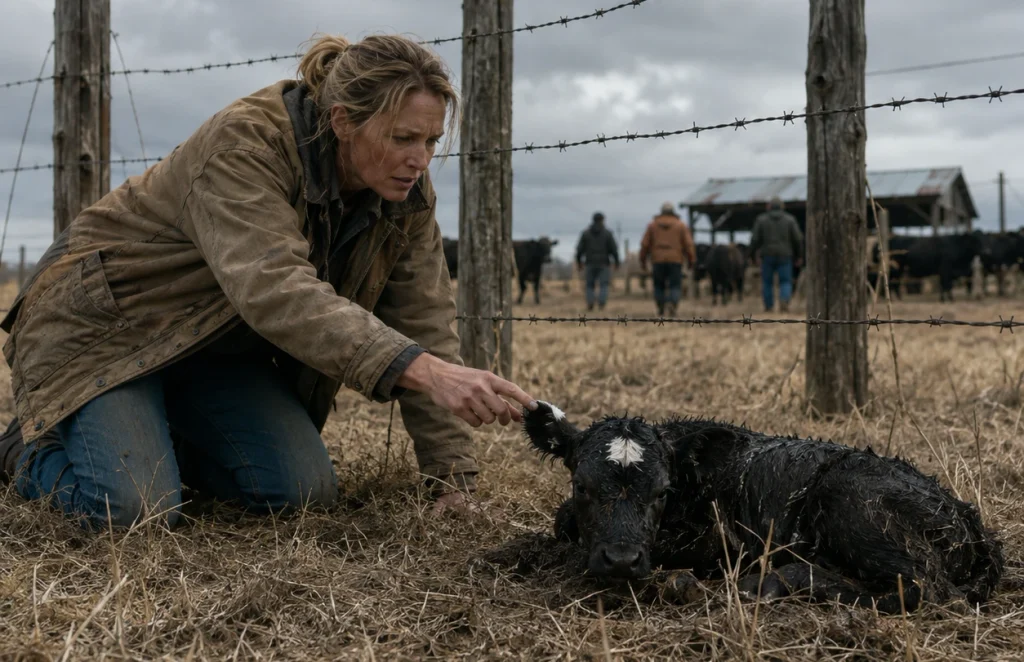
One black shape remained in the flattened bluestem.
Leah watched for a full minute because she had learned, in the sixteen months since her husband died, not to confuse wanting with seeing. The calf did not raise its head. Its ribs did not appear to move. Then one white-tipped ear twitched beneath the shadow of a wing.
She dropped the spool and climbed onto the bottom rail, close enough to see a pale circle of hair in the middle of the calf’s forehead. He was a small bull calf, wet along one flank and already stiffening. A cow bawled from the herd being pushed north, but she did not turn back.
Leah called Wade.
He answered over an engine and men shouting through the wind. “If this is about the fence, put the materials on my account.”
“There’s a live calf below post eighty-three.”
The engine noise faded. Wade asked for the cow’s tag, then swore softly when Leah read the number on the retreating dam.
“Second twin,” he said. “We worked on him before daylight. Tubed colostrum, warmed him, put him back with 441. She took the heifer and kept knocking him off. When he quit shivering and stopped responding, my foreman marked him as a death loss. We moved the live pairs before the sleet and were sending the carcass sled back.”
“He isn’t dead.”
“Then we called it wrong.” Wade’s answer came without hesitation. “I still had twenty-six pairs in an open draw and three cows calving at once. Don’t turn a bad assessment into something it wasn’t.”
Leah put two fingers through the wire. The calf’s ear was cold against them. “Let me take him.”
Wade was silent long enough for her to hear a gate clang at his end of the call. He and Clay had been friends before Leah knew either of them. Wade had sat in the oncology parking lot with Clay on the days Leah could not leave the grain elevator’s payroll office. After the funeral, he had delivered six round bales without an invoice. He had also offered three times to buy her sixty-four acres.
“Leah, he’s maybe fifty pounds,” Wade said. “You can spend a week and a vet bill proving what we already know.”
“Is that a yes?”
“If you take him, he’s yours. Feed, treatment, disposal if he dies—none of it comes back on me. Wait for my text before you cross the fence.”
The message arrived less than a minute later, plain enough to preserve: the black twin born to cow 441 was transferred to Leah Vance at no charge, as he lay. She saved a screenshot, then fetched the blue calf sled from her machine shed.
Clay had bought the sled for the last winter they kept cows. Leah had not used it since the dispersal sale, and mouse-chewed baling twine hung from one handle. She threaded it beneath the loose bottom wire, crossed at the brace post, and knelt beside the calf.
His mouth was cold. His eyes followed her, though, and when she rubbed hard along his side, a tremor traveled from his shoulder to his hip. That small resistance decided the rest of her morning.
She rolled him onto the sled, strapped him loosely so he would not slide, and dragged him the quarter mile to her mudroom. Twice she stopped because her breath caught in the place Clay’s illness had left tender. The calf made no sound. The plastic runners whispered over dead grass behind her.
Inside, Leah called Dr. Imani Reed, the large-animal veterinarian who covered four counties and was already at a difficult calving forty miles west. Dr. Reed told her to take a rectal temperature, dry the calf completely, warm the room, and hold off pouring anything into an animal too cold to swallow safely.
The thermometer read 95.1.
Leah turned the baseboard heat as high as it would go and packed towels warmed in the dryer around the calf’s chest and groin. She found the old hair dryer she had used on Clay’s feet when neuropathy made him hate cold sheets, then set it down. The sound frightened the calf, and fear was energy he could not spare.
Milo Alvarez arrived carrying a red plastic tote before she asked him to come. He had seen her pulling the sled from his pickup on the county road. At seventy-two, he braced one hand on the doorframe before lowering himself beside the calf.
“How cold?” he asked.
“Ninety-five one.”
“Reed coming?”
“When she can.”
Milo opened the tote. Two sealed pouches of colostrum replacer lay inside, left from the small dairy herd his son had sold. “Then we get him warm enough for what I brought.”
He did not tell Leah the calf would live. That was one of the reasons she trusted him.
They worked for nearly two hours. Milo changed towels while Leah recorded temperatures on the back of an unopened electric bill. At 97.6, the calf began to shiver in earnest. At 99, he tried once to tuck a foreleg beneath himself and failed.
Dr. Reed came just before noon, snow melting in the shoulders of her canvas jacket. She listened to his chest, checked his suck reflex, and gave warmed fluids beneath the skin. Because Wade’s crew had already given one feeding, she used only what she judged he still needed, passing it through a tube while Leah held the calf upright.
“His odds are better than they were at sunrise,” she said when she finished. “That’s all I’ll sell you today.”
The visit cost more than Leah had budgeted for groceries and fuel until the next payroll deposit. She wrote the check anyway. Dr. Reed tucked it into her case without looking at the amount, then made Leah promise to call if the calf bloated, coughed, stopped shivering, or failed to improve.
By dark, his temperature was normal. He could hold his head up, but he would not take the nipple Leah pressed to his mouth. Milo went home to his own chores. Leah sat on the mudroom floor with her back against the washing machine and the calf between her knees, listening to his uneven breathing and the ice tap at the window.
Finn Dorsey knocked after eight. He was fifteen, narrow as a gate picket, and usually more comfortable around his father’s welding table than in a kitchen. He held out a clean spiral notebook.
“Grandpa Milo said you were writing temperatures on bills.”
Milo was not his grandfather, but Finn had called him that since kindergarten and nobody remembered why. Leah took the notebook. On the first page Finn had ruled columns for time, temperature, ounces, urine, and stool.
“You planning to audit me?” she asked.
“Somebody should.” Finn ran his thumb down the ruled columns. “We lost a bottle calf when I was nine because Dad thought I’d fed her and I thought he had. We didn’t write anything down.”
He crouched outside the circle of towels. The calf turned his head, and Finn noticed the round white mark.
“Looks like a button.”
“That is not a name for a bull.”
“Right now he’s not much of a bull.”
Finn stayed while she tried the bottle again. This time the calf mouthed the rubber, lost it, then found it with a sudden pull that bent Leah’s wrist. Milk foamed at one corner of his mouth. Finn made a sound that was almost a laugh and entered four ounces in the notebook as carefully as if the number might keep the animal alive.
At 3:20 a.m., the calf drank again. Near dawn, Leah woke on the floor to the scrape of a hoof. He had gathered all four legs beneath him and was rocking there, his joints folded at unlikely angles. She put out both hands but did not lift. He rose because he chose to, stood for six shaking seconds, and dropped back into the towels.
On the next attempt, he stayed up.
Wade arrived at seven with a one-page bill of sale. He filled the mudroom doorway in a clean ranch coat, gray already showing in his beard. The calf was drinking while Leah steadied the bottle between her knees.
Wade watched him finish. His face changed, but not into the shame Leah had imagined while she waited for him. He looked tired and relieved, which annoyed her more.
“You could have done this,” she said.
“We tried. He was warm when we put him with his dam.” Wade knelt, pressed a hand along the calf’s spine, and checked the navel with practiced fingers. “Then three cows calved at once and a heifer prolapsed. I trusted my foreman’s assessment and went where I thought we still had a chance.”
“You made the wrong one.”
“Yes.”
There was no defense in his voice, but no performance of guilt either. He laid the bill of sale on the dryer and signed it. One dollar, as-is. Leah gave him a coin from the jar above the washer, and he put it into his pocket.
Before leaving, Wade stood with his hand on the screen door. The calf had finished the bottle and was nosing the knee of Leah’s jeans, searching for more.
“Keep records,” Wade said. “Castrate him on schedule unless you have a real reason not to. And don’t let this”—he nodded toward the calf pressing against her—“turn into something you think is affection.” “He knows my voice.” “That’s not the same as knowing your size.” Wade looked at her, and for the first time that morning she heard concern instead of argument. “If you keep him intact, make sure he learns he’s cattle. A bottle bull that forgets that can kill the person he follows most…”
To read the rest of the story – CLICK the NEXT button 👇👇👇