


Nate Mercer saw the dog when his headlights swept across the cabin porch. At first she looked like something the storm had built there—a dark ridge under the amber bulb, packed around with snow. Then one ear moved. He stopped the truck crooked in the drive and left the engine running. Snow struck his face hard enough to sting as he climbed the steps. The German Shepherd was pressed against the blue front door, her hindquarters buried in a drift, her forelegs stiff beneath her as though she had spent the last of her strength refusing to lie down.
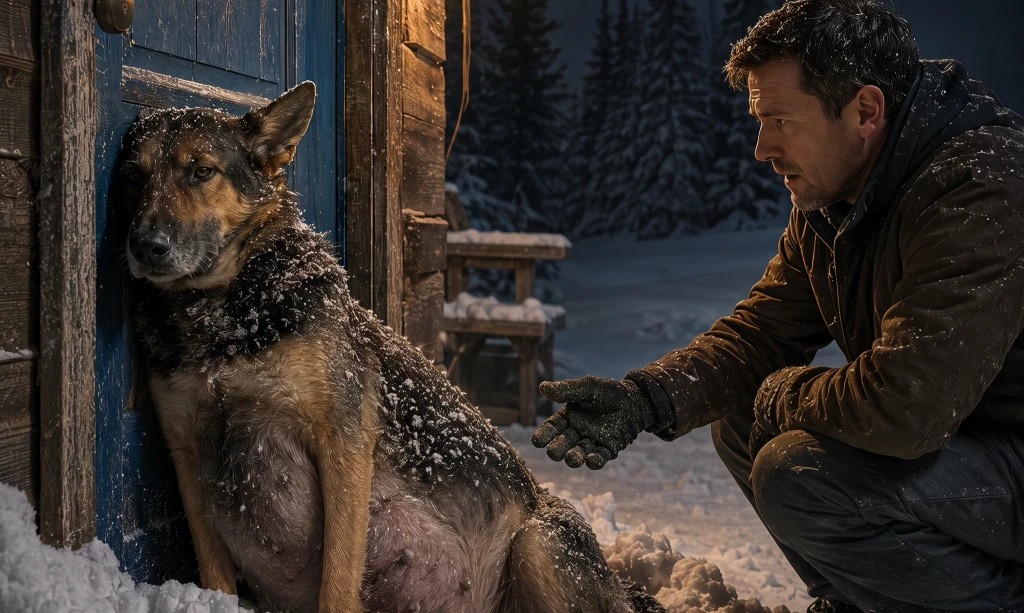
Her belly was enormously round.
“Easy,” Nate said, crouching beyond the reach of her teeth. “I’m coming closer.”
The dog watched him without lifting her head. Ice clung to the sable fur along her spine, and a strip of orange webbing hung from beneath her chest. She wore no collar. When Nate touched two fingers to the side of her neck, he found a pulse—fast and thin, but there.
He had come to Black Pine on twelve days of leave to empty his father’s cabin, sign whatever his sister put in front of him, and get back to Virginia before either of them had to discuss the previous eleven months. He had not told Erin he was driving in tonight. Surprise seemed easier than permission, and a storm had seemed easier than another postponed conversation.
Now he slid one arm behind the dog’s front legs and the other beneath her hips, careful of the swollen abdomen. She made a low sound, not quite a growl. Her body was heavier than it looked and frighteningly cold through his gloves.
“You can object inside,” he told her.
The cabin smelled of shut rooms, pine boards, and the ashes Erin had cleaned from the stove in October. Nate laid the dog on two wool blankets from the hall cupboard, well away from the cast-iron stove, then returned for his duffel and the emergency kit from his truck. By the time he came back, she had tried to stand and fallen against the folded blanket without making a sound.
At forty, Nate was still on active duty with a Navy SEAL team in Virginia. Cold-weather training had taught him enough to know that a chilled body could be injured by careless warming; a pregnant dog in labor was outside anything he had trained to manage.
He shut the door, fed kindling into the stove, and turned on the kitchen tap. Electric baseboards had kept the empty rooms barely warm enough to protect the pipes, which groaned before giving him a narrow stream. On the wall above the sink, his father’s penciled note was still visible beneath the varnish: RED VALVE FIRST. Nate had been fourteen when Cal Mercer made him copy those words after he flooded the pump cabinet. Erin had drawn a small crown over the R.
The dog’s coat had begun to thaw. Nate blotted it with towels rather than rubbing, wrapped warm—not hot—water bottles in dishcloths, and placed them beside her chest and abdomen. He knew enough about cold injury to know that speed could become another kind of harm. He did not know enough about pregnant dogs to trust himself for long.
His phone showed one bar at the kitchen window. He called Erin.
She answered on the fourth ring with the clipped voice she used at the county emergency dispatch center. “Mercer.”
“I need the number for the on-call veterinarian.”
There was a pause. “Where are you?”
The dog’s abdomen tightened under the blanket. Nate watched the movement pass from her ribs toward her hindquarters.
“At the cabin.”
“Of course you are.” Erin’s chair rolled somewhere on the other end, followed by the soft clatter of a keyboard. “The county put out a no-travel advisory forty minutes ago. Did you go around the gate at Miller’s Cut?”
“The gate wasn’t down when I passed it.”
“That wasn’t my question.”
“There’s a pregnant shepherd on the porch. She’s hypothermic, maybe in labor.”
Whatever Erin had been about to say disappeared. “Is she inside?”
“Yes.”
“Breathing?”
“Fast. Gums pale but not white. Pulse is there.”
“Put me on speaker.”
Nate set the phone on the floor. Erin logged the situation with her shift supervisor, made two calls from another line, and returned with Dr. Lena Ortiz, who ran the mixed-animal practice in town. Her voice was rough with sleep and immediately precise. She asked about the dog’s awareness, breathing, discharge, and whether Nate had a thermometer.
He found an old digital one in the bathroom cabinet. The reading made Dr. Ortiz quiet for a moment.
“Keep doing what you’re doing,” she said. “Dry layers, wrapped warm bottles near the core, no direct heat on her ears or paws. Don’t make her walk. I can’t safely reach you until the county plow opens Black Pine Road.”
“How long?”
“The driver says at least three hours. Maybe more if that oak is still across the lower switchback.”
Nate looked at the dog. Meltwater darkened the blanket beneath her, and the orange webbing had come free enough for him to see it was part of a broad lifting sling, cut raggedly at one end. The fur beneath it was rubbed pink.
“Someone carried her with a sling,” he said. “Then left it tangled under her.”
“Photograph it where it is before you remove it,” Erin said.
The instruction irritated him because it was sensible and because it sounded like their father. Nate took the pictures. He cut the remaining strap where it had twisted near the dog’s foreleg, bagged it in a clean freezer bag at Dr. Ortiz’s request, and wrote the time on the label.
“Look at you, following directions,” Erin said.
“Not tonight.”
“You called me, Nate.”
Dr. Ortiz broke in before the old argument could find its shape. “Does she respond to your voice?”
Nate lowered himself beside the blanket. The dog’s eyes tracked him, dark brown and exhausted. When he offered the back of his bare hand, she sniffed once. Her nose was cold, but no longer icy.
“Some.”
“Good. Keep the room quiet. If contractions become regular or you see fluid, tell me immediately.”
For the next forty minutes, Nate measured time by the stove, the dog’s breaths, and Erin’s voice. He added one split log when the iron cooled, changed damp towels, and moved the wrapped bottles before they lost their warmth. He had spent most of his adult life learning to act before fear could turn into confusion. Here, the useful action was often to wait.
The dog disliked his hands near her hindquarters. Each time he checked the blanket, her lip tightened and her eyes sharpened. Nate backed off before the warning became a fight. On Dr. Ortiz’s advice, he placed a shallow bowl near her muzzle. She ignored it twice, then took three careful laps.
“That’s enough for now,” the veterinarian said through the phone. “Small amounts.”
Erin had gone quiet. Nate could hear dispatch traffic behind her and the occasional change in her breathing when she muted the call to answer someone else. She had worked this desk during their father’s final winter, coordinating stranded motorists while also driving to the cabin every morning to measure his medication and split wood. Nate had called from overseas on Sundays when he could. He had sent money, instructions, and promises about the next flight home.
The flight had arrived six hours after Cal died.
“Why was the porch light on?” Nate asked.
“I leave it on when snow’s forecast.”
“In an empty cabin?”
“Dad did.”
“Dad lived here.”
“Not every winter.” Erin’s voice flattened. “People on the logging road knew they could see that light from the bend. It cost four dollars last month, if that’s what’s bothering you.”
Nate glanced through the front window. Snow erased the railing beyond the amber circle, but the bulb held steady above the door. He had planned to switch off the breaker before he left.
On the blanket, the shepherd shifted. Her front paw scraped once against the floor, and Nate moved close enough for her to find him. She pressed the side of her muzzle against his wrist—not affection, he thought, but a way to measure what was there.
Her body softened by degrees. For the first time since he had carried her in, she let her head rest fully on the wool.
“She’s settling,” he said.
Dr. Ortiz asked him to place a palm lightly against the dog’s abdomen. Nate waited for permission in the animal’s eyes, then touched her. Beneath the taut warmth, something moved against his hand and withdrew. A second movement answered from farther back.
Erin let out a breath that caught halfway.
“At least two,” Nate said.
“Likely more,” Dr. Ortiz replied. “Her temperature is coming up, but that can bring labor forward if it was already starting. Watch her closely.”
The dog’s muscles tightened again. This contraction did not fade as quickly as the others. She lifted her head, panted twice, and turned toward her flank.
Nate saw clear fluid spread across the clean towel beneath her.
“Lena.” His voice changed enough that both women stopped speaking. “Her water just broke.”
The veterinarian asked him what he could see. Nate moved the lamp closer without shining it into the dog’s eyes. At first there was only the wet dark fur beneath her tail. Then the next contraction came, and a small membrane appeared.
“The first puppy is coming,” he said.
The shepherd pushed once. Her legs trembled, and the effort seemed to empty what little strength the cold had left her. She lowered her head against Nate’s wrist and did not push again…
To read the rest of the story – CLICK the NEXT button 👇👇👇