


Kaiser watched Jonathan’s left hand because an explosion had taken most of the hearing in the dog’s right ear. Two fingers lowered beside Jonathan’s thigh meant wait. The same fingers drawn toward Jonathan’s knee meant come. An open palm held at muzzle height meant touch. A small turn of the wrist meant the ground ahead was safe.
That Tuesday morning, at the edge of the salt marsh, Jonathan gave none of those signals. He stood on the porch of the old shellfish warden’s cottage and let Kaiser choose whether he wanted the three wooden steps or the plywood ramp Jonathan had built beside them.
The German shepherd considered both. At eleven, he distrusted stairs before breakfast and distrusted ramps after rain. He finally took the steps, placing his rear left paw with care. Then he looked up as if the delay had been Jonathan’s idea.
“Fair enough,” Jonathan said. Kaiser sneezed and walked toward the truck.
Jonathan’s phone vibrated in his shirt pocket. The screen showed CLAIRE, then went dark before he touched it. His thirty-year-old daughter had called twice the previous week and once the week before that. Fourteen months earlier, she had told him that living alone with a dog was not the same as building a life. He had told her she was welcome to stop visiting if every visit required an evaluation.
She had taken him at his word. The phone vibrated again, this time with a voicemail notification. Jonathan returned it to his shirt pocket without listening.
He and Kaiser drove into Bellweather with the windows cracked. The salt-white mansions along Shore Road gave way to the library, a white-steepled church, and the low brick stores that had survived three floods and two generations of rent increases. Jonathan repaired marine electrical systems for three boatyards, usually after their younger technicians had exhausted their patience. Around town, people knew him as the man who could trace a bad ground through forty feet of wet wiring and who would leave before anyone opened a bottle of wine.
At forty-eight, Jonathan had been retired from the Navy for three years. Few people in Bellweather knew it. No one at the boatyards knew that the faded scar beneath Kaiser’s shoulder fur matched the one on Jonathan’s left calf.
Centennial Park lay beside the harbor, where clipped lawns descended toward a public beach and a line of oaks kept the benches shaded until noon. A new sign at the gate said DOGS MUST BE LEASHED AT ALL TIMES. Jonathan read it, as he had every morning since it appeared in May.
He kept Kaiser’s leash clipped through the crowded entrance. Once they reached the broad empty lawn, he unhooked it.
The dog’s hips had stiffened over the winter. Moving at his own pace across grass was easier than matching Jonathan stride for stride on pavement. Jonathan had trained men and dogs in places where a missed instruction cost more than a municipal fine. Kaiser did not need six feet of nylon to remain under control.
That was what Jonathan told himself. They reached the largest oak. Jonathan sat with a paperback he had been carrying for three weeks and Kaiser lowered himself beside the bench. The dog turned twice before settling, nose toward the harbor, scarred side against Jonathan’s boot. A gull landed ten yards away. Kaiser opened one eye, decided the bird did not merit retirement’s limited energy, and closed it again.
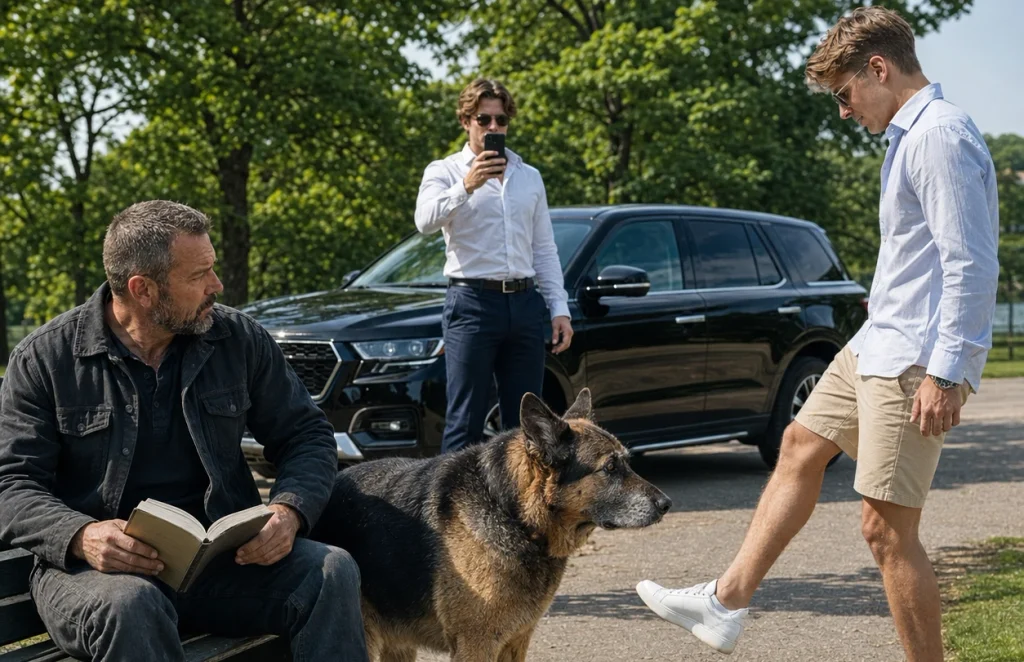
The quiet lasted eleven minutes. Then a black sport utility vehicle bumped over the curb at the far side of the park and rolled onto the lawn. Music came through its open windows. The driver cut across a sprinkler line and stopped beside a picnic table beneath a NO VEHICLES sign.
Three young men climbed out. Jonathan recognized nineteen-year-old Trent Harrington first. Everyone in Bellweather recognized Arthur Harrington’s only son, though the recognition was usually followed by a quick decision not to stare. Arthur’s company owned both private marinas, the old cannery property, and enough storefronts to make disagreement expensive.
Trent wore white sneakers that had never met a dock plank. Logan Pierce came around the passenger side holding a phone on a short grip, already filming. The third boy, Bryce Calder, wore a faded Harrington Coastal work shirt. Jonathan had seen him at the south marina, cutting launch-day footage on a battered tablet between fuel customers. He looked less entertained than the others.
“Park’s dead,” Logan said, checking the screen.
“Then find something,” Trent replied.
They wandered toward the oak. Kaiser’s ear moved before Jonathan looked up. Jonathan placed two fingers beside his thigh. Wait.
Kaiser remained down. Logan’s phone pointed directly at them.
“Morning,” Bryce said when they came within twenty feet. Jonathan gave him a nod.
Trent stopped closer. “That your dog?”
Jonathan turned a page. “It is.”
“There’s a leash rule.”
The objection was valid, which made Trent’s grin more irritating, not less. Jonathan closed the book around one finger.
“You’re right,” he said. “We’ll be moving on.”
He reached for the leash beside him. Trent stepped between the bench and Kaiser.
“Hold up. People want to see him.” He glanced at Logan’s phone. “What kind is he?”
“German shepherd.”
“No, I mean what’s wrong with him?” Trent pointed at the pale ridge through Kaiser’s shoulder fur. “He lose a fight?”
Kaiser lifted his head. “Give him room,” Jonathan said.
“He looks mean.”
“He’s resting.”
Trent shifted one polished shoe toward the dog’s front paw. Kaiser rose without a sound and moved closer to Jonathan’s knee. The movement was economical, but it put ninety pounds of shepherd between Trent and the bench.
Logan laughed. “He doesn’t like you.” Color climbed Trent’s neck.
“Come on,” Bryce said. “We’ve got the launch inventory.” Trent ignored him. “If that thing comes at me, I’m allowed to defend myself.”
Jonathan stood. He clipped the leash to Kaiser’s collar and kept it short but loose. “Nobody is coming at you. Walk away.”
For a moment, Trent seemed about to do exactly that. Then he looked at Logan’s camera and saw whatever expression he feared would be preserved there: retreat, embarrassment, uncertainty. He nudged his toe toward Kaiser’s ribs.
It was not a full kick. It was worse in a different way—casual, experimental, performed for an audience.
Kaiser twisted clear and gave one hard warning bark.
Trent stumbled backward. His sunglasses fell into the grass. Logan made a startled sound, then laughed again.
“You see that?” Trent shouted. “That dog tried to bite me.”
“He never touched you.” Jonathan stepped between them. “It’s over. Go.”
Trent snatched the stainless-steel bottle from the side pocket of Logan’s bag. Bryce said his name once, sharply.
Jonathan saw the shoulder turn. He moved toward Trent, but Kaiser moved first—not to attack, only to close the space beside Jonathan as he had been taught to do for years.
The bottle struck the side of Kaiser’s head with a flat metallic sound. The dog dropped.
Jonathan remembered the next few seconds in pieces: the bottle turning in the air after Trent released it; Kaiser’s leash sliding under the bench; Logan swearing as his phone hit the grass. Jonathan caught Trent’s wrist, drove him backward, and put him down beside the oak. Trent fought, heels tearing at the lawn. Jonathan pinned one arm and set his forearm high across the boy’s chest.
Then Trent stopped fighting. Jonathan did not immediately let him go.
The park narrowed to Trent’s breath under his arm and the old, familiar pressure building behind Jonathan’s eyes. He could no longer hear the gulls or Bryce shouting. He saw only a raised metal object, a body falling, the impossible half second in which everything could still be prevented.
“Your dog,” Bryce said. The words reached him from far away.
“Sir—your dog is down.” Jonathan released Trent and turned.
Kaiser lay on his side beside the bench. His legs moved once as if he were running in sleep. Blood darkened the fur below his left ear.
Trent rolled away, coughing. Logan dragged him upright while Bryce stood frozen between them and the dog.
“You’re finished,” Trent rasped. “My father will—”
“Get him out of here,” Jonathan said.
His voice sounded steady. His hands were not.
Bryce pulled a clean work towel from the vehicle and set it in the grass before Logan shoved him toward the passenger door. The SUV crossed the lawn, leaving two muddy tracks and Trent’s metal bottle beneath the oak.
Jonathan knelt without moving Kaiser’s neck. He pressed the folded towel below the injured ear, then held his open palm six inches from the dog’s nose.
Touch.
Kaiser had answered that signal in sandstorms, darkness, rotor wash, and the bright confusion after an explosion. Now his eyes moved past Jonathan’s hand. He tried to lift his head, lost the direction of the ground, and fell against Jonathan’s knee…
To read the rest of the story – CLICK the NEXT button 👇👇👇