


By the time Wade Mercer reached the south gate, Ellen Avery’s seventy goslings had learned the sound of her boots. They poured after her through the brooder shed in a gray-and-yellow tide, peeping at the cuffs of her canvas pants while she carried a fresh water pan away from the heat lamps. One white gosling, larger than the rest and marked by a gray thumbprint over its right shoulder, kept catching the tin scoop in its bill. Each time Ellen freed it, it hurried around to try again.
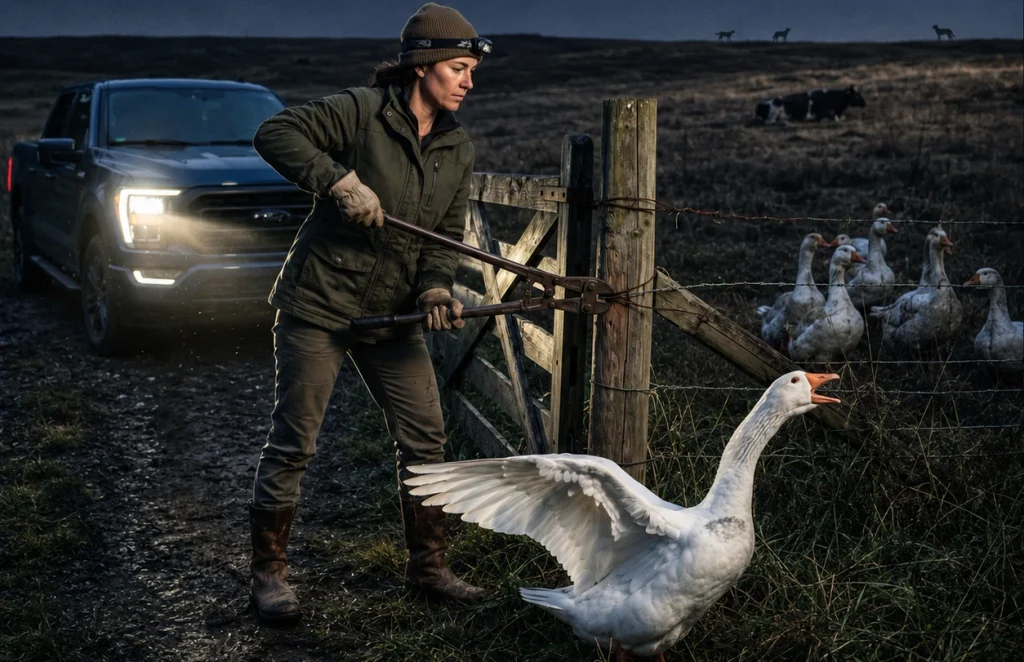
Wade watched from the gate with both hands resting on the silver head of his walking stick. He had used the stick since a bull rolled him against a feed bunk the previous winter, but he still treated it as temporary, the way he treated his hearing aids and anyone else’s opinion.
“Clara said I was to ask before I started in,” he called.
Ellen set the pan down. “That must have cost her some breath.”
“What have you done?”
So much for asking.
It was May 2010, eighteen months after Ellen’s husband, Tom, had died, and six weeks after Wade had offered for the third time to lease the wet south meadow from her. The Avery place lay thirty miles below Valentine, Nebraska, where the Sandhills softened around two spring-fed ponds and a mile of sedge meadow that stayed green after the upland grass turned brittle. Tom had called that meadow their savings account. Wade called it too much good ground for one widow to risk learning on.
Ellen wiped her hands on her pants. “Sixty-four Toulouse. Six Embdens. Day-old when I picked them up in Iowa.”
Wade stared past her at the heat lamps, water pans, and low partitions she had built from smooth boards. The shed had once held orphan calves. Tom had replaced its roof during his last good summer, when the treatments still seemed to be buying them years instead of months.
“You drove to Iowa for birds.”
“I drove to Iowa for these birds.”
“On borrowed money?”
“Mine.”
“You’re carrying an operating note.”
“Most ranches are.”
“Most ranches don’t put poultry on cattle grass.”
Inside the shed, the white gosling seized the scoop again and dragged it two inches through the bedding before losing its grip. Ellen heard her mother’s laugh so plainly that she turned toward the sound.
Mabel Hart’s ledger lay on a shelf above the feed bin, wrapped in a flour-sack towel against dust. The book was the length of Ellen’s hand, dark leather rubbed pale along the spine, with a brass clasp that had to be pressed sideways before it would open. Mabel had begun it in 1951, when she was twenty-two and her father let her raise a trial flock of geese on a ranch near Long Pine. She had recorded feed, losses, hatch dates, weather, pasture moves, and the hour of every predator alarm she heard for nine years. Between columns were sketches of gates, brooder partitions, and lines of birds moving beside cattle.
After Mabel died, Ellen had read the ledger as if it were a letter meant for her. After Tom died, she had begun reading it as instructions.
Wade followed her gaze. “Your mother ran geese sixty years ago.”
“That’s generally how old records work.”
“Your mother also had three brothers sleeping within shouting distance and a father who checked the calving lot with a shotgun.”
“She wrote that down too.”
His mouth tightened. Wade had driven Tom to chemotherapy when Ellen needed to stay for a difficult calving. He had handled their sale cattle the week of the funeral and refused payment. He was her godfather, her father’s oldest friend, and the man who had taught her to back a stock trailer before she could legally drive. The debt between them was real. So was the way he had begun, since Tom’s illness, to enter her kitchen with solutions already arranged.
“I’m not saying your mother was foolish,” he said.
“No. You’re saying I am.”
“I’m saying grief can make a new idea feel like an old promise.”
That landed because it was partly true. Ellen had waited until after dark to unload the boxes, not because goslings traveled better in cool air, as she told herself, but because she had not wanted a pickup to stop on the county road. She had not told Wade, Clara, or even Luis Ortega, who helped her three days a week. She wanted the flock established before anybody could turn concern into a vote.
“Come back in August,” she said. “You can tell me what you think when they’re on grass.”
Wade looked at the birds, then at the wrapped ledger. “And if a coyote comes before August?”
“They stay inside the hot fence after dusk.”
“That isn’t what I asked.”
“It’s the answer you’re getting.”
He stood there long enough for the goslings to settle around Ellen’s boots. Then he took one hand from his stick and touched the brim of his hat.
“Clara made rhubarb cake,” he said. “It’s in the truck.”
“Tell her thank you.”
He left the cake on the gatepost and drove home.
For six weeks, Ellen divided her days between cattle and birds. At five each morning and again before sundown, she sat on an upturned mineral tub inside the largest brooder bay and fed the goslings from the tin scoop. She used the same low call her mother had written in the ledger—two drawn-out notes, neither quite a word. When she walked, the flock followed. When she stopped, they collected around her boots and worried her laces.
She did not follow the book blindly. A poultry specialist at the county extension office helped her adjust brooder temperatures and warned her that Mabel’s old practice of letting young birds sleep near open water invited loss. Ellen built a roofed night pen with buried wire, added shade cloth, and divided the growing flock so no paddock held competing mature ganders. In the margin beside Mabel’s sketch, she wrote the changes in blue ink. It felt disloyal the first time. By the third, it felt like answering.
Clara Mercer came on Sunday afternoons with coffee in a thermos and no advice. She sat outside the pen while the goslings grazed around her chair.
“Wade parks on the north rise sometimes,” she said in July.
Ellen kept her eyes on the flock. “He owns the north rise.”
“He brings binoculars.”
“Then he’s getting his money’s worth.”
Clara smiled, but only briefly. “He thinks keeping watch is the same as helping. Tom encouraged that in him.”
“Tom could tell him to go home.”
“So can you.”
“I have.”
By mid-August, the geese had their full feathers. Ellen spent ten days walking them through a lane beside the quietest Hereford cows, separated at first by pipe panels. The cattle disliked the hissing. The geese disliked the cattle’s size. Ellen shortened each exposure before fear hardened into habit, then tried again the next day.
On the eleventh evening, she opened the lane.
The flock entered the south meadow behind her in a loose stream. The two ponds held the color of old pewter under a sky thick with heat. Cows lifted their heads along the sedge line. One red cow stepped toward the birds, stopped when the white-shouldered gander spread his wings, and returned to grazing.
Wade was waiting on horseback near the boundary fence. Ellen had invited him, which surprised them both. He said nothing as the geese sampled the short grass, moved toward the shallows, and then drifted back toward the cattle instead of scattering. For almost an hour, nothing happened beyond the small adjustments of animals learning one another’s space.
Ellen felt a knot loosen beneath her ribs. Her mother’s pencil arrows had become living movement: birds between water and herd, never still, never far from one another. The white-shouldered gander lowered his head near a calf, and the calf leaned close enough to smell his feathers.
“They haven’t ruined anything yet,” Wade said.
It was the nearest he had come to praise. Ellen was deciding whether to accept it when the gander snapped his head toward the west bank.
His call was nothing like the fretful noise in the brooder. It was lower and harder, answered at once by the entire flock. The geese drew together. Several cows raised their heads, and the calf beside the gander moved behind its mother.
Ellen followed the line of the birds’ bodies. A coyote stood in the tawny grass beyond the pond, thin from summer, its ears fixed on the flock.
Wade’s horse shifted under him. “Now we find out what you bought.” The geese kept calling. The coyote took three silent steps down the bank. It did not turn away…
To read the rest of the story – CLICK the NEXT button 👇👇👇