


The first lion cub reached Hemlock Ridge in a blue dog crate, crying hard enough to be heard over the emergency generator. On the other side of the concrete wall, Otis answered with three slow knocks. It was after two in the morning, and the tail of a hurricane had dropped nearly a foot of rain on western North Carolina. Water ran over the refuge road in brown sheets. Our lower nursery had lost power, two culverts were gone, and the county animal-control truck had arrived carrying four five-week-old cubs from a flooded roadside zoo that had finally given the sheriff enough cause to enter.
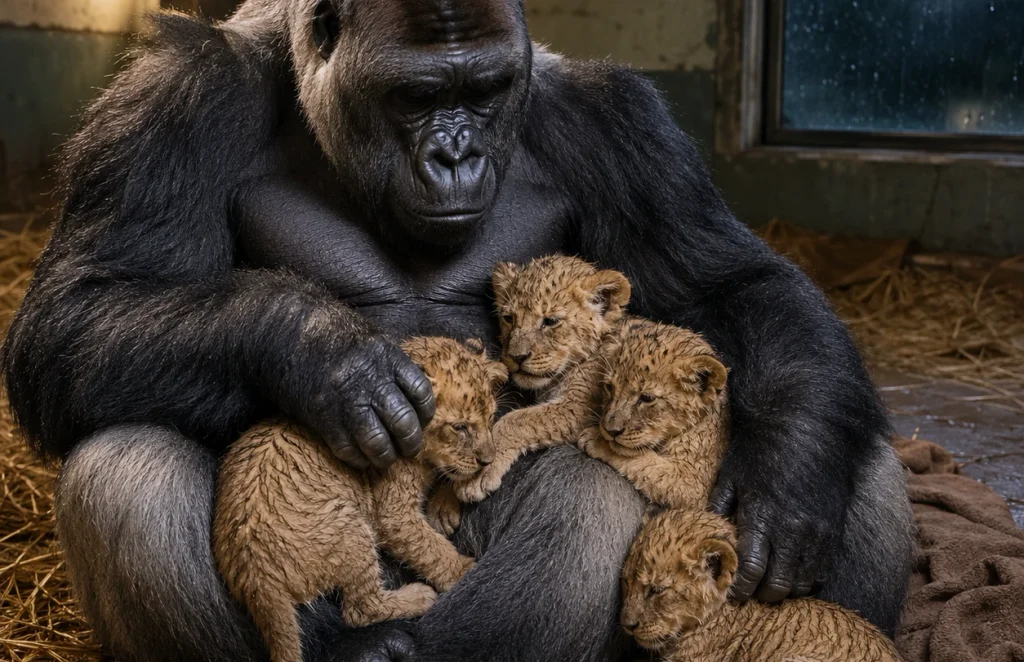
Their mother had died before the seizure. The cubs had spent most of the day in a feed shed while deputies, a state inspector, and two exhausted keepers tried to account for animals whose records existed mostly on stained index cards.
My daughter Kate climbed into the truck before the driver had set the brake. She was thirty-seven, a zoo veterinarian in Charlotte, and still wore the navy rain shell she had thrown over her scrubs when I called. She had been at Hemlock Ridge for eleven minutes and had not yet hugged me.
She had left the refuge at twenty-nine saying she could be my daughter or my employee but had failed at being both. Even afterward, her number remained first on my emergency list. She always answered. The trouble was what happened when there was no sedated bear, flooded enclosure, or sick animal to stand between us.
“Which one hasn’t taken formula?” she asked.
“Small female in the back. White spot on the left hind foot.”
“Vomiting?”
“Not since Asheville.”
Kate looked at me over the crate. “That wasn’t my question.”
The driver stared at the water boiling past his tires. I gave Kate the answer she wanted. “Once. Animal control said mostly foam.”
She nodded and reached for the crate handle. With Kate, anger had always made her more precise.
The cubs should have gone into our intake building, away from every resident animal until examinations and test results told us what they might be carrying. But a pine had split the intake roof at midnight. The dry room I had left was Bay Two in the old ape house, a former nursery separated from Otis’s night quarters by a concrete wall and two welded-mesh panels with an eighteen-inch service space between them.
No animal could touch another through that divider. Air did not circulate between the rooms. A solid steel shutter usually covered the mesh on both sides.
I had already opened it.
Luis Ortega, our senior keeper, met us at the ape-house door with towels warmed in the laundry dryer. At fifty-two, Luis could repair a hydraulic closer with a socket wrench and calm a frightened macaque without pretending either job made him a magician. He looked at the four crates, then at the open shutter.
“You sure about him hearing all this?” he asked me.
“He already hears it.”
Another cry rose from the smallest crate. It was thin at the end, scraped almost empty. Otis knocked again from his bedroom: three measured blows, the flat of his knuckles against the cinder-block ledge.
He had learned that signal from my husband Ben, who used to knock before entering the keeper aisle so Otis would never be surprised by a man appearing at the mesh. Ben had been dead five years. Otis still answered any familiar footstep with the same three beats.
Kate stopped inside the doorway. “Why is the visual barrier open?”
“Move the cubs first,” I said.
Her mouth tightened, but the smallest cub cried again and triage won. We carried the crates into Bay Two, set them on clean rubber mats, and closed the outer door. The room smelled of disinfectant, damp concrete, and the sour milk dried into the cubs’ fur.
Kate worked in the order that mattered. Temperature. Gums. Breathing. Belly. She listened to each chest while Luis mixed warmed formula and I wrote weights on a dry-erase board. Two males, two females. All dehydrated. One male had a rubbed patch across his muzzle. The larger female kept kneading her towel even when Kate lifted her.
The small female with the white toe was coldest. When Kate slid a bottle into her mouth, she turned her face away and cried toward the open divider.
Otis sat on the far side.
At thirty-six, he was an old silverback with a gray saddle broad as a winter coat spread across a bed. A shuttered carnival park had kept him alone for twenty-one years. By the time he came to us, introductions to other gorillas caused a panic so severe that even specialists stopped calling his solitude a simple problem. We gave him sight of the forest, choice over his rooms, puzzles, keeper contact through barriers, and more consultations than our roof had shingles. None of that made another gorilla appear beside him at night.
He watched the cub without showing his teeth or striking the mesh. His lips came together and he made a low, breathy sound I had heard him use when Luis brought a new object into the yard.
The cub stopped crying.
Kate held the bottle still. “Helen, close the shutter.”
“Give her ten seconds.”
“We don’t know their health status.”
“Separate air. Separate drains. Double barrier.”
“And an open visual introduction nobody approved.”
The cub pulled herself forward on unsteady legs. She crossed the rubber mat until her nose was inches from the first mesh panel. Otis lowered his enormous right hand to the floor on his side. His fingers did not fit through the openings, nor could the cub reach him across the service gap, but he curled them against the steel as though holding something small in his palm.
The cub leaned into the mesh.
Her three siblings quieted one after another. The male with the rubbed muzzle came first, dragging his towel. The larger female followed. The last male remained beneath his crate door until Otis gave one soft grunt, and then he stumbled out and pressed himself against the warm bodies already gathered at the divider.
Kate’s face changed, though her hands did not. She crouched beside the smallest female and offered the bottle again. This time the cub latched.
She drank less than an ounce before tiring. It was not enough, but it was the first amount she had kept down in hours. Luis fed the larger female. I took the rubbed-muzzle male, and Kate moved to the fourth. Across the gap, Otis lay on his side with one arm resting along the steel.
For nine minutes, the only sounds in Bay Two were swallowing, the generator’s uneven hum, and rain ticking against the vent hood. I knew better than to call what I saw adoption, comfort, or recognition. I had spent thirty years learning how quickly a person could turn an animal’s behavior into a story about herself.
I also knew four cubs had stopped screaming when an old gorilla came to the wall.
When the bottles were empty, Kate showed Luis how much formula to prepare for the next feeding. I carried the used towels to the sealed bin. The smallest female had fallen asleep against the divider, her white toe tucked beneath her sister’s neck. Otis had not moved.
Kate walked to the shutter controls. Her flashlight caught the yellow handle, then the stainless-steel tag wired beneath it. The tag should have held Luis’s initials, the date, and the reason the barrier had been opened. It was blank.
She looked at the floor. I followed her gaze to the manual track, where a red-handled screwdriver lay beside a shallow dent in the steel. The shutter had jammed halfway that afternoon. I had used the screwdriver to lever it past the bent place, then left it open when the storm worsened.
Kate picked up the tool. “Tell me you didn’t open this before I examined them,” she said…
To read the rest of the story – CLICK the NEXT button 👇👇👇