


Everett Sloan knew the bull was in trouble before the sale-barn gate finished rattling shut behind him. A healthy bull filled a pen by deciding where every other body could stand. This one made himself narrow. He came into the ring with his head low and his red coat rubbed gray over the hips. The points of both hip bones showed. Mud had dried in plates along his belly, and a raw place above his left shoulder shone through a crust of dust. When the handler lifted the sorting flag, the bull tried to turn and nearly went to one knee.
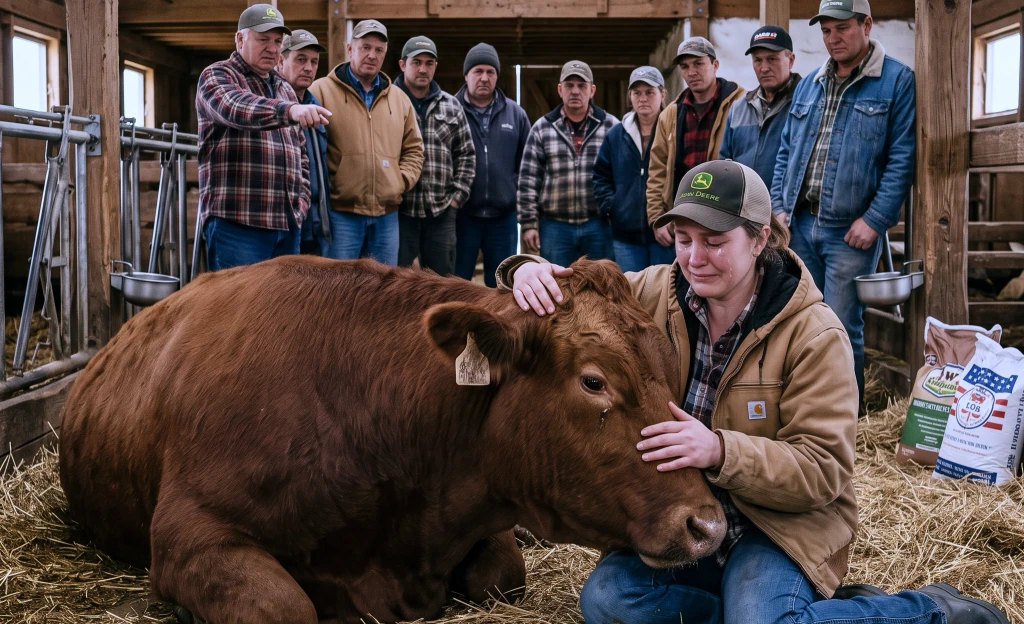
The first laugh came from three rows below Everett. It was short and surprised, the sound a man might make when a piece of equipment failed in a ridiculous way. A second voice said, “Somebody forget to bury that one?”
Everett looked down at his sale sheet. Lot 118 had been the last printed number. The bull wore 119 in black marker on a paper tag glued above his tail.
Wade Pritchard, who managed the Alder County Livestock Exchange, stepped onto the edge of the ring and motioned for the auctioneer to lower his microphone. Wade was not a tender man, but he ran a clean barn. He looked furious now.
“This animal was represented as thin but sound,” he said. “He is neither. We are not putting him through the regular sale.”
The consignor had already left. That fact moved through the seats in murmurs. The barn veterinarian came in through the side gate, watched the bull take six reluctant steps, then spoke quietly to Wade.
“He can make a short local trip if somebody has a quarantine pen and veterinary care waiting,” Wade announced. “Otherwise we’ll deal with him here. No hauling him on. No slaughter buyers.”
The man three rows down said, “Save the diesel and deal with him now.” More people laughed, though fewer this time.
Everett had come to the Friday sale because there were only so many hours a person could spend in a house where every useful object belonged to someone who was dead. Mae’s reading glasses still lay upside down on the kitchen windowsill. Her yellow raincoat hung behind the mudroom door, one sleeve folded inward as if an arm had just slipped out of it. For six months Everett had walked around those things without moving them and called that endurance.
He had not owned cattle in three years. He had no business raising his hand.
“I’ve got a pen,” he said.
The words did not carry. Wade was conferring with the veterinarian.
Everett stood. “I said I’ll take him.”
People turned then. Several knew him. One man removed his cap and looked away, which was worse than laughter. Everett was seventy-two, recently widowed, and thin enough himself that grief had become visible above his collar. He knew what conclusion they were making and resented them for reaching it so quickly.
Wade came to the rail. “You still have that isolation lot behind the calving shed?”
“New boards on the east side. Water works.”
“And somebody to call?”
Everett almost said yes. The lie rose easily because yes had been his answer to every question about help since Mae’s funeral.
“I know who’s on call,” he said instead.
Wade studied him for a moment, then nodded toward the office. The bill of sale listed the bull as an aged commercial Red Angus of unknown origin. Purchase price: twenty-five dollars. Everett paid another forty for the barn veterinarian’s examination and signed beneath a paragraph acknowledging that the animal’s condition was guarded and that the fourteen-mile transport had been approved only because Everett had a suitable pen.
Nobody congratulated him. Wade sent two experienced hands to build a narrow lane of portable panels to Everett’s stock trailer. They gave the bull time. No shouting, no electric prod, no men trying to prove something by getting behind him. After several minutes, he stepped onto the rubber-lined floor and stood with his nose almost touching the front wall. Everett drove home below forty miles an hour.
Mae had always accused him of hearing trouble in machinery before other people did. All the way down County Road H, he listened to the trailer: the soft shifting of hooves on rubber, the occasional knock of a panel, then long stretches of nothing. At the stop sign by Mount Moriah Church, he nearly got out to check. The road sloped there, and he could not safely leave the truck. He drove on with both hands tight around the wheel.
The old isolation pen stood behind the calving shed, separate from the empty barn and sheltered from the north wind. Everett had replaced two boards in August because fixing something that did not need to be used felt less foolish than sitting at Mae’s kitchen table alone. Now he bedded the shed with straw, scrubbed the water tub a second time, and opened the trailer into a paneled alley.
The bull did not want to back out. Everett could see the white rims of his eyes each time the trailer creaked. He set the butt end of a sorting stick against a side panel and waited, resisting the urge to crowd him. After several minutes, the bull found the ramp with one hind foot, then the other. He moved into the pen with the stiff, careful gait of an animal saving what little strength remained.
Only when the gate was latched did Everett call Alder Veterinary Service. The answering service asked for his name and address, and there was a pause long enough for him to understand who was covering large-animal emergencies that weekend.
“Dr. Sloan will call you back,” the woman said.
Everett looked at the bull. “Isn’t anybody else available?”
“Dr. Sloan is on call.”
His daughter phoned in less than two minutes. “What happened?” Caroline asked.
No hello. Her voice had the clipped steadiness she used when someone else’s panic might waste time.
“I brought home a bull from Pritchard’s.”
A cabinet door closed on Caroline’s end before she answered.
“You bought cattle?”
“One.”
“You told me in June you were done.”
“I am done. He needed somewhere to go.”
“That sentence does not improve the first one.” He heard a drawer close and keys strike a counter. “Is he standing?”
“Yes.”
“Breathing with his mouth open?”
“No.”
“Any nasal discharge? Swelling under the jaw? Bloody manure?”
Everett answered as best he could. Caroline told him not to offer grain, not to force water, and not to enter the pen. She would be there in thirty minutes with a technician.
“I know how to stand around a bull,” he said.
“Then this should be easy.” The line went dead.
Everett put his phone in his pocket. The bull had gone to the far corner and turned so his left side faced the wall. Up close, Everett could see that the raw place above the shoulder was not a simple cut. Something had rubbed there for weeks, perhaps a badly fitted halter or the edge of a feeder. The animal’s breathing was faster than it should have been, but he was not gasping. When Everett slid a flake of good grass hay under the fence, the bull sniffed it and let it fall from his mouth.
“She gets that tone from me,” Everett told him. “Her mother never hung up on anybody in her life.” The bull shifted his weight away.
Caroline’s truck arrived less than half an hour later, followed by the clinic utility trailer. She stepped out already pulling her dark hair through the back of a cap. At forty-four, she had Mae’s quick walk and Everett’s unwillingness to pretend a bad thing was smaller than it was.
Her technician, Devon Pike, began unloading portable panels without being asked. He was a broad, patient young man who had once backed a frightened heifer out of a head gate by taking the mechanism apart around her. Everett trusted him, though he had never said so.
Caroline stopped at the fence. Her eyes went first to the bull, then the water, the hay, the trailer position, and finally Everett.
“Tell me exactly what he did in the ring and on the trailer.”
Everett did. She listened without interrupting, which felt less like forgiveness than evidence collection.
They created a protected working lane along the fence. Caroline watched the bull walk before she approached, and even then she stayed behind steel. His body-condition score was barely above the point at which cattle lost the muscle needed to rise. His gums were pale. The wound was infected but did not appear to involve the shoulder joint. His lungs sounded rough in the lower fields.
“He’s very sick,” she said, “but I don’t have enough yet to tell you he can’t recover.”
Everett had not realized how tightly he was holding the top rail until his fingers hurt.
“So we treat him.”
“We take blood. We check a fecal sample. We control pain, start fluids, clean that wound, and feed him slowly enough that his rumen can adjust. Then we see what his body does.” She met his eyes. “Slowly is part of the treatment. More is not better.”
“I heard you.”
Her expression said that hearing had never been the family’s problem.
The bull tolerated the first injection through the panel. For the blood draw, Devon held a padded board to narrow the lane while Caroline reached toward the animal’s tail. When the bull swung his head, his left ear folded inside out against the panel.
The outer edge had been split years before and healed into a shallow V. Beneath dirt and a crust of old skin, green marks showed inside the ear. Caroline asked Devon for clippers. Her voice had changed.
She cleaned only enough hair to expose the tattoo. The digits and letters emerged, blurred but legible: MS 417E. The second numeral bled into a small crescent where the ink had spread under the skin.
Caroline did not touch the bull again. She looked across the panel at her father, and whatever professional distance she had brought into the pen was gone.
“Dad,” she said. “This is Copper…”
To read the rest of the story – CLICK the NEXT button 👇👇👇