


Tully noticed the boot before Sam Mercer saw the man wearing it. The old German shepherd lifted his gray muzzle from the water bowl beneath the diner table. At nine, Tully no longer moved quickly unless he had a reason. Now his front paw drew back, and the leather handle of his service harness tightened beneath Sam’s fingers. The boot stopped an inch from Tully’s toes.
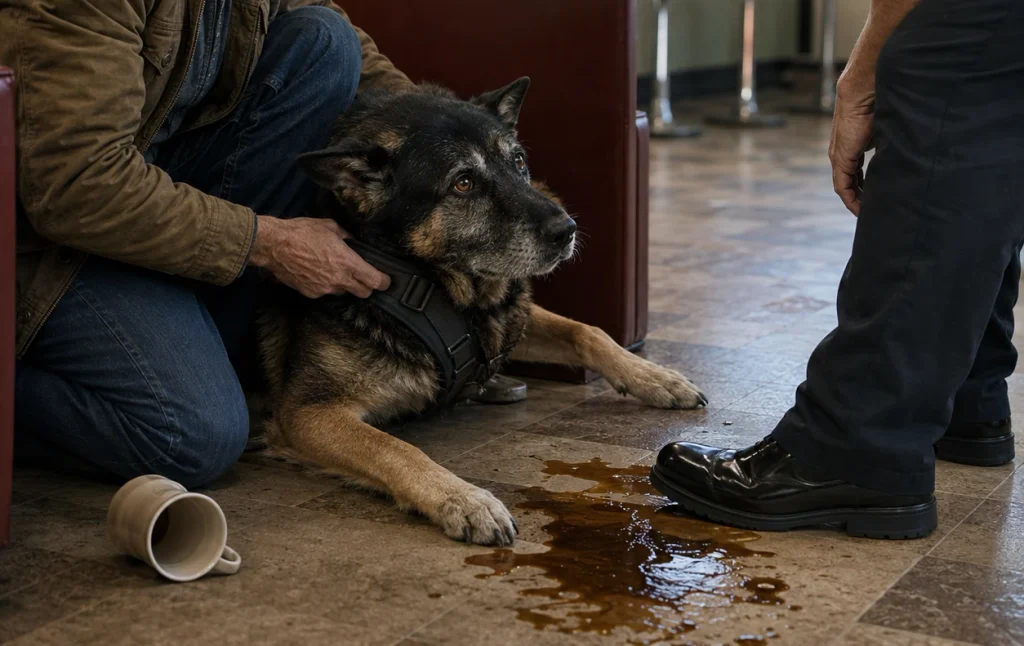
“You’re in my booth,” the police chief said.
Sam looked up. Wade Kessler stood beside the table with a paper cup in one hand and his free thumb hooked behind his duty belt. He was in his mid-forties, thick through the chest, with sun-reddened skin and the comfortable posture of a man who had spent years deciding when other people should move.
The badge above his nameplate caught the morning light from the window.
“I didn’t see a reserved sign,” Sam said.
“There isn’t one.”
Kessler smiled as if that settled the matter.
Sam had chosen the booth because it gave him a view of both doors. He had been in Marlow, Montana, for four days, long enough to clean out his late father’s house and meet the buyer who wanted it, but not long enough to know which diner tables belonged to which men.
He had planned to sign the closing papers on Friday and report to a private security job in Spokane the following Monday. Marlow was a task to finish, not another place to learn.
Tully had folded beneath the table while Sam ate, his hind legs angled carefully around a hip that had never recovered completely from an explosion outside Sangin. The square plastic mount on his harness was empty. Sam normally attached a small action camera during their walks so he could review Tully’s gait for the veterinarian who managed the dog’s arthritis.
This morning he had left the camera in the truck.
Maggie Sloan appeared from behind the counter before either man spoke again. She carried a coffeepot in one hand and a dish towel over her shoulder. Her dark hair was twisted up with a pencil, and a pale burn scar curved around the inside of her wrist.
“Wade,” she said, “there are six other booths.”
“There are seven other booths.” Kessler nodded toward the one by the window. “This one has decent light.”
Maggie’s gaze dropped to Tully. A black-and-gold patch on his harness read SERVICE DOG in plain block letters.
“He’s allowed in here,” she said.
“I know what the patch says.”
Kessler’s tone remained pleasant. That seemed to make Maggie more careful, not less.
A younger officer waited behind him, turning his patrol cap in his hands. Eli Danner looked about thirty, with a narrow face and a recently healed cut through one eyebrow. When an elderly customer near the counter dropped his truck keys, Eli picked them up and returned them without being asked.
“Art, you’re going to lose those for good one morning,” Kessler said.
Art Barlow, a retired body-shop owner with two stiff knees and oil permanently worked into the creases of his hands, grunted.
“You found them under your own patrol car last Tuesday.”
“And returned them, didn’t I?”
Kessler set his coffee on the edge of Sam’s table. He had the easy familiarity of someone who remembered which residents misplaced keys and which ones needed help carrying groceries. Sam understood why that could feel like safety.
He also saw the way Maggie kept one hand pressed against the pocket of her apron.
Kessler glanced beneath the table again. “What does the dog do?”
Sam knew the questions a business owner or police officer could legally ask. He also knew how quickly a reasonable question could become an invitation to explain the worst parts of his life.
“He interrupts a medical episode and guides me out,” he said.
“Combat?”
“That isn’t one of the questions.”
The younger officer looked toward the counter. Kessler’s smile thinned.
“No, it isn’t.” He lifted his coffee again. “But a dog that size makes people nervous.”
Tully’s ears remained forward. His eyes followed the chief’s boots.
“He hasn’t bothered anyone,” Maggie said.
Kessler turned toward her. His elbow struck the metal edge of the table, hard enough to make the cup jump in his hand. Hot coffee spilled across the vinyl seat and streamed over the edge.
Sam pulled Tully backward by the harness. Most of the coffee hit the floor, but several drops darkened the fur above the dog’s paw.
Tully gave one low growl.
It lasted less than a second. Sam touched two fingers to the leather between Tully’s shoulders.
“Leave it.”
The growl stopped. Tully backed against Sam’s legs, eyes fixed on Kessler.
No one in the diner moved. The coffee hissed faintly where it struck the chrome base of the table.
Kessler looked down at his wet hand and then at the dog.
“That’s an aggressive response.”
“You spilled hot coffee on him,” Sam said.
“I bumped a table.”
“Your boot was against his paw.”
Kessler’s expression changed by a fraction. He had expected anger or apology. Sam had offered neither.
Maggie grabbed towels from behind the counter. As she knelt, Kessler stepped aside, but not before Sam saw a white envelope protruding from her apron pocket. MARLOW PUBLIC SAFETY PARTNERSHIP had been printed across the front in blue ink.
A number—$175—was written beneath it.
“Wade, let them finish breakfast,” Maggie said.
“I’m trying to prevent a problem.”
“You’re making one.”
The pencil in Maggie’s hair had loosened. A strand fell across her cheek, and she pushed it away with the back of her wrist without looking up.
Kessler watched her for a moment. His face did not harden; it became blank.
A girl of about nine had appeared in the doorway leading to the kitchen. She held a paper placemat folded into the shape of a small house. The windows had been drawn in purple crayon, and one wall leaned because she had creased it unevenly.
Maggie saw her.
“Bea, honey, go finish your cereal.”
The girl did not move. Her eyes remained on Tully.
“He’s all right,” Sam told her.
Tully heard the child’s voice and turned his head. His tail touched the floor once.
That small movement changed the room more than anything Sam could have said. Bea took one cautious step forward and held out the paper house.
“Does he like things?”
“Tennis balls. Pieces of apple. Sleeping where I’m trying to put my feet.”
A few customers smiled. Even Eli Danner’s mouth shifted.
Bea crouched at a respectful distance and set the paper house beside Tully’s water bowl. Tully sniffed its crooked roof, then looked at Sam for permission.
“Go ahead.”
The dog touched his nose to the paper. Bea grinned.
For several seconds, the diner recovered something ordinary. Maggie finished wiping the floor. Art Barlow returned to his coffee, and someone at the counter asked for more syrup.
Kessler picked up the paper house.
Bea’s smile vanished.
“Chief,” Sam said.
Kessler examined the purple windows, then placed the house on the table rather than the wet floor. His touch was unexpectedly careful.
“My granddaughter builds these,” he told Bea. “Hers fall over too.”
“Mine doesn’t fall over.”
“No?” Kessler tapped the crooked wall. “Then I stand corrected.”
He set the house near Sam’s plate. The human moment was brief and unperformed. That made what followed harder to dismiss.
Kessler turned to Sam. “Take the dog outside.”
“He’s under control.”
“He growled at a police officer in a crowded business.”
“After you hurt him.”
“I bumped a cup.”
Maggie stood between the booth and the counter, holding the wet towels against her apron. “I saw what happened.”
Kessler’s gaze moved to the envelope in her pocket. Maggie covered it with her hand.
“I’m giving a lawful direction,” he said. “Remove the animal.”
Sam felt the first tightening behind his ribs. Tully noticed it and pressed his shoulder against Sam’s shin, applying steady weight. That was one of the tasks he had learned after his military retirement, when Sam’s body still reacted to threats his mind had not yet named.
Sam breathed until the diner came back into focus.
“We’ll leave,” he said. “When I’ve paid.”
Kessler gave a small nod. “Good choice.”
Sam put cash beside his plate and rose. Tully came up slowly, favoring the paw the coffee had struck. Sam checked the skin beneath the wet fur. It was pink but not blistered.
Eli Danner moved toward the door to clear a path. Kessler remained beside the booth.
As Sam reached for the leash, the chief placed his hand on Tully’s harness.
Tully froze.
“Don’t touch him,” Sam said.
Kessler looked at the empty camera mount. “What’s this for?”
“Veterinary gait videos.”
“Convenient place for a camera.”
“It’s empty.”
“For now.”
Tully turned his head toward Kessler’s wrist. He did not bare his teeth, but the muscles along his back gathered beneath the harness.
Sam put his hand over Kessler’s and removed it.
The diner went quiet again.
Kessler’s face remained composed, but Eli stopped near the door.
“You put your hands on me,” Kessler said.
“I removed your hand from my service dog.”
“Wade,” Maggie said, “let him go.”
Kessler looked from Sam to Maggie and then to the watching customers. He understood the room. Whatever else he was, he knew when force would cost more than patience.
He stepped aside.
“Animal control gets a copy of every aggressive-dog complaint,” he said. “If I see him loose, lunging, or causing another disturbance, they’ll hold him pending review.”
Tully had never bitten a civilian. He had never failed a public-access evaluation. Sam had a folder of records in his truck that proved both facts.
Kessler spoke as if records were details he could arrange later.
Sam guided Tully toward the entrance. Maggie hurried after them, carrying the water bowl as though that gave her a reason to follow.
She waited until Kessler had turned back toward the counter.
“Mr. Mercer.”
Sam stopped with his hand on the door.
Maggie kept her voice low. “Whatever happens next, don’t hand Wade Kessler that leash…”
To read the rest of the story – CLICK the NEXT button 👇👇👇