


Rook began digging before Cal Mercer had carried the second suitcase out of the truck. The German shepherd drove both forepaws into a seam of wet earth behind the cabin, where mountain laurel crowded the base of Briar Hill. Each stroke threw black soil across the faded Army duffel Cal had set in the grass. He called the dog once, then again with the command Rook had obeyed through thunderstorms, crowded clinics, and six years of Cal waking with no idea which country he was in.
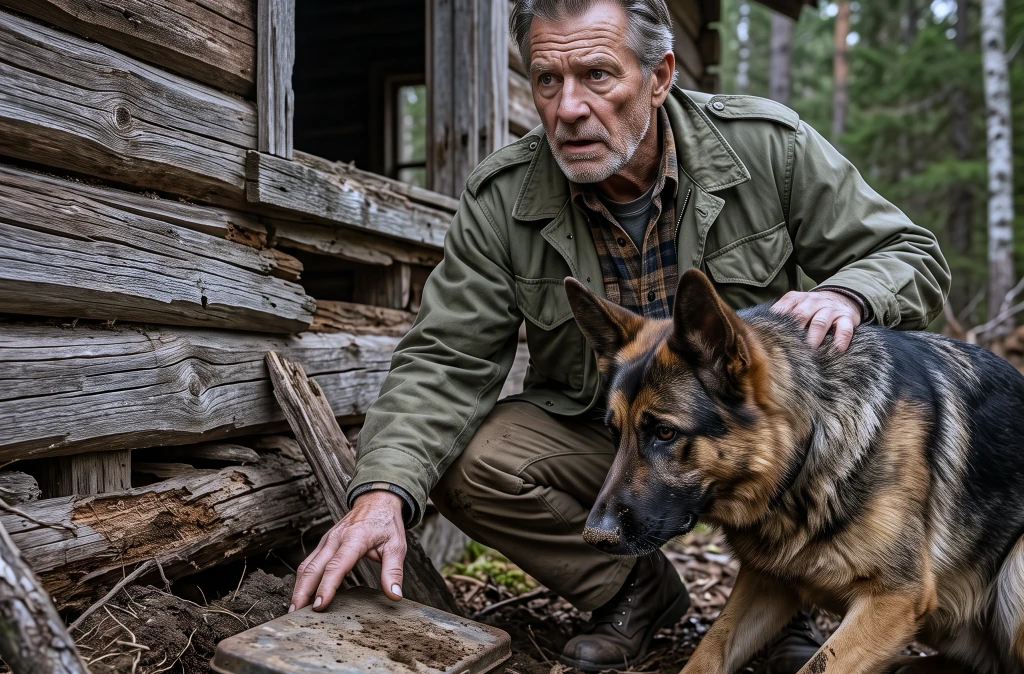
Rook did not look up.
“Leave it.” Cal put command into his voice this time.
The dog backed away, but only as far as Cal’s bad knee. His gray muzzle pointed toward the shallow hole, and his ribs moved fast beneath a coat darkened by rain.
Cal crouched with one hand braced against his thigh. At sixty-seven, he could still lower himself like a soldier when he remembered to plan the movement. Standing again was where age and an old blast injury collected their fee.
Something straight showed beneath the roots—an inch-wide line of rust that could have been an old barrel hoop or the edge of farm machinery. Cold air touched the back of Cal’s wet hand, faint enough that he might have imagined it.
“Mouse hotel,” he told Rook. “Tomorrow.” Rook glanced at the hole, then followed him to the cabin.
Four hours earlier, in a family courtroom in Charleston, Cal had agreed to let Nora keep the brick house in Kanawha City, the retirement account built through her bookkeeping business, and every piece of furniture except his father’s pine chest. Nora took the mortgage and the business debt. Cal kept his Army pension, his disability benefit, an eleven-year-old pickup, and forty-one acres in Pocahontas County that the settlement valued mostly for timber no one had cut in decades. His lawyer had pressed two fingers onto the agreement before Cal signed it.
“Take the weekend,” Dana Croft had said. “You’ve spent thirty-five years married. Forty-eight more hours won’t injure anybody.”
Across the table, Nora had looked tired rather than triumphant. Her hair, once black, had gone almost entirely silver in the year since they separated. She had brought the blue thermos Cal used to take on predawn drives and set it beside his papers because he had left it at the house.
“He won’t take the weekend,” she said.
Cal disliked that she still knew him well enough to be right. He signed every flagged page without reading it again.
On the courthouse steps, Nora had tried to hand him the thermos. He told her to keep it. Then he crossed the wet sidewalk to the truck, where Rook waited with his chin on the passenger-seat headrest, and drove east without looking in the mirror.
The cabin was not much of a victory. One porch pier had sunk. Rain had darkened the ceiling above the kitchen, and a squirrel had filled the woodstove flue with enough twigs to build a second squirrel. Cal’s father had died nineteen years earlier; Cal had returned twice since the funeral, both times only long enough to pay someone to cut brush away from the structure.
Nora had paid the property taxes. Cal remembered that only when he found the county receipts bundled with his deed.
He opened windows, swept a place for Rook’s bed, and carried in bottled water. The power came on after he reset the main breaker, but he left the well pump off until he could inspect it in daylight. By dusk, he had a camp stove on the porch and a can of beef stew warming in a dented saucepan.
Rook ate first. He had been retired from military service with a torn shoulder and a record that described him as reliable, intense, and unsuitable for inexperienced handling. Cal, who had met him through an adoption program during his own rehabilitation, had considered that a fair description of both of them. The dog kept turning his head toward Briar Hill.
“It’ll still be there in the morning,” Cal said.
Inside, rain tapped the metal roof with the irregular sound of gravel against a vehicle. Cal was rinsing the saucepan when the camp stove coughed behind him. Blue flame lifted orange, and for half a second the cabin smelled not of propane but of hot wiring and scorched rubber.
The sink disappeared. The dark window became an armored windshield. Cal’s right hand clamped on the counter while his left searched for a radio that had not been attached to his vest in twelve years.
Rook struck him hard behind the knees.
Cal turned, ready to fight, and found eighty pounds of shepherd leaning broadside against his shins. The dog did not lick his hands or whine. He simply held pressure there and looked toward the cabin door, as if the only decision required was whether they were staying or leaving.
“Staying,” Cal managed.
He shut off the stove, opened the door, and stood on the porch until he could name five things in the clearing. Truck. Barn. Pump handle. Split oak. Rook. The last one moved closer when Cal said it.
They slept on the floor because the old mattress had mouse droppings under the quilt. Near midnight, Cal woke to Rook’s empty blanket and found him sitting at the back window, ears angled toward the hill. The dog returned when called this time, but he lay facing the window until dawn.
Morning came cold and clear. Cal drank instant coffee from a paper cup, fetched a trenching shovel and pry bar from the barn, and followed Rook uphill.
The dog went directly to the place he had opened the evening before. Cal let him dig long enough to expose the scent line, then moved him back and took over. Beneath six inches of soil lay a steel corner. A second corner emerged three feet away, then a vertical seam running into the bank.
It was not a hatch in the ground. It was a service door built into the hill and buried by years of runoff.
Cal cleared the upper edge and found a concrete lintel under the roots. Moss hid two heavy latches. A corroded metal plate, no bigger than his palm, carried four legible words: COUNTY CIVIL DEFENSE SITE.
He sat back on his heels. His father had once mentioned a storage room on the property, usually when asking Cal to come home and help with it. Cal had pictured a root cellar full of rusted canning jars. He had never asked a second question.
Rook pressed his nose toward the seam. Cool air moved there again, carrying old mineral damp and the sharp animal smell that had probably held the dog’s attention.
“No,” Cal said when Rook pawed once at the latch. “You found it. I open it.”
The first latch yielded after penetrating oil and twenty minutes of patient force. The second required the pry bar. When the seal finally broke, the door shifted inward half an inch and released a breath of air so cold that moisture formed along the exposed steel.
Cal stopped. Underground rooms killed careless people. He widened the gap without putting his face near it, then waited while the interior vented. From the truck he brought a flashlight, gloves, and the battery carbon-monoxide alarm he carried when working around old heaters. It was not a proper confined-space meter, and he knew the difference, so he stayed outside.
The beam reached a short concrete passage and a second door standing open beyond it. Dust lay undisturbed except for small tracks near a drain. On the wall hung a dented fire extinguisher, a red valve wheel, and a clipboard furred gray with age. Cal extended the pry bar, hooked the clipboard, and drew it across the floor.
The paper on top had crumbled around the clip. Beneath it was a yellow envelope, protected by a cloudy plastic sleeve. Across the front, in his father’s square carpenter’s hand, was one word Cal had not seen written in almost twenty years.
Danny…
To read the rest of the story – CLICK the NEXT button 👇👇👇