


The old shepherd lay with one foreleg across the puppy’s ribs. Daniel Mercer noticed that before he read the red sentence beneath the photograph: Scheduled for euthanasia at 8:00 a.m. He had come off patrol a little after one in the morning and was eating reheated soup at the narrow counter in his apartment. Four moving boxes still stood against the living-room wall six months after his transfer to Juniper, Colorado. Daniel used one as a table for unopened mail and told himself that counted as unpacking.
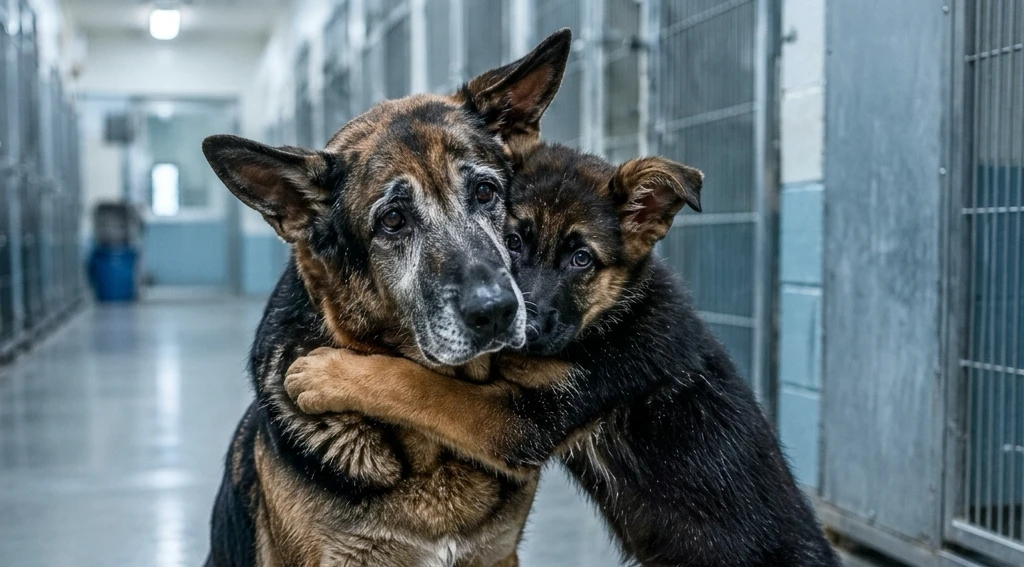
The photograph had been shared by a dispatcher from the county animal shelter. It showed kennel bars, a gray concrete floor, and two German shepherds who were not looking at the camera. The puppy’s paws were hooked around the older dog’s neck. The old dog, silver around the muzzle, held him with the weary patience of someone accustomed to being climbed on.
Daniel read the post twice. The senior dog’s name was Gus. He was eleven, arthritic, and had been at Juniper Valley Animal Shelter for nearly three months. Finn, the four-month-old puppy pressed beneath his chin, had arrived frightened and underweight two weeks earlier. He ate when Gus ate, slept when Gus slept, and panicked when staff tried to move him to another kennel.
At the bottom was a phone number. Daniel called it, listened to the shelter’s recorded hours, and left a message that sounded too much like a report.
“This is Officer Daniel Mercer with Juniper Police. I’m calling about Gus. Please don’t proceed until I get there. I’ll be outside before you open.”
He ended the call and looked again at the picture. The phrase please don’t proceed sat badly in his mouth. It was language for traffic control and paperwork, not for an animal whose last night was already being counted.
Daniel owned no dog bed, no fenced yard, and a lease that allowed one pet under forty-five pounds with written approval. He knew all of that. He also knew he was not going to sleep.
At twenty minutes past six, the shelter parking lot was empty except for a mud-streaked hatchback. Cold rain stippled Daniel’s windshield. Beyond the low cinder-block building, a drainage channel carried a thin brown ribbon of runoff toward Pine Creek.
A woman in a yellow rain shell was unlocking the front door. She was in her early fifties, with short dark curls going gray at the temples and a canvas pouch of keys bumping against her hip.
“Officer Mercer?” she asked.
“Daniel’s fine. I left the message.”
“I heard it at five-forty. I’m Mara Velez.” She studied his empty hands, then his car. “You came fast.”
“Not fast enough to bring anything useful.”
“Leashes we have. Homes are harder.”
Inside, the shelter smelled of disinfectant, wet fur, and yesterday’s coffee. Dogs woke as they passed, first one bark and then a whole corridor answering. Mara did not raise her voice over them. She walked to kennel seventeen and stopped.
Gus rose from a folded blanket. The stiffness began in his hips and traveled through his body, but once he was standing, he came forward without hesitation. One ear remained upright; the other leaned outward as if years had worn the hinge loose.
Finn appeared beneath him. The puppy had feet too large for the rest of him and one ear that folded at the tip. He looked at Daniel, backed into Gus’s chest, and peered out again.
“He was found in a produce box near the highway,” Mara said. “Wouldn’t eat if anyone stayed in the room. Wouldn’t eat if everyone left. Gus lay down at the divider and turned his head away. Ten minutes later, Finn walked over.”
Daniel crouched without putting his fingers through the wire. Gus came close enough to smell his knuckles. Finn watched, then stretched his neck forward and caught one of Daniel’s bootlaces between his front teeth.
“That’s promising,” Daniel said.
“He steals from people he trusts.”
“Then I feel honored.”
Mara opened the gate and handed him a slip lead. Daniel sat on the concrete instead of reaching for either dog. Gus inspected the shoulder of his jacket, his hands, and finally his face. Then the old shepherd turned sideways and leaned a measured amount of weight against him.
Finn came out from behind Gus and climbed directly into Daniel’s lap. He worried at the zipper on Daniel’s jacket until Gus touched his muzzle to the puppy’s shoulder. Finn stopped at once.
“That,” Mara said quietly, “is most of what he’s done for two weeks.”
Daniel rubbed the thick fur at Gus’s neck. Beneath it he felt a shallow ridge of scar tissue and an area where the coat seemed worn in an old, straight line.
“Why today?”
Mara did not pretend to misunderstand. “We’re an open-admission shelter. Fourteen dogs from a neglect seizure are being transferred here this morning now that the court hold has cleared. Every rescue partner we use is full. Gus has been listed three times, and his hips have gotten worse in here.”
“Is he suffering?”
“Not enough that I would choose this if we had room. Enough that someone could defend it on paper.” Mara rubbed her thumb along the metal edge of the gate. “I was in the placement meeting. I put my initials on the list.”
Finn climbed over Daniel’s thigh and pushed his head under Gus’s chin. The old dog adjusted his stance so the puppy could fit.
“Yesterday we moved Finn to the adoption wing,” Mara continued. “He threw himself against the gate until his gums bled. Gus stood here listening and wouldn’t take his evening pills. I asked for one more night, brought Finn back, and found them like that after the thunder started.”
“You took the picture.”
“I did. My director approved an emergency post. She also made me promise I wouldn’t write things we couldn’t know about what the dogs were feeling.” Mara glanced toward the office clock. “The facts were enough.”
Daniel had spent years arriving after people had made bad decisions and telling himself that calm procedure was the useful thing he could bring. Now he looked at the two dogs and felt the familiar urge to reduce the problem to the part he could solve.
“I’ll take Gus.”
Mara’s relief came and went so quickly he might have imagined it. “And Finn?”
The puppy was chewing the loose end of the slip lead. Daniel looked down the hall toward the adoption wing, then back at Gus.
“What happens to him?”
“He stays. He may adjust. He may not. I won’t tell you that taking one dog obligates you to take two.”
Mara called another staff member to hold Finn and led Gus six feet into the corridor. The puppy froze. When Gus passed beyond the kennel door, Finn gave a thin, startled cry and scrambled after him until the lead checked his movement.
Gus stopped too. He turned, returned to Finn, and placed his body between the puppy and the busy hallway. Finn pushed against his side and began to breathe normally again.
Daniel felt Mara watching him. He disliked being watched while deciding something, as if another person’s hope could contaminate the facts. He checked the time on the office wall and then took out his phone.
“I need the paperwork for both.”
“Before I hand it to you, where do you live?”
He gave her the address. Recognition crossed her face; several officers rented in the same complex.
“They have a weight limit. We verify housing before release.”
“I know.”
“Do you have another place?”
Daniel had one possibility, which was not the same as having a place. Jo Palmer had retired after thirty-one years as a police dispatcher and rented a cottage behind her house. She had offered it to Daniel when he first transferred. He had chosen the apartment instead because it was closer to work, cheaper, and did not come with Jo noticing when he skipped dinner.
He called her. She answered on the fourth ring with the wary voice of someone who had spent a career receiving trouble before breakfast.
“Mercer, if this is about a body, call the current dispatcher.”
“No body. Two dogs.”
There was a pause. “That answer did not improve the call.”
He told her about Gus, Finn, the lease, and the deadline. He heard a cupboard close at her end, then the scrape of a chair.
“The cottage fence is sound,” she said. “You pay the same rent I quoted in March, you repair anything the puppy eats, and you do not call this temporary while standing in my kitchen.”
“I don’t know what it is yet.”
“Then you can say that when you get here. Bring them.”
Mara spoke to Jo, confirmed the fenced property, and returned with two foster-to-adopt forms. The shelter director signed the hold on Gus herself. Daniel accepted a bag of medication, vaccination records, two battered blankets, donated food, and a handwritten note that began: Finn believes electrical cords are prey.
When the kennel opened for the last time, Finn bounded into the lobby and nearly pulled Daniel sideways. Gus followed carefully, stopping once to look back down the row. Mara knelt and pressed her face briefly into the fur beneath his upright ear.
“You don’t owe us anything,” she murmured. “Just go.”
Rain had softened to mist by the time they reached Daniel’s SUV. Finn jumped against the rear door, missed, and tried again. Gus stood beside the bumper, studying the open cargo space.
Daniel shortened the leash and said, “Up.”
The old dog did not move. On instinct, Daniel lowered his voice and made a two-finger motion he had seen the department’s canine handler use. Gus’s attention snapped to the hand. He stepped to Daniel’s left knee, waited for the signal, and climbed into the vehicle with a precision that made his age disappear for three seconds.
Mara had seen it too. She stared at Gus, then at Daniel. “Who trained him…”
To read the rest of the story – CLICK the NEXT button 👇👇👇