


Cal Mercer had spent eleven minutes in the Blue Heron parking lot rehearsing a sentence that became less honest each time he tried it. Max waited in the passenger seat, his graying black muzzle resting above the open window and his ears following every gull that crossed the hot white sky.
Inside the diner, June Vale moved between the counter and the pie case in a blue apron, refilling coffee as if this were an ordinary Thursday. She had asked Cal to come at seven, before the breakfast crowd. It was seven twenty-three, and the red-and-white fishing spoon in his pocket had left a damp crescent against his palm.
“We can still leave,” he told the dog.
Max turned his head and looked at him. At ten years old, the German shepherd had lost most of the dark mask around his eyes, but he could still hold a man in place with that patient stare. The faded vest over his shoulders read SERVICE DOG in plain black letters. Beneath it, hidden by fur, ran the long scar from the operation that had ended Max’s military career and taken Owen Vale’s life.
Cal had retired the previous spring after twenty-one years with the Navy SEAL teams. The Navy retired Max after his recovery, and a veterans’ program helped retrain the dog to interrupt Cal’s panic episodes instead of searching rooms for danger.
Cal shut off the truck.
The bell above the diner door gave a thin brass rattle when they entered. June was carrying two plates of biscuits and gravy. She saw Max first, stopped so abruptly that a ribbon of white gravy slid into the blue rim of one plate, and set both dishes down on the nearest table.
“You brought him.”
It was not the greeting Cal had rehearsed. “I said I would.”
June came around the counter slowly. She was sixty-two now, smaller than he remembered from the funeral, her silver hair pinned with two crossed bobby pins. Max stood without being told. When she offered the back of her hand, he smelled it for a long moment and then pressed his forehead beneath her fingers.
June’s mouth folded inward. “Owen said he always did that when he wanted somebody to stop pretending.”
Cal glanced toward the nearest booths. A few customers had begun to watch. “He still does.”
She left her hand on Max’s head, but her eyes went to Cal. “Does it work?”
“Not reliably.”
Something almost like a laugh passed through her face and was gone. She pointed to a rear booth with a blue vinyl seat and a clear view of both doors. “I saved you the one you’d pick.”
Cal had not told her about sitting with a wall behind him. Owen had.
The Blue Heron had belonged to June and her husband before the highway widened. Its terrazzo floor was pale along the path to the counter, where a wooden heron with one missing foot stood beneath handwritten tabs for shrimp crews and local regulars. June had mailed Owen photographs of every change. Cal had seen them taped inside lockers six thousand miles away.
Max folded himself beneath the booth. June brought coffee, a bowl of water, and one dry biscuit on a saucer.
“He can have it?” she asked.
“If you don’t mind being remembered forever.”
She broke the biscuit in half and held one piece under the table. Max took it with the care of an old dog who had learned that gentleness earned more than speed. June watched him chew, then slid into the seat opposite Cal.
“Twenty-seven months,” she said.
Cal wrapped both hands around his mug. “I know.”
“You answered three of my calls.”
“Four.”
“One was six seconds long because you said you were boarding a plane.”
He remembered standing in his empty kitchen when he said it. “I was leaving.”
“The house doesn’t count as a plane, Cal.”
Max’s tags made a quiet sound under the table as he shifted. Cal looked down, grateful for the interruption, but the dog had only stretched one foreleg.
June pushed the sugar jar to the edge of the table and pulled it back. “I don’t need the version they gave us at the base. I have that in a folder. I need to know who my son was with at the end.”
Cal felt the fishing lure against his thigh. Its treble hook had been clipped off before he flew home, but one bent shank remained and had worried a small tear in the coin pocket of his jeans. He had carried it in four countries, two rented houses, and the truck outside. He had planned to set it on the table, answer what he could, and be gone before lunch.
“I came to tell you,” he said.
June studied him. She had Owen’s habit of letting silence do the rude work. “Then tell me.”
A ticket bell rang twice from the kitchen. The young line cook called that he had six eggs working and no clean plates. June closed her eyes for a second.
“Don’t disappear while I rescue breakfast.”
“I’m not going anywhere.”
“You’ve said things before.”
She rose and returned to the counter. Cal watched her knot her apron tighter as she passed through the swinging kitchen doors. He had faced rooms where every object could hide harm, but nothing in them had required him to sit still while a dead man’s mother asked a plain question.
Max lifted his head.
The movement was small enough that no one else noticed. His ears came forward, not toward the kitchen or the strip of bacon a toddler had dropped beside a high chair, but toward the front entrance. He drew one long breath through his nose.
Cal set down his coffee.
Max rose beneath the table, bumped the underside with his back, and emerged at Cal’s left knee. His body had changed. The easy curve was gone from his spine, and his tail hung low without touching the floor.
“What have you got?” Cal murmured.
The dog’s nose tracked past the pie case and the register to a gray plastic trash bin beside the front door. Cal had noticed the bin when he entered. It stood beneath a rack of tourist brochures, close enough to the door that customers dropped receipts and paper cups into it on their way out.
Max took two steps and stopped. The hands-free leash tightened at Cal’s waist.
Since retirement, Max had interrupted Cal’s waking nightmares, leaned against his legs when crowded rooms narrowed, and woken him before panic became breathlessness. But the old trained response ran deeper. Cal had seen its first stage beside roads and gates he preferred not to remember.
He stood. “Marisol.”
Their waitress was lifting a coffeepot from its burner. She looked over, saw his face, and put it down.
“I need you to keep people away from the front door and get June. Quietly.”
Marisol glanced at Max. “Is he sick?”
“No. Call 911 from the kitchen. Tell them a retired explosives-detection dog is showing interest in a container near the entrance. Say we need the building cleared and the container checked.”
Her eyes widened. “You mean a bomb?”
“I mean he’s showing interest. Don’t tell the room anything yet. Move people through the kitchen if you can do it without a rush.”
Cal should have taken out his own phone then. Later, he would return to that choice more often than he wanted. Training had taught him to control the nearest variables before opening another channel. Civilian life required him to trust systems he had never commanded, and under pressure he reverted to the older habit.
Marisol had taken only one step when Wade Kern came from behind the register. Wade managed mornings when June cooked. Broad-chested and careful with his white shirts, he remembered which regulars needed low-sodium gravy. He looked from Marisol to Cal and then to the dog straining toward his new trash bin.
“What’s going on?”
“Keep this entrance clear,” Cal said. “Marisol is calling 911.”
“For what?”
“Max was trained to detect explosives. He’s responding to something by that bin.”
Wade stared at him, waiting for the rest of the joke. Behind him, a fisherman in rubber boots reached for the front door.
“Sir, use the kitchen exit,” Cal said.
The fisherman stopped. Wade’s face tightened. “You can’t block my customers in because your dog sniffed garbage.”
“I’m asking you to move them out the other way.”
“And I’m asking you to take him back to your booth.” Wade lowered his voice. “June said you were having a hard time. I don’t know what she meant by that, but you’re frightening people.”
Cal felt the words land and chose not to answer them. “Call 911.”
“I’ll call.” Wade took his phone from his pocket. “But I’m telling them I have a man refusing to leave and making threats about a bomb.”
“That isn’t what I said.”
“Back away from my door.”
Wade dialed before Marisol could reach the kitchen. Cal moved only far enough to take the tension out of Max’s leash. The dog did not sit. He remained fixed on the bin, tasting the air in short, controlled breaths.
Conversations thinned around the diner. A woman pulled her little boy out of the aisle. Thomas Greer, a seventy-one-year-old regular in a faded Marine cap, set down his fork and watched Max rather than Cal.
Wade spoke to dispatch in a hurried undertone. He said trespasser twice and disturbance once. He did not mention Max’s former training.
The first patrol car arrived in less than five minutes. Officer Ben Hollis entered alone, one hand free beside his belt. He was perhaps thirty-eight, square-faced and sunburned above the collar. Before approaching Cal, he guided an elderly woman away from the doorway and asked Wade whether anyone had seen a package placed in the bin.
“No package,” Wade said. “Just him acting like he owns the place.”
Ben looked at Max’s vest, the taut waist leash, and Cal’s hands. “Sir, I need you to step away from the entrance.”
“Gladly. Use the rear door and clear everybody with us.”
“I need you outside where I can speak to you.”
“Not past that bin.” Cal kept his voice level. “The dog worked explosive odor for seven years. He is showing pre-alert behavior.”
Ben’s eyes moved to the trash can. “Did you put anything in there?”
“No.”
“Do you have a device on you?”
“No.”
“Then turn around and walk to the kitchen with me.”
It was a reasonable instruction. Cal knew it, and still he looked at the people between them and the rear doors, at the high chairs and walkers and narrow passage beside the griddle. “Start them moving first.”
Ben’s jaw flexed. “You called in a possible bomb, you’re refusing to move, and you won’t give me your name. Right now, you’re the person I have to control.”
“Cal Mercer. Retired Navy SEAL. My identification is in my right rear pocket.”
“Keep your hands where I can see them.” Ben spoke into his shoulder radio, requesting another unit and asking dispatch to check the name. The burst of static made Cal’s attention snap back to the bin.
“Move the radio outside.”
Ben heard an order where Cal had intended a warning. “Do not tell me how to use my equipment.”
“Then clear the room.”
The kitchen doors swung open. June came through carrying a towel, Marisol close behind her.
“Ben,” June called. “Wait. I know him.”
Cal turned toward her voice. Ben saw the turn, the tightening leash, and Cal’s weight shift toward the front of the diner. His decision came fast.
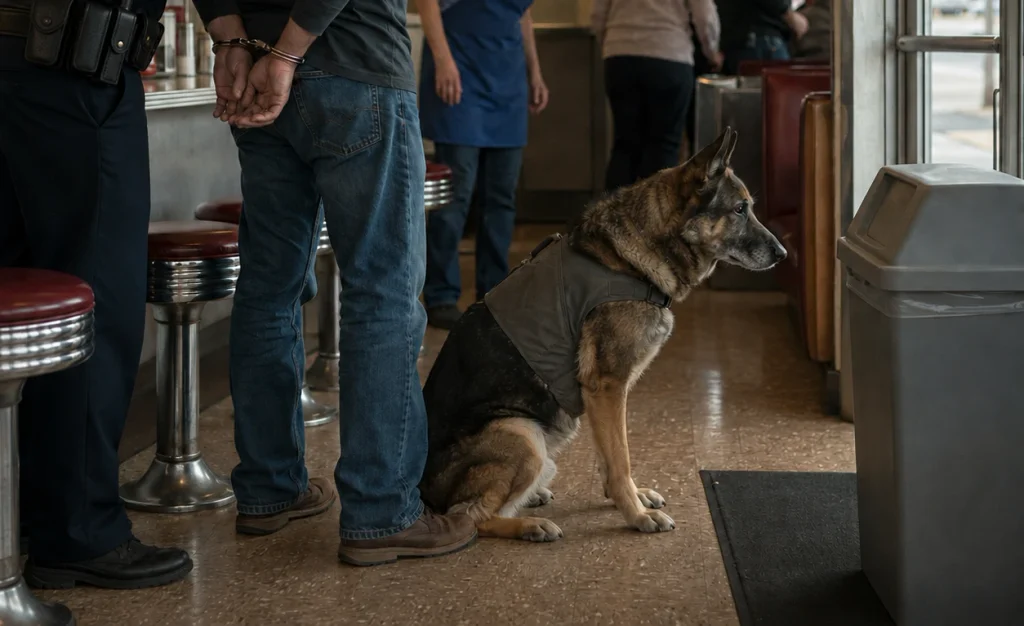
He took Cal’s left arm, turned him toward the counter, and drew it behind his back. Cal could have broken the grip. The knowledge arrived without emotion, followed by the image of Ben stumbling into the bin or drawing his weapon in a room full of families. Cal let himself be turned.
“Don’t fight me,” Ben said.
“I’m not.”
The first cuff closed. Ben caught Cal’s other wrist, and the second cuff bit down too tight. Max pivoted toward them, ears flat, a low sound gathering in his chest.
“Max, hold.”
The dog froze. Ben began to pull Cal toward the kitchen, away from the front entrance. Cal could no longer see Max’s nose, only the line of his shoulders. With two fingers behind his back, he gave the old hand signal and made one short click with his tongue.
Max looked at the man who had restrained Cal. Then he turned his back on both of them, walked to the gray bin, and sat…
To read the rest of the story – CLICK the NEXT button 👇👇👇