


The joke reached Miriam Bell while she had a fifty-pound sack of mineral balanced against her chest. “Twenty bulls and not one cow,” Glen Cates said from the loading dock at Prescott Feed. “Miriam’s running a bachelor party, not a ranch.” Three men laughed. Tom Arnett did not, though he did not tell them to stop, either. He took one step toward Miriam’s tailgate, offering his hands for the sack, and she swung it into the truck before he could touch it.
“I’ve got it.”
“I can see that.” Tom glanced at the second sack on the pallet. “Doesn’t mean you need to prove it twice.”
He looked toward the brittle grass beyond the loading yard. “Winter never showed up. Twenty is a lot to carry if April misses us too.”
“That’s why I’m buying mineral and pricing hay.”
“Hay takes money.”
Miriam slid the second sack against the first. “Thank you, Tom. I had wondered what they took for it.”
Miriam signed the receipt and drove north toward Chino Valley with the windows cracked. At fifty-nine, she had learned that anger was easier to carry if you gave it a practical job. By the time she turned through the cattle guard at Juniper Draw, she had used hers to decide which water trough needed scrubbing, which buyer needed calling, and how many days she could postpone ordering hay if the April rain missed them again.
The bulls were where they had no business being.
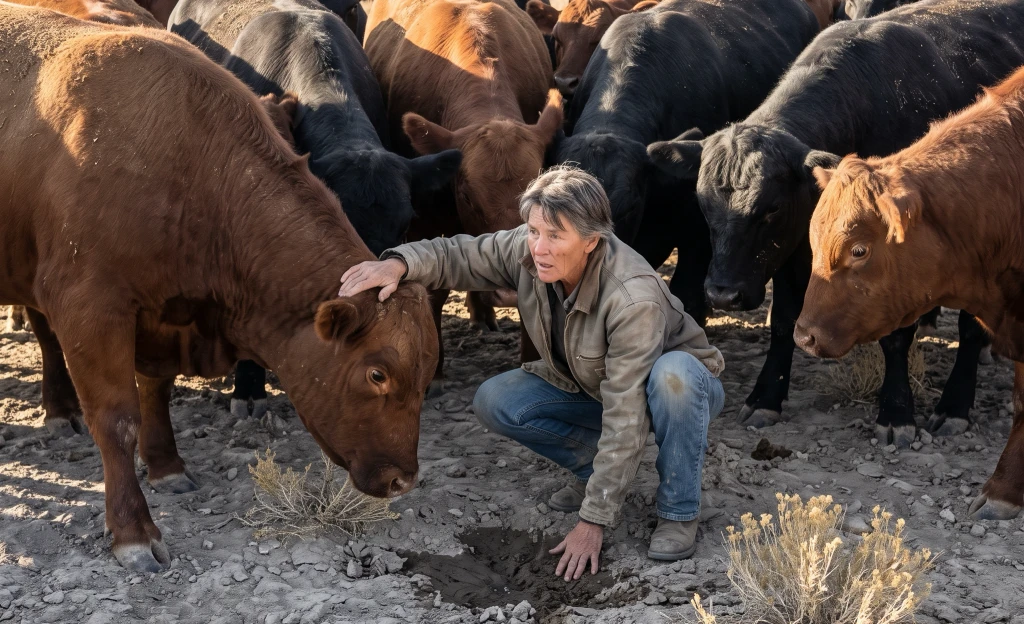
All twenty stood in the southwest corner of the home pasture, crowded onto a pale shelf of stone and rabbitbrush. There was no shade there, barely any forage, and the trough in the north paddock was clean and full. Yet the bulls held their heads low as if listening through their hooves.
Miriam killed the engine. A red Angus yearling with tag 14 scraped once at the hardpan. Dust lifted, but the bull did not lower his nose to it or lick the soil. He simply shifted his weight and stood over the mark.
“You boys lose a bet?” she called.
Their ears turned toward her. Nothing else moved.
People who did not handle bulls imagined that keeping twenty together meant surviving twenty separate tempers. Miriam kept one stable cohort, no cows close enough to excite them, and enough room at gates and feed bunks that no animal had to fight for an exit. She bought sound weaned calves from seed-stock ranches, grew them slowly on forage, hay when the grass failed, and careful mineral, then sold them before they became heavy, isolated herd sires.
Russ had called the idea foolish from his hospice bed. He had also spent the next afternoon showing her where his father had doubled the braces on the sorting alley. That was how he had loved her near the end: resisting the future while quietly leaving her tools for it.
After he died, Tom brought auction contacts and a yellow legal pad covered with numbers. Miriam heard only the part he never said—that a woman alone should not attempt what Russ had barely managed with help. She sold the cows, paid down the worst of the debt, and bought ten bull calves that fall.
Six years later, buyers came from three counties. The ranch was not prosperous, but it was still hers.
Miriam opened the cross-fence and moved the bulls off the shelf at a walk. Tag 14 hesitated, looking back, then followed the others toward the trough. There was no bawling, shoving, or challenge at the gate. Glen Cates would have found that disappointing.
An hour later, every bull was back.
Miriam checked the mineral tub, then the trough float. She walked the fence for a fallen branch and found none. When she returned, tag 14 was pawing the same shallow depression. The other bulls stood around him, their flanks touching despite the warmth.
She crouched after she had pushed them away a second time. Beneath the loose gray dust was darker soil, no larger than her palm. She pressed two fingers into it. The ground was cool.
Her first thought was a leaking water line. Russ had buried pipe wherever the shortest route occurred to him, then trusted memory instead of maps. Miriam fetched a shovel and scraped down six inches. The soil became sticky against the blade.
Tom’s truck appeared along the shared fence before she had gone much deeper. He was replacing staples on his side where elk had leaned through during winter, and he watched her for a moment before climbing over.
“If you’re burying Glen, that hole’s undersized.”
“The bulls keep standing here.”
Tom’s amusement disappeared. He knelt without asking and rubbed the damp soil between his thumb and forefinger. “You’ve got a line under this?”
“Not one I know about.”
“Shut the main valve.”
Miriam almost told him she knew how to diagnose her own plumbing. Then she looked at the wet dirt and walked back to the pump house. The pressure tank shuddered when she closed the valve. By the time she returned, Tom had pushed two steel posts into the ground and strung temporary electric tape to keep the bulls back.
They waited. A broken ranch line should have lost pressure and slowed. Instead, clear water gathered at the bottom of the shallow cut. Tom dipped the back of his fingers into it, then touched the dry rock beside the hole.
“Cold,” he said.
Miriam widened the cut with the shovel tip. A thread of water slipped through a seam in the stone, carrying one bright grain of sand. She watched it disappear, then watched another take its place.
Tom stood and looked toward the twenty bulls waiting beyond the tape. “Don’t let them back in here,” he said. “That isn’t one of your pipes…”
To read the rest of the story – CLICK the NEXT button 👇👇👇